
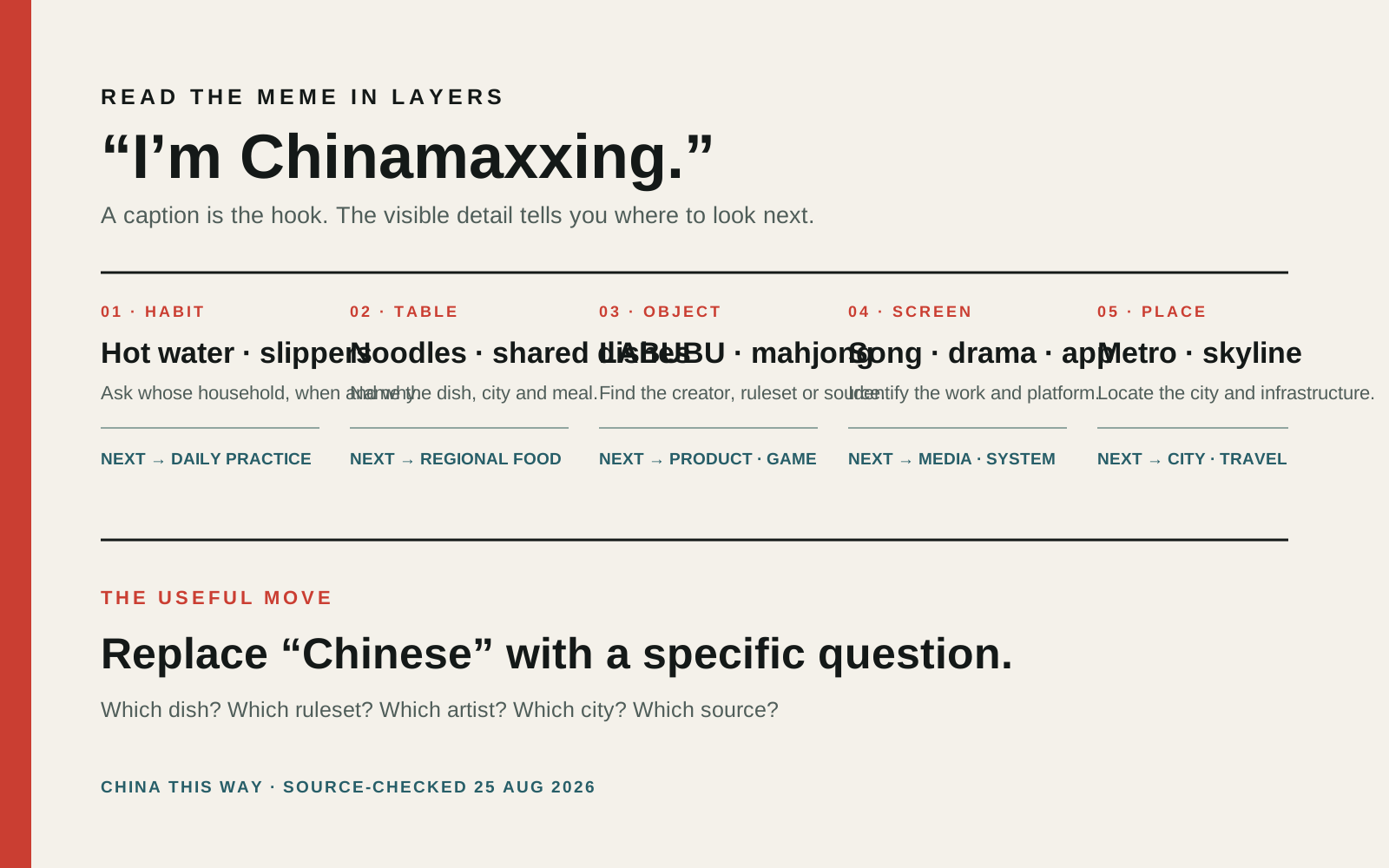
Chinamaxxing is an informal internet label for enthusiastically leaning into things a post presents as Chinese. In the 2025–26 “Becoming Chinese” wave, that can mean drinking warm water, adding goji berries, wearing house slippers, learning mahjong, eating a Chinese breakfast, carrying LABUBU, listening to Chinese music or wanting to see Chinese cities firsthand.
It is a meme format, not a movement with membership rules. There is no official Chinamaxxing checklist, one approved soundtrack or single person who can define what counts as “Chinese enough.” The useful way to read it is as a door into specific habits, objects, games, media and places—not as a compact theory of 1.4 billion people.
The four phrases are related, but not identical
| Phrase | What people usually mean | What it does not prove |
|---|---|---|
| Chinamaxxing / China-maxxing | Deliberately doing more things the poster associates with China | that the habit is universal, ancient or exclusive to China |
| Becoming Chinese / entering my Chinese era | A self-aware caption for adopting one or several habits, tastes or interests | a literal change of ethnicity or nationality |
| Very Chinese time of my life | A joke template for a moment framed as especially China-coded | that everyone agrees on the frame |
| China Travel | Firsthand travel videos about visiting China, cities and infrastructure | the same thing as the Chinamaxxing meme |
The suffix “-maxxing” comes from internet slang for maximizing a trait or leaning hard into a goal. It can be sincere, ironic or both in the same post. That ambiguity is part of the format: someone may genuinely enjoy mahjong while exaggerating the transformation for the caption.
What actually appears in Chinamaxxing posts?
Current reporting does not describe one stable recipe. It describes a loose bundle of recognizable details:
- At home: warm or hot water, goji berries, tea, slippers, pajamas and household routines.
- At the table: dumplings, noodles, shared dishes, congee and regional breakfast foods.
- For play and style: mahjong, LABUBU and other designer toys, Chinese-inspired makeup or clothing, and Mandarin phrases.
- On screen and in headphones: Chinese songs, dramas, short-video audio, apps and memes.
- In travel clips: metro systems, high-speed rail, streets at night, delivery systems and visually dense cities such as Chongqing and Shanghai.
These categories travel well on short video because a small visible action can carry the whole joke. Holding a mug or changing slippers takes one second to understand. A city system, regional cuisine or language history does not. The format therefore favors details that are easy to show, not necessarily the details that best explain China.
That distinction matters. Warm water may be the hook. The more interesting follow-up could be why a family serves it, how a workplace provides it, whether the person simply prefers it, or why another Chinese household does not treat it as notable at all.
Why is hot water part of the trend?
Warm or hot water works as a meme symbol because it is visually simple and already recognizable to many Chinese and diaspora viewers as an everyday recommendation. Adding goji berries makes the cup even easier to identify on camera.
But “Chinese people drink hot water” is too blunt to use as a rule. Preferences differ by household, age, region, season and situation. A creator doing a deliberately exaggerated routine is performing a social-media format; the cup is not survey evidence. It is also not medical advice. The cited reporting documents what participants post and say, not a clinical benefit from one water temperature.
Is there one Chinamaxxing song?
No. There is no official Chinamaxxing song. Search results and social posts can make one audio clip look definitive because a platform repeats what is currently popular, but creators reuse multiple Chinese songs, remixes and original sounds. The dominant audio can also differ between TikTok, Instagram, YouTube Shorts and regional reposts.
If you are trying to identify a song, use the sound title attached to the exact post, then confirm the artist and release on a licensed music service. “It was used in a Chinamaxxing video” is context, not a reliable song title.
Why did the meme become visible now?
There is no source-checked basis for assigning the trend to one cause. The evidence supports several channels arriving together:
- Creator-led repetition. The “Becoming Chinese” caption gives viewers a format they can copy without needing a long explanation.
- Direct visual access. Travel clips and creator posts show ordinary streets, trains, stores and homes without waiting for a documentary or news story to frame them.
- Portable cultural objects. LABUBU, mahjong tiles, food and music give an abstract interest a visible object or action.
- A contrast with stale imagery. Bright contemporary city and lifestyle clips challenge the idea that China can be represented only by palaces, red lanterns or a gray industrial skyline.
- Participation across backgrounds. Reports include Chinese, diaspora and non-Chinese creators responding to one another, so the trend is not a one-way export campaign.
The Associated Press reported that Chinamaxxing posts had reached millions of views and included participants well beyond China. TIME traced the “Chinese era” format through creator videos and reactions from Chinese and diaspora viewers. Those observations establish visibility; they do not tell us what percentage of Americans participate, whether the trend will last or how much it changes long-term opinion.
It is also too neat to say an institution “made” the meme. Official promotion, entertainment exports, travel videos, consumer brands and creator curiosity can all add visibility, but a repeatable joke succeeds through users adapting it. A source may call that soft power; it still does not make every post a coordinated message.
Appreciation, stereotype—or both?
Chinese and diaspora responses reported by TIME were mixed. Some viewers enjoyed seeing small parts of their family life treated as desirable rather than embarrassing. Others objected when a broad identity became a costume or when non-Chinese participants repeated a habit as though they had discovered it.
The useful dividing line is not “only Chinese people may do this.” Food, games, language and products move between people. A better test is how much specificity and respect the post carries:
- More useful: name the dish, ruleset, region, artist or source; credit the person who taught it; stay open to correction.
- Less useful: present one family habit as the Chinese way; treat ethnicity as an aesthetic upgrade; tell a Chinese person they are doing their own culture incorrectly.
- More useful: learn enough to continue after the joke—play the actual game, identify the music, understand the product or visit with practical preparation.
- Less useful: use a visible prop as proof of expertise.
The meme can be affectionate and flattening at the same time. The answer depends on the particular post, not on whether the caption contains one approved word.
From the meme to the real subject
The best use of Chinamaxxing is discovery. Pick the detail that caught your attention and replace the vague label with a specific question:
| If the post showed… | Continue with… |
|---|---|
| LABUBU or a “Lafufu” | Official price units and POP MART’s authenticity route |
| a mahjong night | Chinese ruleset families versus American Mah Jongg |
| a train passing through a building | How Chongqing’s elevation and public transport fit together |
| a first trip to China | Current requirements for U.S. citizens and the minimum travel-app stack |
| a Chinese game character | Who Zhong Kui is before Black Myth: Zhong Kui |
| comments flying across a video | How danmu changes the screen |
| Chinese typed on a QWERTY keyboard | How Chinese typing works |
This approach keeps the energy of the trend and drops its weakest assumption: that “Chinese” names one coherent lifestyle package.
Questions readers ask next
What does Chinamaxxing mean in simple terms?
It means intentionally doing or enjoying more things that a creator associates with China, usually with a playful, exaggerated caption. The word uses the internet suffix “-maxxing,” meaning to maximize or lean hard into something.
Who started the Becoming Chinese trend?
Current coverage often points to late-2025 “Becoming Chinese” videos by creator Sherry XiiRuii as an important repeatable format. Internet trends rarely have a clean single inventor, however: Chinamaxxing language, China-travel videos, food posts and diaspora jokes already came from overlapping communities. It is safer to name a documented catalyst than to declare one owner of everything that followed.
Is Chinamaxxing a TikTok trend only?
No. TikTok helped circulate the format, but related captions, reposts and explainers appear on Instagram, YouTube and other platforms. Search interest also outlives individual posts. Because access and algorithms vary, no one platform feed is a complete record of the trend.
Does Chinamaxxing mean someone literally wants to become Chinese?
Usually not. In most posts, “becoming Chinese” is deliberate overstatement for adopting a habit or interest. Some participants may also be studying Mandarin, traveling or reconnecting with family culture, but the caption alone does not establish nationality, ancestry or a serious identity claim.
Is drinking hot water a Chinese medical treatment?
The trend presents hot water as a recognizable habit or recommendation. This article does not make a medical claim. Personal preference and household practice should not be confused with clinical evidence.
Is the trend positive or offensive?
It can be either, both or neither depending on the post. Specificity, credit, willingness to learn and respect for Chinese and diaspora participants usually make the difference. A playful interest in food or mahjong is not automatically offensive; reducing a population to slippers, goji berries and an aesthetic can be.
Sources and scope
- Associated Press: Chinamaxxing and “Becoming Chinese” — reported examples, international participation, millions-of-views scale and the distinction between user-led memes and official promotion.
- TIME: the “Chinese era” and Chinamaxxing meme — creator chronology and differing Chinese and diaspora reactions, including appreciation and appropriation concerns.
- The Christian Science Monitor: mahjong clubs and Chinamaxxing — a dated 2026 view of U.S. social play and the wider cultural-interest framing.
- Know Your Meme: Chinamaxxing — a secondary chronology of the term and meme examples; useful for internet-history context, not population statistics or cultural authority.
This page describes English-language search vocabulary and reported social-media examples checked on 25 August 2026. Platform feeds are personalized and unstable. The page does not estimate national participation, turn creator posts into survey data, make medical claims or treat one visible habit as representative of all Chinese people.