

Most U.S. citizens need a visa before an ordinary tourist trip to mainland China. Do not apply that answer blindly, though: a true third-country transit, a trip confined to Hainan, or a visit only to Hong Kong or Macao follows a different rule. Start with your exact passport, purpose and flight sequence—not a “China is visa-free” headline.
This guide was checked on August 30, 2026 for an ordinary U.S. passport. It does not cover diplomatic or official passports, former Chinese nationality, dual-nationality questions, work, study, journalism or permanent residence.
Pick the row that matches your whole itinerary
| Your actual trip | Working answer | The condition people miss |
|---|---|---|
| Ordinary tourism in Beijing, Shanghai, Xi’an or elsewhere in mainland China | Get the appropriate Chinese visa before departure | The U.S. is not on China’s nationwide 30-day unilateral visa-free list |
| You already have a valid Chinese visa or residence document | Verify the document before booking | Entries, dates, passport details and permitted stay must still match |
| International transit of 24 hours or less without leaving the port’s restricted area | Check the 24-hour direct-transit rule | Leaving the restricted area requires a temporary entry permit |
| Place A → mainland China → different country or region C | Test the 240-hour transit rule | Passport, ticket, port, permitted area, purpose and onward route must all qualify |
| Enter Hainan through a Hainan international port and remain only in Hainan | Test Hainan’s 30-day regional visa-free rule | It does not cover a side trip to another mainland province or city |
| Visit only Hong Kong and/or Macao | Apply each SAR’s own entry rule | Permission to visit an SAR is not permission to enter mainland China |
If no row describes every mainland entry on the booking, stop and split the itinerary into border crossings. A connection through a mainland airport can be an entry question even when the final vacation is in Hainan, Hong Kong or Macao.
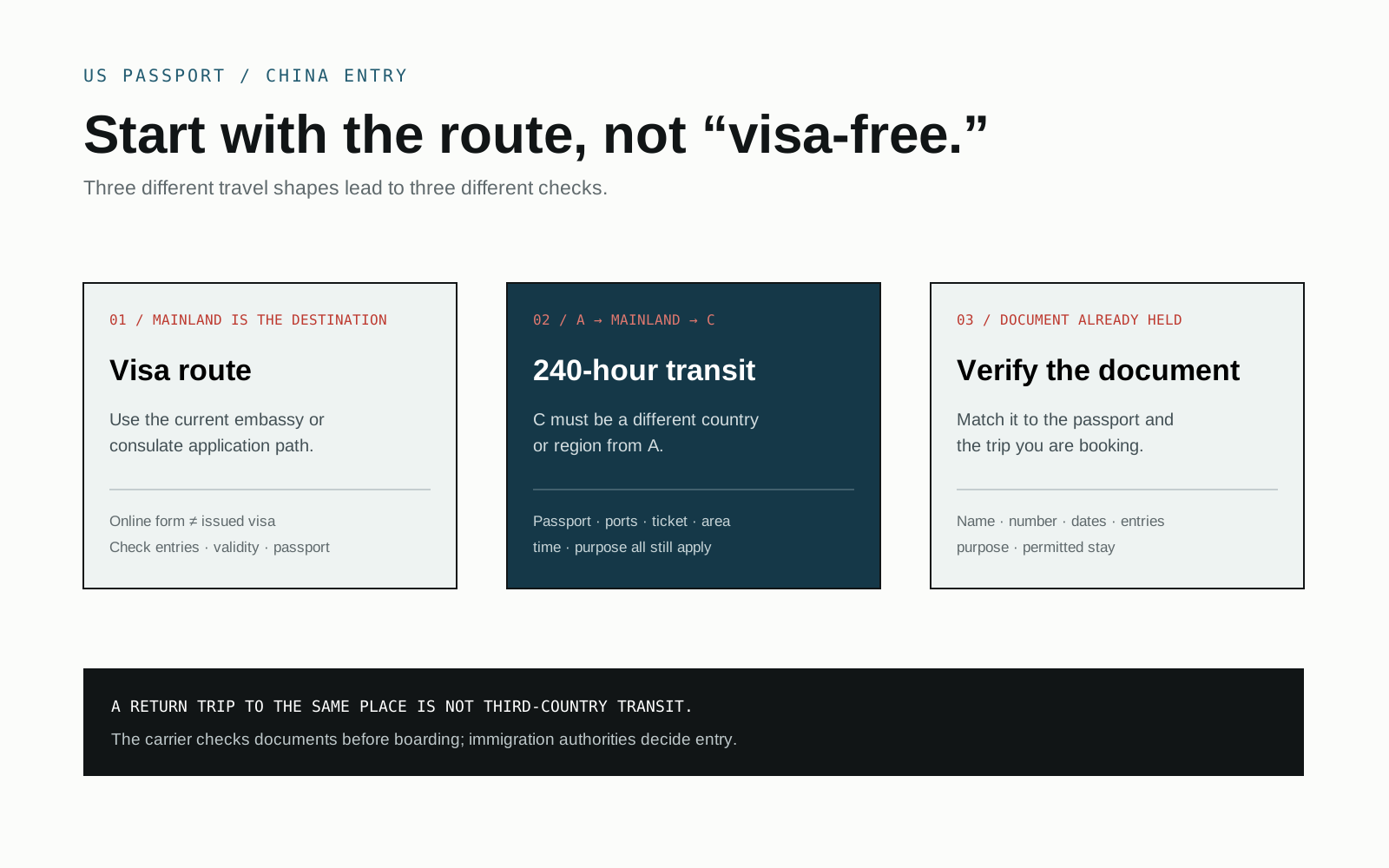
The page’s route diagram shows the three common baseline checks: obtain a visa, test a transit route, or verify an existing document. The decision table above adds the current Hainan and SAR branches that cannot safely be folded into a generic “visa-free China” label.
The normal tourist route: apply for a visa
For a U.S. traveler taking an ordinary mainland vacation with no exact exemption, use the current instructions from the Chinese embassy or consulate responsible for where you live. The present process uses the China Online Visa Application system for the form and preliminary review. When the system tells you to submit the passport, follow the responsible post’s instructions. An online status is not an issued visa.
The embassy’s current basic application list includes:
- a passport with more than six months of remaining validity and at least two blank visa pages;
- an image of the passport bio page and a blank visa page;
- the latest Chinese visa or residence-permit page, if applicable;
- proof of residence in the consular jurisdiction, such as a driver’s license, utility bill or bank statement; and
- extra records when former Chinese nationality, a previous passport, a name change or a minor applicant is involved.
For an L tourist visa, the embassy says applicants in the United States do not routinely submit round-trip tickets, hotel bookings, an itinerary or an invitation letter. A consular officer can still request more material in an individual case. Do not turn the simplified application list into a promise that nobody will ask about the trip.
The online form accepts image uploads rather than PDF files. It asks for work, education, family and travel history, so collect accurate dates and organization names before starting. The system also checks the uploaded photo. If repeated attempts fail, the embassy says to continue the form and bring a standard ID photo when submitting the passport.
Before paying for a nonrefundable booking: confirm the responsible consular post, the live application status and the issued visa’s name, passport number, entries, validity and permitted stay. This page does not promise an approval or processing date.
The 24-hour direct-transit route
China’s National Immigration Administration says the 24-hour visa-free transit policy applies at all ports open to the outside world and is available to travelers of all nationalities who meet its conditions. You need a valid international travel document and a confirmed onward ticket with a reserved seat to a third country or region.
The simplest version stays inside the port’s restricted area for no more than 24 hours. If you need to leave that area—for an airport change, a hotel outside the terminal or another reason—you must apply to border inspection for a temporary entry permit. Do not assume it will be granted merely because the clock is under 24 hours.
Ask the operating carrier and the relevant port before departure if the route involves separate tickets, an airport change, an overnight outside the restricted area or any unclear transfer. The national policy describes eligibility; it is not a carrier-specific boarding checklist.
The 240-hour transit route
Write only the immediate international sequence:
place A → mainland China → place C
Place C must be a different country or region from place A. Los Angeles → Shanghai → Los Angeles is a round trip, not a third-country transit route. Then check every condition on the current NIA page:
- You hold an ordinary passport from an eligible country; the United States is currently included.
- You have a confirmed onward ticket with a set date and itinerary to a third country or region.
- Your arrival and departure ports are among the current open ports for this policy.
- You remain inside the permitted area rather than treating the whole country as open.
- You leave within the allowed period, currently no more than 240 hours.
- Your purpose is covered, such as tourism, business, a visit or family visit; work, study and journalism require prior authorization and a visa.
- Every separate mainland entry on a multi-stop trip passes the test on its own.
NIA uses the wording “third country or region.” If your route uses Hong Kong or Macao as place A or C, or uses separate tickets, confirm the exact booking with the operating carrier and NIA before relying on it. Do not infer approval from a similar itinerary posted online.
Use the entry documents decision path to expose a missing condition. It deliberately does not issue an immigration decision.
The Hainan-only 30-day route
This is the major exception that a nationwide visa-waiver list does not explain. NIA’s current regional policy includes ordinary U.S. passport holders among the nationalities that may enter Hainan without a visa for up to 30 days for specified short-term purposes. Tourism, business, visits, family visits, medical care, conferences and sports are listed; work and study are not.
All of these limits matter:
- enter and leave through a Hainan port open to international travelers;
- remain within Hainan Province for the visa-free stay;
- stay no more than 30 days; and
- use an eligible short-term purpose with an ordinary passport.
If the itinerary includes Beijing, Shanghai, Guangzhou or any other place outside Hainan, the Hainan exception does not authorize that mainland segment. A domestic connection through another mainland city also creates a route question; confirm it with NIA and the operating carrier before ticketing rather than assuming it is covered.
Hainan’s regional policy is not the same as China’s nationwide unilateral 30-day waiver. The current nationwide list does not include the United States; the Hainan list does.
Hong Kong and Macao are separate entry checks
Hong Kong’s Immigration Department currently lists an ordinary U.S. passport as visa-free for a visit of up to 90 days. Macao’s government currently lists U.S. nationals—except holders of U.S. diplomatic passports—among those exempt from a visa or entry permit, with the general table showing a maximum 30-day stay for ordinary valid passports.
Those are Hong Kong and Macao rules. They do not answer whether you may cross into mainland China. If the trip adds Shenzhen, Guangzhou, Zhuhai or another mainland destination, return to the mainland visa, transit or Hainan test for that crossing.
Keep three document checks separate
1. The visa-application check
The embassy or consulate tells you what to submit and whether a visa was issued. Its application-document list is not an airline boarding checklist.
2. The airline check
The operating carrier checks the documents for the actual booking. Before departure, ask it to verify:
- the passport and visa details for a normal visa trip;
- the exact A → China → C ticket structure for 240-hour transit;
- the terminal, port and temporary-entry issue for a 24-hour transfer; and
- a Hainan itinerary that connects anywhere outside Hainan.
Carrier confirmation reduces a boarding surprise, but it does not guarantee admission.
3. The border check
Chinese immigration authorities make the entry decision. Keep the passport, issued visa or exemption basis, confirmed onward ticket, first accommodation address and route details available offline. A screenshot or printout does not create eligibility; it makes the itinerary easier to inspect when the phone or network fails.
If a Chinese visa is in an expired passport, the U.S. Department of State says it can remain usable when the personal information on both passports matches exactly. Because a replacement passport, name change or damage can change the answer, verify the specific pair with the issuing post and operating carrier instead of assuming that carrying both always works.
Arrival card and health checks
China’s online arrival card is a separate arrival form, not a visa. Travelers who are not exempt can submit it before travel through the official National Immigration Administration channel, or complete it after arrival by QR code, an on-site device or paper form. Direct 24-hour transit without leaving the restricted port area is among the listed exemptions.
Use the China digital arrival card guide for the official link and field-by-field preparation. You do not need a paid intermediary to reach the government form.
The U.S. Department of State says routine vaccinations are not generally required for entry. Yellow-fever proof can be required when arriving from a risk country, including certain transits of 12 hours or more. Check the exact route; health recommendations and border-document rules are separate questions.
Common mistakes to catch before booking
- “Canada and the United Kingdom are visa-free, so the U.S. must be too.” The current nationwide 30-day list includes Canada and the United Kingdom but not the United States.
- “Hainan is visa-free, so I can add Shanghai.” Hainan’s rule is regional and does not authorize travel outside Hainan Province.
- “Ten days means I have a short tourist visa.” The 240-hour policy is transit tied to an onward route, listed ports and permitted areas.
- “Hong Kong is visa-free, so I can cross into Shenzhen.” Hong Kong admission and mainland admission are separate decisions.
- “I submitted COVA, so the visa is approved.” Submission and preliminary review are steps before issuance.
- “The arrival card replaces the visa.” It does not.
- “The government rule means the airline must board me.” Ask the operating carrier to check the exact booking; Chinese immigration still makes the admission decision.
Questions readers ask next
Do U.S. citizens need a visa for China in 2026?
Usually, yes, for an ordinary tourist trip to mainland China. The main current exceptions to test are 24-hour direct transit, qualifying 240-hour third-country transit and Hainan-only regional entry. Hong Kong and Macao apply their own visitor rules.
Can a U.S. citizen enter Hainan without a visa?
Yes, an ordinary U.S. passport is on NIA’s current Hainan 30-day regional list for eligible short-term purposes. You must enter through a Hainan international port, stay within Hainan and satisfy the current conditions. The policy does not cover a side trip elsewhere in mainland China.
Is a U.S.–China–U.S. return flight eligible for 240-hour transit?
No, not on that route alone. The immediate onward destination must be a different country or region from the place immediately before mainland China.
Can I visit Hong Kong or Macao without a mainland Chinese visa?
Their current rules allow visa-free visits for ordinary U.S. passport holders within their stated limits. That permission does not extend to mainland China. Test every mainland crossing separately.
Does submitting the online visa form mean the visa is approved?
No. Follow the live status and the responsible embassy or consulate’s instructions. Verify the issued document before relying on it.
Sources and scope
- Chinese Embassy in the United States: visa application requirements — current U.S. application route and basic documents.
- Chinese Embassy in the United States: online application guide — form, photo validation and preliminary-review sequence.
- Chinese Embassy in the United States: visa-free entry FAQ — current nationwide 30-day waiver list and scope.
- National Immigration Administration: 24- and 240-hour transit policies — current nationality, route, ticket, port, area and purpose conditions.
- National Immigration Administration: regional visa-free policies — current Hainan nationality list, purposes, ports, area and 30-day limit.
- National Immigration Administration via the Chinese Embassy: online arrival card — advance, on-arrival and paper routes plus exemptions.
- Hong Kong Immigration Department: visit visa requirements — U.S. ordinary-passport visit period and local entry boundary.
- Macao SAR Government: immigration clearance for non-residents — U.S. visa-exemption listing and stay table.
- U.S. Department of State: China travel requirements — U.S.-traveler document and health context; Chinese authorities control entry.
Checked August 30, 2026. Recheck the linked government pages and the operating carrier before departure because entry policies, port coverage and document checks can change.