
Baduanjin (八段锦, bā duàn jǐn) is a Chinese qigong routine built from eight linked movement sections. The name is commonly translated as Eight Brocades or Eight Pieces of Brocade. A standard standing version uses slow weight shifts, arm patterns, turns, a forward fold, a controlled punch and a heel rise. It normally needs no equipment and an official full routine runs about 12 minutes.
It is not simply “Chinese stretching,” and it is not the same routine as tai chi. Baduanjin combines body shape, breathing and attention, but a beginner does not need to force all three at once. The clearest official teaching advice is more practical: learn a controllable shape first, breathe naturally, and add deliberate breath coordination only after the movements are familiar.
The practice is old; the version on a phone screen is not timeless. Texts, names, lineages and postures changed over centuries, and China now has a standardized Health Qigong Baduanjin alongside other versions. That distinction explains why two credible videos may not look identical.
Baduanjin in one minute
| Question | Useful answer |
|---|---|
| What does Baduanjin mean? | Eight linked “brocade” sections: a complete routine whose parts are valued together. |
| Is it qigong? | Yes. The standardized form is promoted as Health Qigong in China. |
| Is it tai chi? | No. Both can be slow mind-body movement practices, but they have different routines, histories and training structures. |
| How many moves? | Eight main sections, plus an opening and closing in the standardized routine. |
| How long does it take? | The Chinese Health Qigong Association’s current full demonstration is 12 minutes 31 seconds; shortened versions also exist. |
| Do I need equipment? | No. You need stable floor space and a range of motion you can control. |
| Does it cure disease? | That is not a defensible general claim. A 2026 trial found a modest blood-pressure result in a defined group; it did not turn the routine into a replacement for diagnosis, medication or individualized care. |
The eight movements, without turning their names into diagnoses
The traditional titles contain the language of Chinese medicine, imagery and promised effects. They are useful cultural labels. An English reader should not mistake a literal translation—“regulate the spleen and stomach,” for example—for a modern clinical outcome that automatically occurs when one arm rises.
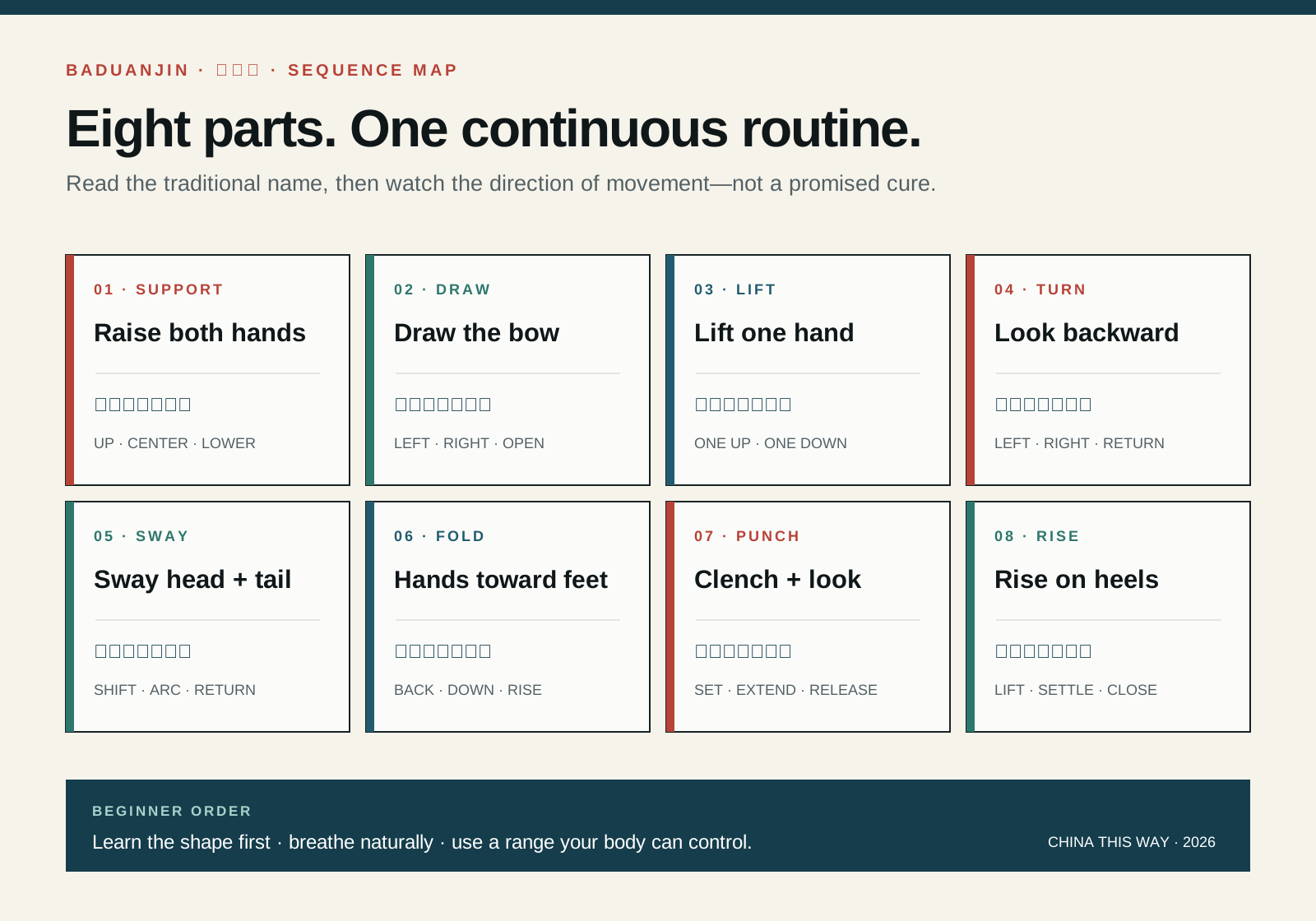
The General Administration of Sport of China sequence lists these eight standard titles. The plain-motion column below describes what a viewer can actually identify. It is an orientation, not a substitute for instruction.
| # | Standard Chinese title | Common English rendering | What to watch |
|---|---|---|---|
| 1 | 两手托天理三焦 | Two hands hold up the heavens | hands cross low, travel upward, turn and support overhead before lowering |
| 2 | 左右开弓似射雕 | Draw the bow left and right | a wider stance and alternating bow-and-arrow arm pattern |
| 3 | 调理脾胃须单举 | Raise one hand | one palm supports upward as the other presses down, then the sides exchange |
| 4 | 五劳七伤往后瞧 | Look backward | the body lengthens while the head and upper body turn with control |
| 5 | 摇头摆尾去心火 | Sway the head and tail | a lower stance, weight shift and broad torso arc rather than a loose neck circle |
| 6 | 两手攀足固肾腰 | Two hands reach toward the feet | hands travel back and down as the torso folds, then the body returns upright |
| 7 | 攒拳怒目增气力 | Clench the fists and glare | a set stance, deliberate fist extension and controlled release |
| 8 | 背后七颠百病消 | Rise and fall on the heels | the body lifts through the heels and settles before the routine closes |
The sequence matters more than treating each title as an isolated exercise prescription. Transitions return the body to balanced positions, and the standardized performance has a beginning and an end. A five-minute social clip may omit repetitions, transitions or the closing even when it correctly names the eight sections.
What beginners should copy—and what they should not
The Chinese Health Qigong Association’s 2026 official demonstration is the best visual reference on this page because it shows the whole standardized routine at an unhurried pace. Use it first to see order, stance width, weight shift and continuity. Do not use a single viewing to chase an exact depth or range.
Three choices make a first session more sensible:
- Learn the silhouette before the breathing script. China’s official explanation of Baduanjin’s “three adjustments” says beginners should prioritize learning the movement and use natural breathing. Conscious breath coordination can be introduced gradually after the shape is familiar.
- Reduce range, not control. A shallower stance, smaller turn or shorter fold is more useful than forcing the official performer’s range. The same official guidance says practice should reflect age, experience and physical condition rather than comparison with other people.
- Use a stable visual source. Search results mix standardized Health Qigong, martial variants, seated adaptations, mirrored videos and creator-made hybrids. That variety is historically plausible, but changing routines every session makes it difficult to know what you are learning.
Loose clothing may be comfortable, but a silk uniform is not required. A park is not required. Music is not required. The routine’s low equipment demand is one reason it moves easily among homes, schools, workplaces, community groups and online classes.
What the 2026 blood-pressure trial found
Search results often jump from “Baduanjin benefits” to a cure list. A better answer starts with one strong, recent study and keeps its population, comparison and effect size attached.
In a 2026 Journal of the American College of Cardiology randomized controlled trial, researchers assigned 216 adults aged 40 or older with high-normal blood pressure across seven Beijing communities to Baduanjin, self-directed exercise or brisk walking. At 12 weeks, the Baduanjin group had a 3.1 mm Hg greater reduction in 24-hour systolic blood pressure than the self-directed-exercise group. At 52 weeks, the difference was 3.3 mm Hg. The study did not find a significant difference between Baduanjin and brisk walking at 52 weeks.
That is a meaningful research result, but its honest translation is narrow:
- It studied people with a specified blood-pressure range, not every healthy adult or every medical condition.
- It compared structured Baduanjin with particular control conditions; it did not prove that any short online routine produces the same result.
- “Comparable to brisk walking” in that trial does not mean the two activities are mechanically identical or interchangeable for every person.
- The result does not justify stopping medication, delaying diagnosis or substituting a webpage for a clinician’s plan.
The interesting modern story is not “ancient wisdom beats science.” It is that a centuries-old movement family can be standardized, registered as a trial, measured with ambulatory blood pressure and compared with another familiar activity. Tradition and modern evidence are doing different jobs in the same study.
Is Baduanjin safe?
The available evidence is reassuring enough to reject scare language, but not complete enough to call the routine risk-free.
A systematic review of Baduanjin safety included 47 trials and 3,877 participants. Only 22 trials described adverse-event monitoring, and two reported events potentially related to training. Reported events included muscle ache, knee or back pain, dizziness, fatigue, palpitations, chest tightness and shortness of breath. The review’s central limitation is important: inconsistent monitoring means “few events reported” is not the same as perfect proof of safety.
Stop the session if you feel chest pain or tightness, faintness, unusual shortness of breath, a new irregular heartbeat sensation or sharp/worsening joint pain. Seek urgent medical help for severe symptoms. If you have cardiovascular disease, recent surgery, significant balance problems, pregnancy-related restrictions or a condition that changes safe exercise intensity, ask a qualified clinician or physical therapist how the routine fits your situation.
For an ordinary beginner, the page’s non-medical rule is simple: controlled and repeatable beats deep and impressive.
Baduanjin is old, but its current life is modern
The official Chinese history record places the name Baduanjin in Song-dynasty writing and traces related standing patterns through later texts. It also says the creator and exact starting date are unresolved. Popular attribution to the general Yue Fei is not supported by a clear written record. By the late Qing period, an illustrated standing sequence had moved closer to the familiar routine, but different streams and versions continued.
That history prevents two opposite mistakes. Baduanjin is not a wellness product invented by a recent algorithm. It is also not one perfectly frozen routine transmitted unchanged for eight centuries.
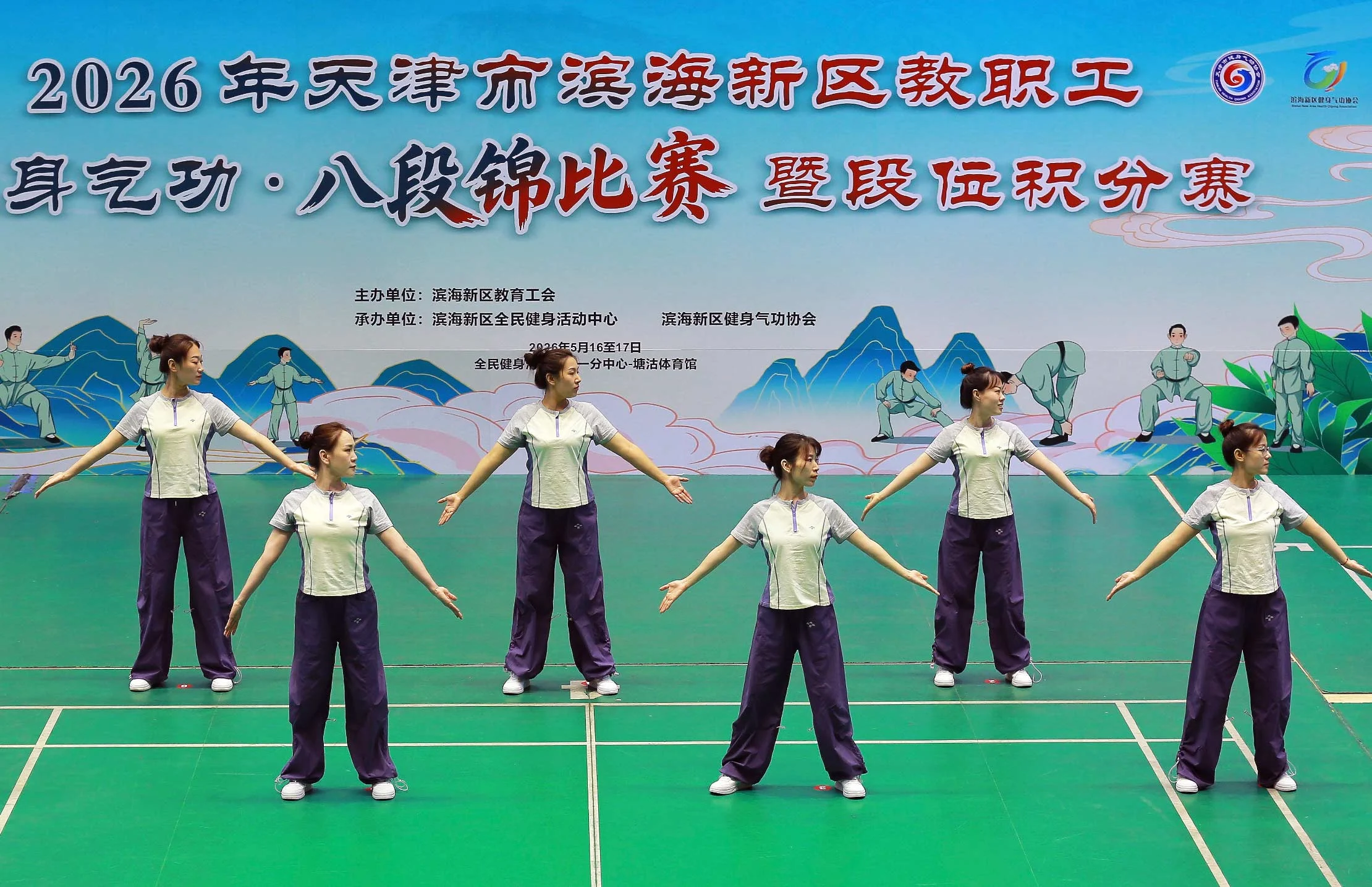
Today’s infrastructure is plainly contemporary. The Chinese Health Qigong Association published a new standard demonstration in January 2026. In May, a Baduanjin competition in Tianjin’s Binhai New Area brought together 84 teams and nearly 900 teachers, according to the General Administration of Sport report. The event used coordinated sports clothing, an indoor court, formal judging and level points—not an “ancient master on a misty mountain” image.
In August 2026, English-language reporting on China-related social trends specifically listed practicing Baduanjin among the routines circulating with Chinamaxxing. That explains renewed American curiosity; it does not prove that every person posting the hashtag has learned the sequence or its history.
The useful modern picture is wider: an old movement vocabulary now travels through national standards, school programmes, workplace teams, community health research, competitions and vertical video. The practice remains Chinese without needing to look antique.
Baduanjin vs tai chi vs general qigong
Qigong is the broadest label here. It covers many practices that coordinate body, breath and attention. Baduanjin is one named routine within that larger field.
Tai chi (taijiquan) is a martial art with its own forms, principles and lineages. It can be practiced slowly and for health, which is why a short clip may resemble Baduanjin to a newcomer. But a tai chi form usually develops through connected martial postures and footwork; the standardized Baduanjin routine is organized around eight named sections.
Baduanjin is often easier to identify and finish as a compact set. That does not make it a beginner version of tai chi. It is its own practice.
How to choose a Baduanjin video
Before pressing play, check five things:
- Does the publisher identify the version—especially standardized Health Qigong versus another lineage?
- Does the video show the opening, all eight sections, transitions and closing?
- Can you see the feet and full body rather than only an upper-body crop?
- Are left and right orientation or mirroring explained?
- Does the teacher offer range modifications and avoid guaranteed medical outcomes?
The official video below is in Chinese, but its full-body framing and uncut sequence make it useful even before every cue is understood. English instruction can help, but language accessibility is not a license for stronger health promises.
Questions readers ask next
How do you pronounce Baduanjin?
Approximately bah dwahn jeen. Pinyin with tone marks is bā duàn jǐn. You will see Baduanjin, Ba Duan Jin and Eight Brocades in English search results.
Is Baduanjin only for older adults?
No. Older adults are visible in community practice and research, but current Chinese programmes also include school students, teachers, families and sports participants. Age alone does not define the routine.
Can I learn it from YouTube?
A careful video can teach sequence recognition and support home practice. It cannot inspect your balance, pain, breathing or movement substitutions. Use video as a reference, not proof that every position is appropriate for you.
How often should a beginner practice?
There is no universal medically correct frequency for every reader. First learn a short, comfortable session you can repeat without symptoms. Clinical trial schedules are research protocols for defined populations, not automatic prescriptions for the public.
Why do movement names mention organs and illnesses?
The names carry historical Chinese medical language and mnemonic imagery. They help identify the sections and preserve cultural meaning. A name is not, by itself, evidence that the movement treats the organ or condition named.
Sources and scope
This guide was checked on 26 August 2026 against the Chinese Health Qigong Association’s current full demonstration; General Administration of Sport records for the standard sequence, historical development, teaching principles and contemporary practice; the 2026 JACC randomized trial; and a peer-reviewed safety review. Current U.S. interest was tested through Google and Bing autocomplete in the United States, where Baduanjin, exercise, video, senior and Eight Brocades queries appeared across both engines.
The page explains one standardized standing route while acknowledging other versions. It does not certify instructors, prescribe treatment, diagnose a condition or promise that an individual will reproduce a trial result.