
“Chinese mahjong” is not one universal ruleset. It can mean a local family game, Hong Kong style, Sichuan rules, Mahjong Competition Rules (MCR) or another regional form. American Mah Jongg is a separate standardized branch that commonly uses 152 tiles, jokers, racks, a Charleston passing phase and a current annual card of winning hands.
The first beginner skill is therefore not memorizing every tile. It is asking: Which mahjong are we playing?
Chinese mahjong vs American mahjong: the short answer
| Question | Chinese local or home play | MCR / Chinese official competition | American NMJL-style |
|---|---|---|---|
| One universal ruleset? | No; city, family and club rules vary | Yes, for the named competition format | Standardized around NMJL-style rules and the current card |
| Typical tile count | Often 136 or 144, depending on flowers and variant | 144 in the Mahjong International League guide | 152 in the American Mah Jongg Association summary |
| Annual hands card | No | No | Yes; it changes each year |
| Jokers | Usually not part of the core Chinese set | No American-style jokers | Yes, with restricted use |
| Charleston tile passing | No American-style Charleston | No | Yes |
| Common win logic | Often four sets plus a pair, with local exceptions and scoring conditions | Four sets plus a pair or listed special hands; at least 8 points in the official competition rules | One exact pattern on the current card |
| Racks | Optional table equipment | Not the defining rule | Standard equipment in common American play |
| Best first question | “Which local rules?” | “Are we using MCR?” | “Does everyone have the current card?” |
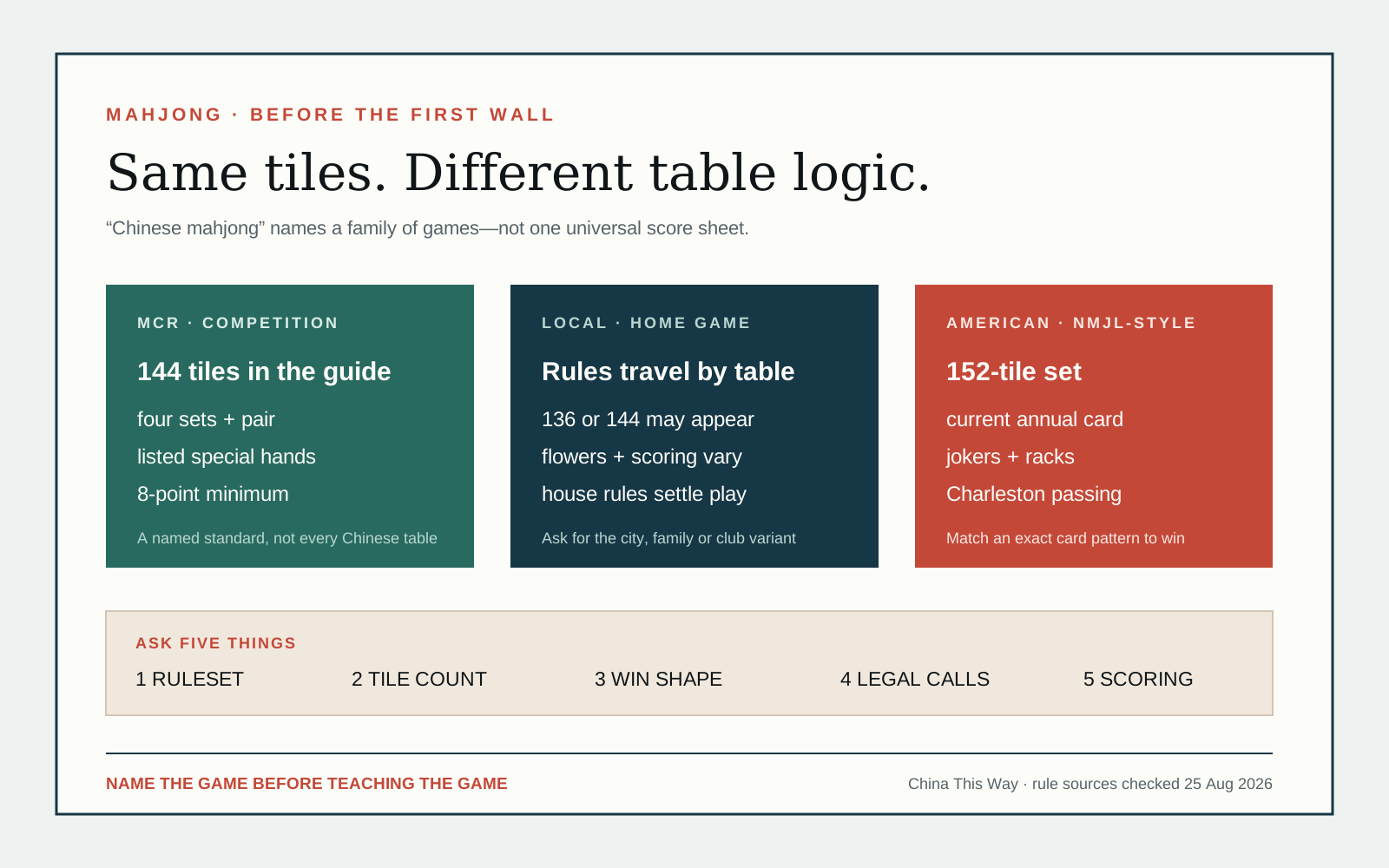
Download the free one-page mahjong ruleset table guide (PDF). It is an original ruleset chooser, not a copy of the copyrighted annual American hands card.
Why “Chinese mahjong rules” is an incomplete request
Mahjong travelled by being played, adapted and taught—not by freezing into one household rulebook. The Mahjong International League currently recognizes MCR, riichi and Sichuan rules among its major international competition systems, while also acknowledging local rules. Even within China, a Harbin table and a Sichuan table can change what tiles remain, what must be declared and which hands may win.
That means a tutorial labelled simply “Chinese mahjong” may be perfectly accurate for one variant and wrong at your table. Before learning, obtain five settings:
- Ruleset name: MCR, Hong Kong, Sichuan, Taiwanese, family rules or something else.
- Tile set: 136, 144 or another configured set; confirm flowers and seasons.
- Win requirement: basic hand only, minimum fan, minimum points or a special pattern list.
- Call rules: who may claim a discard for chow, pung, kong or a win.
- Scoring and payments: what is counted, who pays and whether the dealer continues.
If a host says “the normal rules,” ask them to demonstrate one legal winning hand and score it. Five minutes here prevents an hour of arguments later.
What stays familiar across many Chinese draw-discard forms
Many four-player forms use the same visible rhythm:
- Players begin with concealed tiles; the dealer commonly starts with one extra.
- On a normal turn, draw one tile.
- Check whether the hand can legally win under the named rules.
- If not, discard one tile face up.
- Other players may claim that discard only when the rules allow.
- Continue until someone wins or the live wall is exhausted.
The common vocabulary is useful even when scoring changes:
| Word | Plain-English meaning | Important boundary |
|---|---|---|
| Chow / chi | three consecutive numbers in one suit | commonly limited by turn order; verify the variant |
| Pung / peng | three identical tiles | a claimed pung becomes exposed in many rulesets |
| Kong / gang | four identical tiles | usually requires a replacement draw and special handling |
| Pair | two identical tiles | the pair is part of the common four-sets-plus-pair form |
| Hu | a declaration that the hand wins | a complete shape can still fail a minimum-score rule |
MCR makes the boundary explicit. Its published competition rules say the basic hand is four sets and a pair, list special structures such as Seven Pairs and Thirteen Orphans, and require a 14-tile winning hand worth at least 8 points. That is a clean standardized example; it should not be projected onto every Chinese family table.
How American Mah Jongg changes the problem
American play retains recognizable suits, winds and dragons, but changes how a player plans the hand.
The current card controls the legal hands
The National Mah Jongg League says it publishes a new Official Standard Hands and Rules Card each year. Its 2026 card is a current product, not a timeless chart. Players choose an exact listed pattern and keep checking suit, number, color and exposure requirements as the hand develops.
This is why an old screenshot or a homemade “free 2026 card” is not a reliable substitute. Our printable PDF deliberately does not reproduce the card.
The tile set includes jokers
The American Mah Jongg Association’s NMJL-style overview specifies 152 tiles. Its rules summary permits jokers in pungs, kongs and quints, but not in singles or pairs. Exact joker exchanges and exposed-hand decisions can make a hand legal or dead.
If you own a 144-tile Chinese set, you cannot assume it contains the equipment needed for the American game. Check for eight jokers, racks and access to the current card.
The Charleston happens before ordinary turns
The Charleston is a structured exchange of unwanted tiles before normal draw-and-discard play. A common first sequence passes three tiles right, across and left, with later phases governed by the American rules in use. It is not a universal mahjong ritual and should not be inserted into MCR or a local Chinese game.
Winning means matching the card
In a common Chinese form, a beginner often looks for groups plus a pair and then checks whether the hand meets the score requirement. In American Mah Jongg, the target is an exact hand on the current card. A group that looks sensible but does not match a legal line does not win.
A beginner round without pretending there is one Chinese score sheet
For a first social lesson, separate tile literacy from full scoring.
Round 1: learn the objects
- Sort characters, bamboos and dots into the three numbered suits.
- Find East, South, West and North winds.
- Find red, green and white dragons.
- Set flowers, seasons and jokers aside until the selected ruleset says what to do with them.
Round 2: build shapes openly
Practice identifying a chow, pung, kong and pair. Then lay out a basic four-sets-plus-pair example. This teaches the visual grammar without claiming that the shape scores or wins in every variant.
Round 3: play one named ruleset
Use one published beginner route and state every simplification. If the table chooses MCR, the 8-point minimum and its full fan list still matter. If it chooses American play, every player needs the same current card. If a host teaches Hong Kong or family rules, write the scoring threshold and call rules on one sheet before dealing.
Do not create an accidental hybrid: American jokers plus a Chinese four-sets-and-pair win plus riichi scoring is not “beginner mahjong.” It is a new house game that must be labelled as such.
How to find a mahjong club near you without arriving at the wrong game
Mahjong is visibly becoming a younger social format in U.S. cities. The Christian Science Monitor reported a roughly 200-person Seattle gathering in August 2026, and local event listings describe groups welcoming both newcomers and veteran players. But “mahjong club” still does not identify the game.
Send this message before you RSVP:
Hi—what ruleset do you play, and is this session beginner-friendly? Do I need a current card, a tile set or prior experience? Is teaching included, and which rules document controls disputes?
Then verify:
- the exact venue, date and organizer rather than an old directory listing;
- whether the table is American, Hong Kong, MCR, Sichuan, Taiwanese or riichi;
- whether the event teaches or expects fluency;
- equipment, card, entry fee, food and age requirements;
- whether play is social, league, tournament or gambling-related under local rules.
A club that answers clearly is a better beginner fit than one with the most polished tile photos.
Can two or three people play Chinese mahjong?
Search results contain many two-player and three-player adaptations. They are not interchangeable with the four-player competition rules cited here. If fewer than four people are present, choose a specifically published variant and confirm:
- which seats or winds are removed;
- whether the wall and tile set change;
- who may claim each discard;
- how payments and dealer rotation work;
- whether the result is practice or a recognized competitive game.
For learning tile recognition, two people can practice drawing, discarding and completing shapes. Label it a drill, not a complete universal ruleset.
Questions readers ask next
Is Chinese mahjong the same as American mahjong?
No. They share ancestry and many tile faces, but American NMJL-style play uses a current annual hands card, jokers, racks and the Charleston. Chinese play contains multiple local and competition rulesets rather than one annual American card system.
How many tiles are in Chinese mahjong?
It depends on the named variant. MCR’s beginner guide uses 144 pieces. Some formats remove the eight flower and season tiles and use 136. Ask what the table includes instead of treating one number as universal.
How many tiles are in American Mah Jongg?
The cited American NMJL-style rules summary uses 152 tiles, including jokers. Confirm the set and current league rules before buying equipment.
What is the easiest mahjong for beginners?
The easiest table is the one with a named ruleset, a patient teacher and a short reference sheet. A simplified lesson can teach tile families and the draw-discard rhythm, but it should say which scoring and call rules were postponed.
Do I need the 2026 mahjong card?
For 2026 NMJL-style American play, use the current 2026 card. MCR and local Chinese variants do not use the NMJL annual hands card.
Are jokers used in Chinese mahjong?
Not in the MCR rules described here. Some house or adapted games may differ. Jokers are a defining part of common American Mah Jongg sets and rules.
Is mahjong a game of luck or skill?
Both tile availability and player decisions affect a hand. The proportion changes with rules, scoring, table strength and sample size. Calling it only luck misses hand planning and discard reading; calling it only skill ignores the draw.
Is there one official mahjong rulebook?
There are official rulebooks for named systems. The World Mahjong Organization publishes Mahjong Competition Rules for that competition format, while the National Mah Jongg League publishes American rules and annual cards. Neither governs every home table worldwide.
Sources and scope
- Mahjong International League: A Guide to Mahjong — 144-piece MCR setup and order-of-play guide.
- Mahjong International League — current recognition of MCR, riichi, Sichuan and local competitive rules contexts.
- World Mahjong Organization: Mahjong Competition Rules — four-sets-plus-pair structure, special hands, 14-tile win and 8-point minimum for MCR competition.
- National Mah Jongg League: American and international differences — annual card, extra tiles, jokers and Charleston distinctions stated by the U.S. league.
- National Mah Jongg League: 2026 card and current materials — official current card route and equipment context; no card content is reproduced here.
- American Mah Jongg Association: American rules overview — accessible NMJL-style sequence, 152-tile set, Charleston and joker-use summary; secondary to current league rulings.
- Christian Science Monitor: U.S. mahjong-club reporting — current Seattle social-club observation; used only for the dated U.S. culture context.
- Stoup Brewing: Emerald City Tile Club event — direct venue listing describing an all-level Seattle community event; not a rule authority.
This guide was checked on 25 August 2026. It teaches rule identification and shared vocabulary, not a complete replacement for the selected ruleset. Tournament organizers, the current NMJL card and table-agreed local rules control actual play.