



.jpg)
You do not need fifteen “must-have” apps for a short China trip. You need one tested route for each essential task—and a fallback that survives when the preferred app, card or data connection fails.
Build the smallest stack that can retrieve bookings, navigate to a saved Chinese address, pay a merchant, arrange transport, translate one sentence and recover when the phone is offline. Install names are less important than proven task coverage.
The short answer: which apps should you install?
For a typical short trip, start with this named core and remove anything your itinerary does not use:
| Need | Primary app route | When it belongs on your phone |
|---|---|---|
| Mobile payment | Alipay or WeChat/Weixin | Install at least one; use both only when you can fund and recover them independently |
| Intercity train | China Railway 12306 | Install it or use the English website when the trip includes rail |
| Ride-hailing | Didi-Greater China, or the ride service inside Alipay/WeChat | Add one route and test the pickup and payment flow before an airport arrival |
| Bookings | The airline, hotel or booking service used for the purchase | Keep the app only when it can retrieve or change a real reservation |
| Maps | Amap (Gaode Map) multilingual version, or another map that passes the exact-address test | Amap currently offers multilingual mainland navigation; still verify your hotel and station entrance |
| Translation | A tool with the Chinese language available offline | Download the language pack and test it without mobile data |
The official visitor guide specifically documents Alipay, WeChat, Didi-Greater China and China Railway 12306. Shanghai’s current international-visitor material also documents Amap’s multilingual mainland navigation. There is still no one translation or booking app that every itinerary needs.
What apps are actually needed for China travel?
For a first trip with rail and independent city travel, the practical minimum is usually:
- Alipay or WeChat Pay for a tested mobile-payment route;
- Amap (Gaode Map) for multilingual mainland place search and navigation;
- Didi-Greater China, or Didi inside Alipay/WeChat, for app-based rides;
- Railway 12306 when using intercity trains;
- the airline, hotel or booking app holding a real reservation;
- one offline-capable Chinese translation tool.
This is not six mandatory downloads. If Alipay already exposes the ride service you can test, you may not need standalone Didi. If the trip has no train, you do not need 12306. The task must be covered; the icon count does not matter.
What apps work in China in 2026?
The named core above is current, source-checked and designed for mainland visitor tasks. “Allowed” is still the wrong test for a travel plan: an app can remain installed while a login, map dataset, payment card, verification SMS or online service does not work on the connection you are using.
For U.S. travelers, the U.S. State Department currently warns that the most popular U.S. social-media platforms are prohibited in mainland China. Do not make hotel retrieval, emergency contacts or the only copy of a booking depend on a U.S. social app or cloud service you have not tested under the connection you will use.
This guide does not recommend workarounds around local network rules. It recommends a local task route plus an offline copy: Chinese hotel address, booking reference, first transfer and emergency contacts.
Start with six jobs, not an app list
| Job | Primary route | Independent fallback | Test before departure |
|---|---|---|---|
| Retrieve bookings | Airline, hotel and rail account used for purchase | Offline PDF or screenshot with sensitive details protected | Open the booking in airplane mode |
| Navigate | A map that can search your saved Chinese address | Address in Chinese plus a screenshot of the destination | Search the exact hotel and airport terminal |
| Pay a merchant | Alipay or WeChat Pay with an eligible card | Another issuer’s card plus RMB cash | Complete account setup; make a small test when practical |
| Use intercity rail | Official 12306 website or app | Staffed railway ticket office with the original passport | Verify the passenger identity before release day |
| Arrange a ride | A ride-hailing route available in your chosen app | Staffed taxi queue or public transport route | Confirm pickup location and payment method |
| Translate | A translation tool with an offline language pack | Saved Chinese addresses and short written requests | Translate with mobile data disabled |
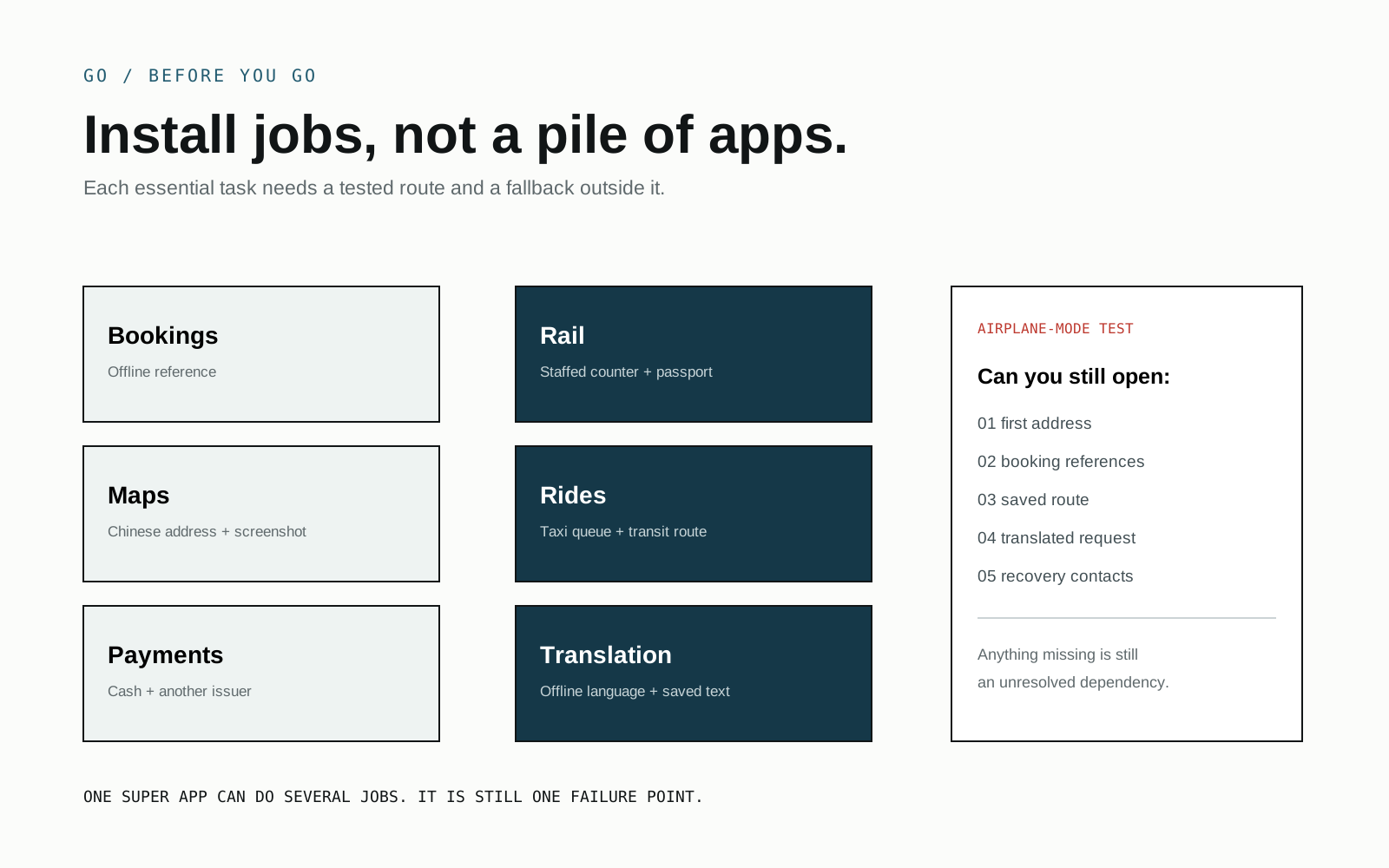
One super app can expose several of these jobs, but that does not make it an independent fallback. If payment, ride-hailing and hotel details all disappear with one account, the stack still has one failure point.
Payment: configure two routes, fund them independently
Official visitor guidance supports registering Alipay or WeChat and attempting to bind eligible international cards. Install the official app, protect the account and follow the current verification prompts.
Read the detailed setup routes for Alipay with an overseas card and WeChat Pay with a foreign card. A successful card binding is not the final test; the useful result is one clearly completed merchant payment.
If both wallets depend on the same card issuer, add cash or another issuer as the real fallback.
Maps: start with Amap, then test the destination
Amap, also called Gaode Map, is now the clearest named starting point for most international visitors. Shanghai’s July 2026 guide says its multilingual services cover pre-arrival planning, airport guidance, public-transport and taxi routes, saved hotels, nearby places, bilingual phrase cards and emergency information; core services can be used without login. The multilingual app is available through overseas app stores.
Before choosing a map, search three real places from your trip:
- the exact airport terminal;
- the hotel’s Chinese name and address;
- the station entrance or attraction gate you will actually use.
Check whether the app provides usable walking, transit or driving context in mainland China and whether the interface language works for you. Save the result in Chinese. A highly rated global map that cannot find the correct entrance is not the primary route for this trip.
Success signal: Amap or your alternative finds the exact Chinese hotel, the correct airport terminal and the named station entrance—not merely the city center.
Rail: use the official 12306 route when you want direct control
China Railway’s English 12306 website and app support real-name bookings with eligible foreign passports. The original passport linked to the order is part of the journey.
Complete identity verification before a time-critical ticket release. Save the exact station names; “Shanghai” and “Shanghai Hongqiao” are different destinations. The full foreign-passport 12306 guide keeps payment, gate and staffed-counter fallbacks visible.
Ride-hailing: make the pickup point legible
Shanghai’s visitor guide, updated in July 2026, documents three current Didi routes: the standalone Didi app, the WeChat service and the Alipay service. The guide shows an English interface, automatic translated messages, vehicle and plate details, and the last four digits of the passenger phone number as a pickup check.
The app is only one part of the ride. A successful route also needs mobile data, a pickup location the driver can reach, a payment method and a way to identify the vehicle.
At an airport or station, prefer the signed ride-hailing pickup zone shown by the venue. Save the hotel address in Chinese. If the app places the pin on a flyover, opposite road or inaccessible level, move to a named pickup point rather than sending increasingly vague messages.
Keep the staffed taxi queue and one public-transport route as alternatives.
Translation: download the language before you need it
Choose a translation tool that can store the needed language offline. Test short, concrete requests such as the hotel address, dietary restriction or “Which exit reaches this address?”
Machine translation can help with an ordinary task; it cannot safely interpret immigration, medical, legal or financial decisions. Show the original official text when the exact rule matters.
Communication and verification codes
Keep the home number active when bank, airline or account recovery codes may still arrive there. A travel eSIM can provide data without providing a mainland number; a local SIM can provide a mainland number but adds a separate registration and setup task.
Choose among eSIM, roaming and a local SIM by the number, routing and recovery functions you actually need.
Run the airplane-mode test
Before departure:
- put the phone in airplane mode;
- open the passport copy, first hotel address and arrival route;
- retrieve the booking references;
- open the offline map or saved screenshot;
- translate one saved sentence;
- confirm that the issuer and account-recovery numbers are available.
Anything that disappears is still an unresolved dependency. Fix it before adding another optional app.
Questions readers ask next
What are the essential apps for China travel?
For most short trips, begin with Alipay or WeChat/Weixin for payment, 12306 when using trains, Didi-Greater China or an in-wallet ride service, the app holding each real booking, a map that can find the Chinese address and an offline-capable translation tool. Remove tasks your itinerary does not need.
Do foreign visitors need the Didi app in China?
Not always. China’s official visitor guide says foreign travelers can book rides through Alipay, WeChat or Didi-Greater China. Install the standalone Didi route only when it is the route you plan to test and use; keeping a staffed taxi queue or public-transport route still matters.
What is the best map app for China travel?
Amap is the strongest current named starting point for an international visitor because its 2026 multilingual service covers mainland navigation, public transport, ride options and saved destinations. Still test the exact Chinese hotel and station entrance; no map app removes that requirement.
Will my American apps work in China?
Do not assume every U.S. social or cloud service will be reachable on a mainland connection. The U.S. State Department currently says the most popular U.S. social-media platforms are prohibited in mainland China. Keep bookings, addresses and recovery contacts offline and use a source-checked local route for each essential task.
Should I download every app before going to China?
Install and sign in to the essential routes before departure, especially when registration, identity verification or an offline language pack is involved. Avoid unofficial APK files and do not fill the phone with apps you have not tested.
Can one app handle payments, taxis and bookings?
It may expose several services, but that creates a shared account and connection dependency. Keep critical booking details, one transport route and one payment fallback outside it.
Sources and scope
- Guide to Working and Living in China 2025 — payment, transport and visitor-service routes.
- Official mobile-services guide — passport-registered SIM and connectivity context.
- 12306 China Railway English FAQ — official railway channel, foreign-passport and e-ticket rules.
- China promotes digital tourism services for overseas personnel — current policy direction for multilingual and visitor-accessible digital services.
- Shanghai: Amap multilingual visitor services — current multilingual maps, saved hotels, route planning and no-login core-service scope.
- Shanghai: how to use Didi — updated July 2026 app, WeChat and Alipay ride routes and pickup verification.
- U.S. State Department: China travel information — current U.S.-traveler technology, network and offline-preparation cautions.
This is a task and dependency checklist, not a ranked app review. The page was source-checked but not tested across every phone, account, card or city. App availability, interface language and features can change; use official stores and live product instructions.