
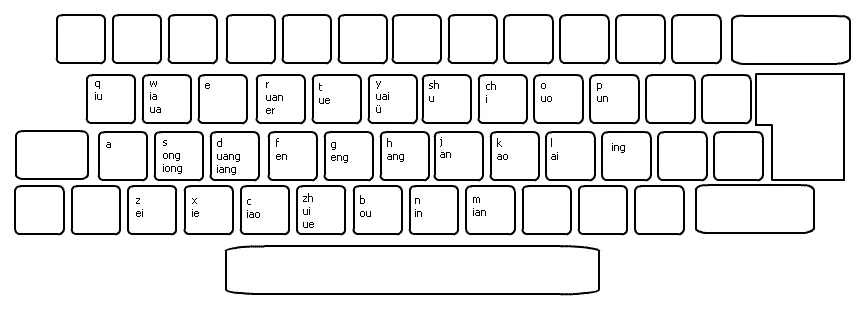

A standard computer keyboard does not need thousands of character keys to write Chinese. Most Chinese-language computers and phones use familiar QWERTY layouts. The key is a layer of software between the physical keys and the finished text: an input method editor, usually shortened to IME.
An IME treats keystrokes as instructions for finding characters rather than as the final characters themselves. That difference sounds technical, but it changes the act of typing. The writer enters a pronunciation, component pattern, stroke sequence or other code; the software returns candidates; the writer or the language model resolves the intended word.
Pinyin input is conversion, not alphabetic Chinese
In a common Mandarin pinyin method, someone who wants to write 中国 can type zhongguo. The IME recognises possible syllables and offers a candidate phrase. Selecting 中国 inserts the characters into the document.
The Latin letters are therefore an intermediate path. The final writing system remains character based. Thomas Mullaney’s history of Chinese computing argues that focusing only on alphabetisation misses this arrangement: QWERTY can be used to retrieve characters without replacing them.
Tone marks are often omitted in everyday keyboard input. That creates ambiguity because many characters share a pronunciation. Context makes the system practical. Typing a longer word or phrase gives the IME more information than entering one syllable at a time.
The Unicode Consortium’s explanation is deliberately general: characters are not hard-wired into any keyboard. All keyboards generate signals that software interprets. Chinese input makes that mediation visible because the path from key to written character is less often one-to-one.
The candidate row is part of writing
When several characters or phrases match the input, a candidate row appears. Frequency, prior text, personal history and language models can affect the order. The writer may accept the first result, choose a numbered candidate, continue typing or correct the conversion.
This makes prediction productive and risky. It can turn a long sequence of letters into several characters quickly. It can also choose a plausible but wrong homophone. A sentence may look grammatically smooth while containing a character the writer did not intend.
Proofreading therefore includes checking conversion, not only spelling. Names, specialised vocabulary and less common characters require particular attention because general frequency may rank a different candidate first.
Sound-based input is not the only answer
Pinyin is widely used for Mandarin and taught in mainland China, but “Chinese” includes different spoken varieties, regions and writing practices. Users who do not rely on Mandarin pronunciation may choose other phonetic systems. Shape-based methods encode visual components or stroke patterns. Handwriting, speech and character lookup offer additional routes on phones and tablets.
Shape methods can reduce homophone ambiguity because the code describes how a character is built rather than how it sounds. Their trade-off is learning: a user must know the decomposition rules and keyboard mapping. Handwriting helps when pronunciation is unknown, but recognition quality and input speed vary.
Traditional and simplified characters are another axis, not a simple on-off equivalent of language. An input method can output different character sets, and regional conventions influence preferred words, punctuation and candidates.
Mobile input adds gestures and voice
On a phone, the QWERTY idea remains but the interface has more options. A user can type full pinyin, abbreviate syllables, swipe, dictate or draw a character. The software may learn personal names and frequent phrases. A smaller screen makes candidate ranking especially important because fewer alternatives are visible at once.
Voice input does not remove conversion. Speech recognition still maps sound to text and must resolve homophones through context. Handwriting recognition likewise interprets a gesture rather than receiving a finished encoded character directly.
The common thread is retrieval. The user supplies evidence; the system searches a character or phrase space; the user confirms or corrects the result.
Why this matters beyond keyboards
Chinese input is a clear example of technology adapting around a writing system rather than forcing the writing system to fit one key per symbol. It also complicates the idea that QWERTY is culturally neutral. The same hardware can support very different relationships between key, sound, prediction and text.
Watching someone type only the letters can create the illusion that Chinese has become alphabetic. Watching only the finished characters hides the computational work. The full action includes both: a compact alphabetic interface and a character-based output joined by software.
That join now feels ordinary to users, which is precisely why it is worth noticing. A major design solution often disappears once it becomes a habit.
Sources and scope
- Unicode Consortium: Fonts and Keyboards FAQ — IMEs, pinyin conversion and why characters are not mapped one per key.
- Thomas S. Mullaney, “QWERTY in China” — historical interpretation of QWERTY, alphabetic mediation and character retention.
This article explains major principles, not every regional input system or accessibility tool. Individual IMEs differ in privacy, prediction, supported languages and keyboard layout.