
There is no single “Chinese social media app.” A person may coordinate a dinner in Weixin, check restaurant notes on Xiaohongshu, watch a creator on Bilibili, follow a breaking public conversation on Weibo and open Douyin after getting home. The useful map is not “Which Chinese app copies Instagram?” It is which job each platform does first.
For a U.S. reader, seven names explain most of the landscape: Weixin/WeChat, Xiaohongshu/RedNote, Douyin, Bilibili, Weibo, Kuaishou and Zhihu. They overlap, and each keeps adding features. Their center of gravity is still different.
Chinese social media apps at a glance
| Platform | Start here when you want to… | Familiar comparison | What that comparison misses |
|---|---|---|---|
| Weixin / WeChat | message people, manage groups, use services and move through daily life | Moments, Official Accounts, Video Accounts, Mini Programs, search and payments | |
| Xiaohongshu / RedNote | search lived experience before choosing a place, product, routine or style | Instagram or Pinterest | note-based search, saved research, practical comments and decision-making |
| Douyin | watch mainland China’s short-video, live and local-content ecosystem | TikTok | it is a separate product with separate accounts, catalogs, commerce and service layers |
| Bilibili | follow creators, fandoms, games, animation and knowledge-shaped video communities | YouTube | danmu, community language, membership culture and separate China/global apps |
| read public, fast-moving topics, celebrities, media and reactions | X | its topic system, distribution, creator ecology and Chinese public conversation | |
| Kuaishou | watch short video and livestreams rooted in a broad content community | TikTok or Twitch | its own creator relationships, live-streaming culture and commerce system |
| Zhihu | ask questions and read long, knowledge-shaped answers and discussion | Quora | its local expert, creator, publication and paid-content ecosystem |
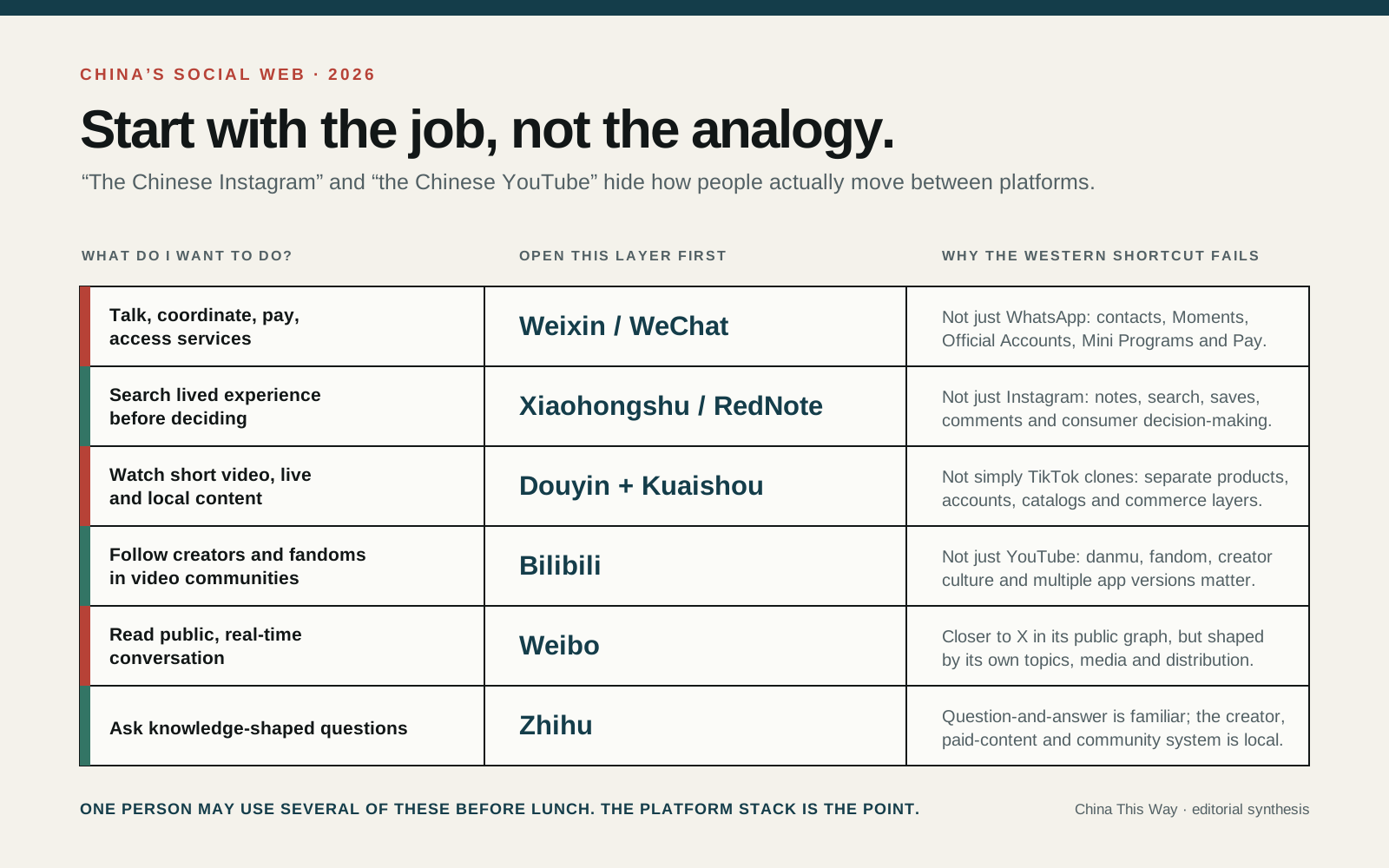
Open the full-size Chinese social media platform map.
The table is a starting route, not a ranking. “Most popular” changes with the metric, age group, city, content category and whether one counts messaging, video, public posting or commerce. A platform can be central without winning every usage chart.
Weixin and WeChat: the relationship layer
Weixin is the mainland China service; WeChat is its international sister service. Tencent describes them as distinct but interoperable products designed for different markets. In ordinary conversation, people often say “WeChat” in English even when the domestic product on a Chinese phone is Weixin.
Messaging is only the front door. A person can move from a direct chat to a group, Moments, an Official Account, a Video Account, a Mini Program or Weixin Pay without treating each function as a separate social network. This is why “Chinese WhatsApp” is both useful and misleading. It identifies the contact-based core but hides the service layer built around it.
Use Weixin first when the relationship already exists: a friend, family group, school, employer, restaurant contact, event organizer or merchant. Use another platform first when the task is open-ended discovery.
For a closer look at services inside the app, read why Weixin Mini Programs feel like an operating layer. Travelers who need payments should use the separate WeChat Pay foreign-card guide, because “has WeChat” and “can complete this payment” are different questions.
Xiaohongshu or RedNote: the decision layer
RedNote and Xiaohongshu are names for the same platform, not competing apps. Xiaohongshu’s own English description centers experience-sharing through photos, text, video and livestreams across subjects such as food, travel, fashion, fitness and everyday life. Its U.S. Apple and Google listings provide a current official download route.
The important object is a note. A useful note may combine images, a caption, location or product context, comments and later updates. Users often search with an intention—what to order, how a neighborhood feels, which route photographs well, whether a product suits a particular body or home—then compare several lived examples.
That is why “Chinese Instagram” is incomplete. The visual layer is real, but search, saves and decision-making are unusually important to the experience. For U.S. installation, English-mode and identity details, use the RedNote and Xiaohongshu guide.
Douyin: the mainland short-video and service layer
Douyin and TikTok share ByteDance origins, but they are separate products. A TikTok login does not simply become a Douyin account, and the feeds, store listings, content catalogs and commercial features are not one global database with a language switch.
Short video remains the most visible surface. Douyin also connects video to livestreaming, creators, products, places and services inside its mainland ecosystem. A restaurant clip can become a location decision; a creator demonstration can connect to a live room or shop; a trending sound can move through many content categories.
For a U.S. reader, the safe route is to verify the official product rather than download an unknown “English Douyin APK.” Our Douyin versus TikTok guide records current official desktop, web and mobile routes and explains the English-language boundary.
Bilibili: the creator, fandom and video-community layer
“Chinese YouTube” explains that Bilibili hosts creator video. It misses much of the social grammar. Bilibili grew around animation, comics and games, then expanded into technology, knowledge, lifestyle, documentary, music and many other communities. Videos can accumulate danmu—time-synchronized viewer comments that appear at the same moment for later audiences.
That makes watching partly archival and partly social. A tutorial may carry corrections at the exact second a tool appears. A performance can retain waves of audience reaction long after upload. A fandom develops shared references in titles, comments, danmu and creator updates.
U.S. search results also mix the main China community app with a separate international entertainment app. Use our Bilibili English app and version guide before installing, and read what danmu comments actually do before dismissing them as ordinary subtitles.
Weibo: the public conversation layer
Weibo is the clearest place in this list to begin when the question is “What are people publicly reacting to right now?” Its company description emphasizes public creation, sharing and discovery, with asymmetric relationships: a person can follow a public figure, organization, media account or creator without a mutual contact relationship.
That makes “Chinese X” a serviceable orientation. It is not a translation key. Topic pages, repost chains, media accounts, entertainment fandoms and recommendation systems shape what becomes visible. A trending topic label also does not prove that every post agrees, that the sample represents the country or that a screenshot preserved the original context.
When researching a Weibo claim, save the post URL, account identity, publication time and attached media. A translated screenshot without those fields is weak evidence.
For the separate installation task, use the current Weibo English app and U.S. sign-up guide. It compares the main and international clients by official store ID and keeps registration uncertainty out of this broader platform map.
Kuaishou: short video, livestreaming and community
Kuaishou is not merely a backup Douyin. The company identifies it as a content community and social platform, with short video, livestreaming and commerce as major parts of the system. Its creator and audience relationships developed through a different product history and can surface communities, performance styles and forms of everyday documentation that do not map neatly onto another app’s feed.
For an outsider, the practical lesson is simple: a trend seen on Douyin does not automatically describe Kuaishou, and a Kuaishou creator’s audience should not be inferred from a repost on another network. Preserve the original platform when reporting where something became popular.
Zhihu: the question and knowledge layer
Zhihu begins from questions, answers and discussion, making “Chinese Quora” the easiest shorthand. The platform’s own business description is broader: it is a content-centric community with multiple publishing and creator formats.
Use Zhihu when the query benefits from explanations, professional perspectives or long discussion. Then inspect author identity, citations, date and counterarguments. A confident long answer is still a user contribution, not an official source. Zhihu is valuable for discovering vocabulary, disagreements and possible experts; factual publication should return to primary evidence.
Which Chinese app is like Instagram, YouTube or TikTok?
If one answer is required:
- Instagram: Xiaohongshu is the closest for visual lifestyle discovery, but search and practical notes matter more to the comparison.
- YouTube: Bilibili is the closest creator-community comparison; licensed television platforms such as iQIYI, Tencent Video and Youku answer a different streaming question.
- TikTok: Douyin is the related mainland product, not a regional TikTok setting.
- WhatsApp: Weixin/WeChat is the closest relationship layer, with far more embedded services.
- X: Weibo is the closest public real-time conversation layer.
- Quora: Zhihu is the closest question-and-answer layer.
Use those labels to find the door. Stop using them once the door opens.
Can Americans use Chinese social media apps?
Some platforms maintain official U.S. app-store listings; others require a more specific route, region or language check. Availability, interface language, login verification and content access are separate questions. An app can install successfully while parts of its catalog, payment system or account flow remain market-specific.
Before installing:
- use the platform’s official site or a first-party Apple/Google listing;
- verify developer and package identity, not only the icon;
- avoid modified APKs and “unlimited” clients;
- review permissions and privacy terms for the exact app version;
- assume machine translation will miss slang, irony and platform-specific words;
- verify any price, booking, health or safety claim outside the social post.
Travel connectivity is a separate subject. Do not infer that a familiar U.S. app or roaming plan will behave normally from an old forum answer. Use the current China mobile data options guide for network preparation.
How to research China without being fooled by one viral post
Use Chinese social platforms as discovery systems, then change evidence layers.
- Record the original platform, account, date and Chinese search term.
- Distinguish an original post from a repost, compilation or translated screenshot.
- Read comments for leads and contradictions, not as a population survey.
- Search the named entity on its official site, store listing or regulator record.
- Preserve what the source proves and what it does not.
- If a platform pattern matters, sample more than one city, creator and date.
This method keeps the energy and specificity of Douyin, Xiaohongshu, Bilibili, Weibo, Kuaishou and Zhihu without treating platform popularity as verified fact.
Questions readers ask next
What is the most popular social media app in China?
There is no honest single answer without naming the metric. Weixin is a foundational relationship and service layer; Douyin and Kuaishou are major short-video systems; Xiaohongshu, Bilibili, Weibo and Zhihu serve different discovery and community jobs. Daily users, total time, age group and use case can produce different rankings.
Is RedNote the same as Xiaohongshu?
Yes. RedNote is the international app-store presentation of Xiaohongshu. It is not a separate “Western Xiaohongshu” network.
Is Douyin the Chinese version of TikTok?
That shorthand explains their shared origin, but Douyin and TikTok are separate products with separate accounts, catalogs and store routes.
What is the Chinese version of YouTube?
Bilibili is the closest answer for creator video and community culture. For licensed drama and film streaming, iQIYI, Tencent Video and Youku are more relevant and should not be collapsed into the social-video comparison.
Do Chinese people use only one super app?
No. Weixin can handle an unusually broad range of daily tasks, but people still move among specialist platforms for public topics, video, lifestyle research, fandoms and knowledge.
Sources and scope
- Tencent: Weixin and WeChat — first-party product functions and the Weixin/WeChat sister-service distinction.
- Xiaohongshu: About — first-party lifestyle, note, community and commerce description.
- Apple U.S.: rednote and Google Play U.S.: rednote — current U.S. app identity and download routes.
- ByteDance: company and product history and Douyin official download — first-party product identity; not a claim that every device or U.S. account can complete installation.
- Bilibili: company overview and Apple U.S. lookup for main app ID 736536022 — community scope and dated U.S. app identity; the lookup record does not guarantee that Apple’s public web route opens for every account.
- Weibo Investor Relations — first-party public creation, sharing, discovery and relationship model.
- Kuaishou 2025 results — company identification of its content-community, social, livestreaming and commerce businesses.
- Zhihu Investor Resources — company description of its community-centered, content-centric model.
This map was checked on 26 August 2026. It describes platform jobs and official routes, not an endorsement, a national popularity league table or a promise that every feature works in every market. Interface, availability and account requirements can change.