

West Lake looks natural enough to encourage a simple story: water, wooded hills, mist and seasonal flowers somehow survived beside a major city. Its more interesting history runs in the opposite direction. The lake people admire is also the result of dredging, causeway building, planting, naming, framing and repeated maintenance.
UNESCO classifies it as a cultural landscape. That phrase matters. The point is not that human intervention spoiled an original natural scene, nor that every tree and reflection was planned from the start. West Lake is valuable because natural features and sustained human choices became inseparable.
Begin with the fourth edge
Hills border the lake on three sides. Hangzhou occupies the fourth. That asymmetry makes the landscape work: one direction opens to an urban shore while others turn toward slopes, temples and wooded depth. The lake is therefore neither outside the city nor swallowed by it. The two have been composing each other’s view for centuries.
Walk a short section of the eastern shore and look back across the water. The skyline establishes the present city. Turn toward a causeway or island and the scene changes scale. The shift is not evidence of two separate West Lakes, one modern and one traditional. It is the defining tension of the place.
Causeways are infrastructure and composition
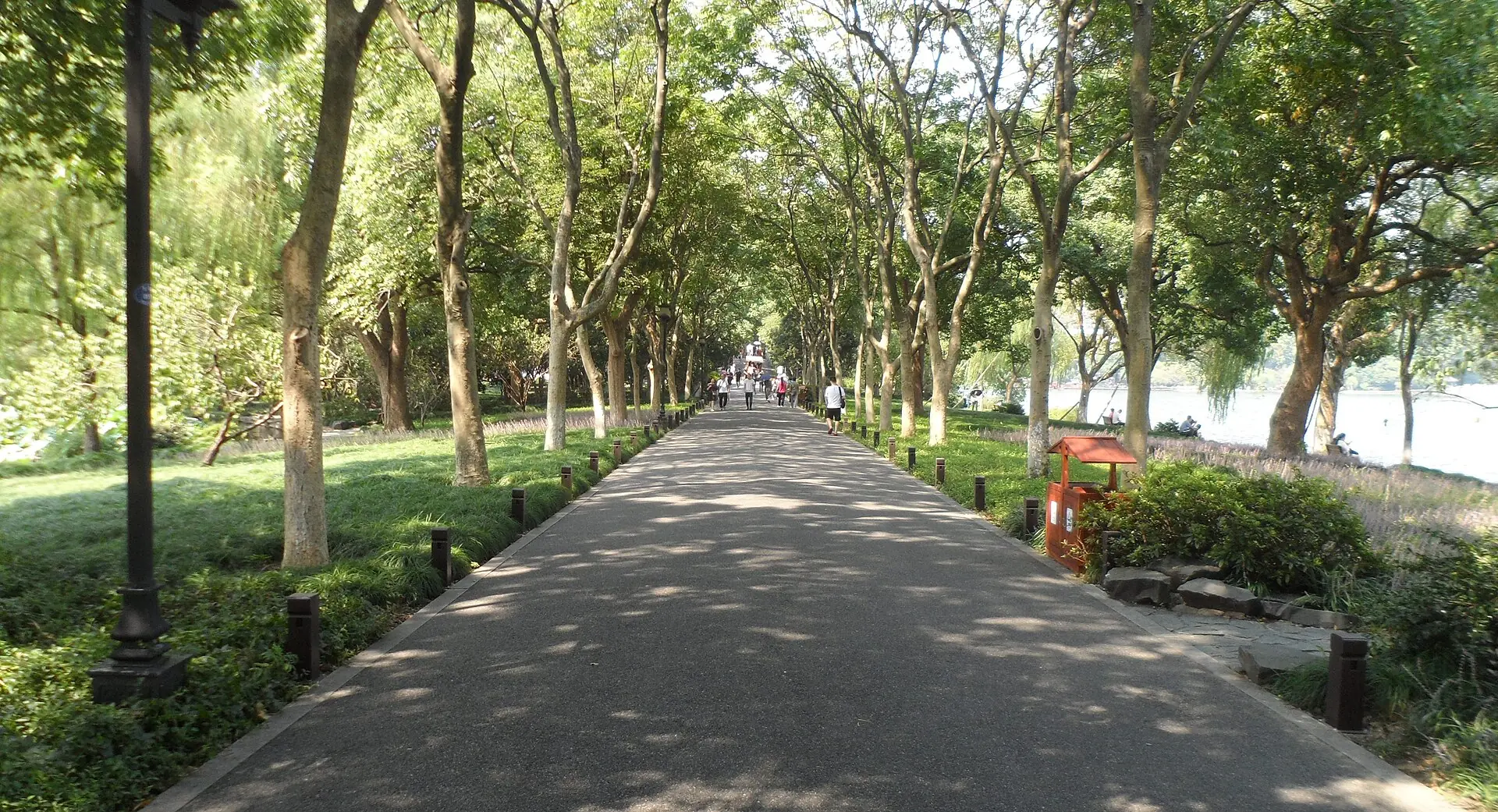
The Su and Bai causeways are among the lake’s most recognisable elements. They also make clear that beauty here has an engineering history. The UNESCO nomination connects the major causeways and islands to dredging projects repeated from the ninth to twelfth centuries. Removed silt became new paths and landforms; maintenance of water became a way to reorganise the view.
A causeway does several jobs at once. It crosses water, divides the lake into visual rooms, creates changing foregrounds and gives walkers a sequence of near and distant scenes. Bridges interrupt the straight line, letting boats and water pass while resetting a person’s view. Calling it merely picturesque ignores the practical work. Calling it merely infrastructure ignores why its alignment and planting matter.
This dual role is a useful Chinese landscape principle to notice elsewhere: an intervention can solve circulation or water management while also being judged by how it frames experience.
Named views teach people where to look
The Ten Poetically Named Scenic Places of West Lake turn observation into a cultural practice. A title links a location with weather, season, light, sound or time of day. It does not guarantee that every visitor will see a perfect historic tableau. It supplies a prompt.
This is different from labelling a landmark. “A bridge” identifies an object. A named scene asks when and under what conditions a relationship becomes visible. Moonlight on calm water, lotus in summer or evening sound around a site depends on timing. The viewer participates by arriving, remembering the name and comparing expectation with the actual day.
The names also help scenes travel. Poems, paintings and later reproductions could circulate an idea of West Lake far beyond Hangzhou. UNESCO notes the landscape’s influence in China, Japan and Korea. The transferable element was not a blueprint for copying every pavilion. It was a practice of refining landscape and giving composed views cultural meaning.
“Improved nature” is not a contradiction here
In some modern conservation language, human intervention and authentic nature are treated as opposites. West Lake asks for a different distinction. The relevant question is whether changes preserve the long relationship among water, hills, built elements and named views.
That is why visual intrusion matters. A building outside the water can still damage a protected landscape if its height or colour overwhelms a historic sightline. UNESCO conservation decisions have addressed such effects around the property. Protecting West Lake therefore includes managing what appears behind it, not only cleaning the water or repairing monuments.
It also means avoiding the claim that the lake is a finished artwork. Dredging and planting continue because living landscapes change. Public use changes too: commuters, runners, tour groups and local families occupy a place once described by courtly or literary elites. Contemporary use is not automatically a loss of meaning, but crowding and commercial pressure can reduce the conditions that make slower looking possible.
A better way to spend two hours
Do not chase every named scene. Choose one causeway, one city-facing shore and one elevated or garden view. At each, identify the human intervention: dredged land, bridge, planting, path, pavilion or title. Then identify the natural condition it works with: water level, slope, seasonal growth, haze or changing light.
That comparison makes West Lake legible as a collaboration maintained across generations. The landscape is not less real because people shaped it. The shaping is the subject.
Sources and scope
- UNESCO World Heritage Centre: West Lake Cultural Landscape of Hangzhou — heritage value, landscape components and city-lake relationship.
- West Lake nomination dossier — detailed history of dredging, causeways, named scenes and landscape aesthetics.
This article explains the landscape’s design logic. It does not provide live crowd levels, boat schedules, accessibility conditions or a complete history of Hangzhou.