
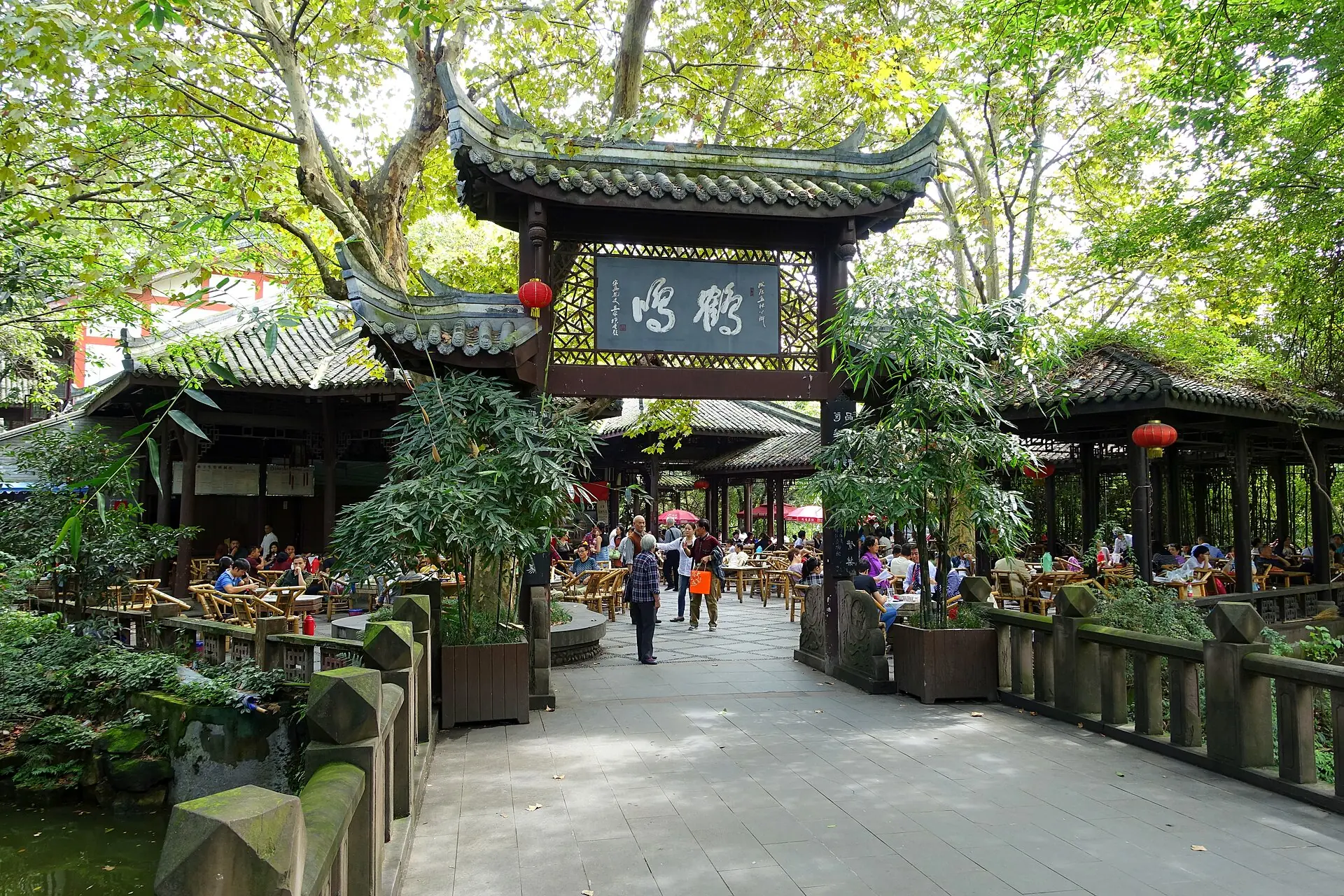

Chengdu’s People’s Park is useful because several versions of public life remain visible in one bounded place. It began as Shaocheng Park in 1911. Its official map now joins monuments, gardens, water, food and Heming Teahouse. The park is therefore neither only a historic site nor simply a green break from the city.
This page explains those layers from published sources. It does not claim to describe the crowd, prices or activities on any particular day.
The first layer is civic, not recreational
The park’s official history dates its establishment to 1911 and describes it as one of China’s early modern public parks. “Public park” in that setting was not merely a landscaping category. The site formed part of a changing city in which new civic institutions and public spaces were being built.
That origin remains readable through protected structures and memorials. A visitor who goes straight to the teahouse can miss that the park’s leisure spaces sit beside a record of political and urban change. The useful sequence is to read the park map first, then notice which features are monuments, which are later leisure facilities and which functions overlap.
The teahouse is a room without four walls
Heming Teahouse appears in the park’s own list of cultural and leisure features. Its open seating turns a commercial transaction—a bowl of tea—into temporary access to a shared social space. The customer is buying tea, but also time at a table and a position inside the park’s flow.
Historical research by Di Wang treats Chengdu teahouses as important sites of business, entertainment, conflict and ordinary public life. UNESCO’s recent work on Chengdu’s traditional teahouse archives connects those histories with contemporary preservation and use. Together, the sources support a long institutional role for teahouses. They do not prove that every table today serves the same purpose it did in 1911 or 1950.
Leisure here is made of small permissions
A city park allows activities that are awkward in a shop, office or private home: sitting without a large purchase, watching other people, meeting in a visible place, walking without a destination. The teahouse modifies that permission by giving it service, furniture and a bill.
This combination helps explain why photographs of People’s Park often look busier than the Western image of a quiet ornamental garden. The park can hold conversation, tea, performance, commemoration and routine movement at once. “Relaxed” is too vague to describe that system. The specific feature is coexistence: different uses remain close enough to observe one another.
What to look for without turning people into scenery
A respectful visit can focus on the design of the space rather than photographing strangers as local colour:
- trace how paths connect the entrance, monuments, water and teahouse;
- notice which seats require a purchase and which do not;
- read signs before assuming an activity is informal or permanent;
- identify the difference between a protected historic structure and a reconstructed or commercial setting;
- keep faces out of photographs unless consent is clear.
These observations produce a better place story than a checklist of “authentic Chengdu experiences.” They show how public life is supported by paths, shade, tables, service and rules.
One park is not the whole city
People’s Park is unusually central and historically legible. That makes it a strong starting point, but a poor statistical sample. It cannot establish how all Chengdu residents spend leisure time, how every neighbourhood park works or whether the city as a whole moves at one pace.
Its value is more precise. In one walkable site, a reader can see that leisure is not the absence of urban structure. It is produced by urban structure: a park boundary, civic history, accessible seating and businesses that let people remain in public for longer.
Sources and scope
- Chengdu People’s Park official site — park history, map, protected features and current institutional description.
- UNESCO: Revitalizing Chengdu’s Traditional Teahouse Archives — archive inscription and documented contemporary teahouse use.
- Di Wang: Teahouses and Public Life in Early Twentieth-Century Chengdu — historical analysis of the teahouse’s public functions.
The page is source-checked, not field-tested. It gives no current price, opening-hour or crowd promise. Use the park’s own notices for live access information and ask before photographing identifiable visitors.