
A Chengdu teahouse sells tea, but the drink does not fully explain the room. A bowl can secure a seat for conversation, reading, games, business or simply staying in public. That combination—low-intensity service and long social time—is why the teahouse matters as more than a beverage format.
Historical research shows that these spaces have changed with the city rather than surviving untouched. UNESCO’s recent work on Chengdu’s traditional teahouse archives records another change: documents about ordinary commercial and public life are now being treated as heritage. The living practice and its archived history should be read together, but not confused.
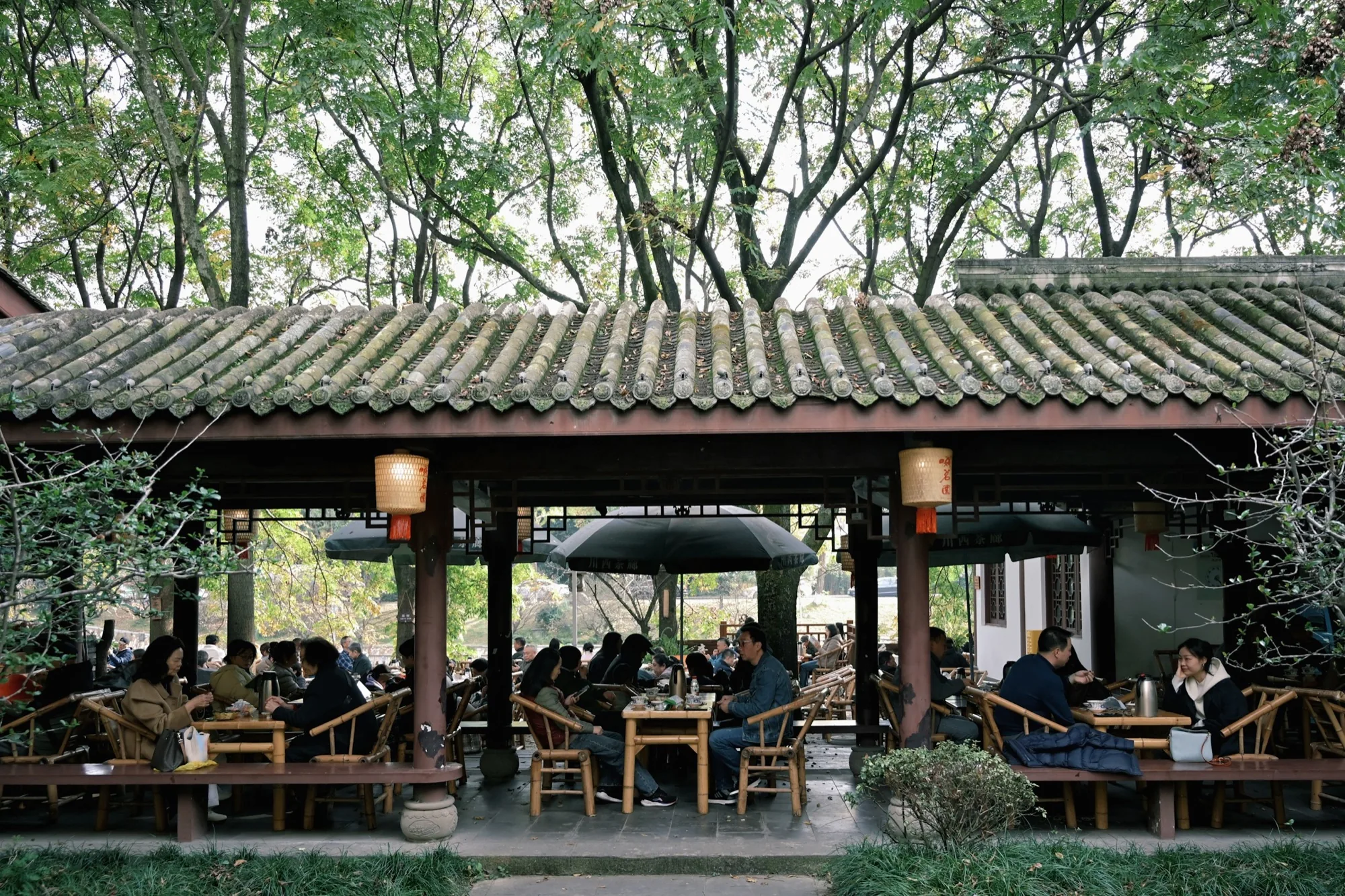
Tea creates a reason to remain
In a takeaway drink shop, the transaction can end when the cup changes hands. In a teahouse, the seat is part of the product. The cup, lid, saucer, hot water and table organise a longer interval. Refilling extends it without requiring a completely new order.
That material arrangement matters. It creates a semi-public room in which strangers are near one another but do not need to join the same activity. A group can play a game while another talks. Someone can wait, watch or read. The space supports low-stakes contact without requiring the intimacy of a home.
This is not unique to Chengdu, and teahouses exist across China and elsewhere. Chengdu’s distinction is the depth of documentation around how the institution became part of its urban public life.
The historical teahouse was not simply peaceful
Di Wang’s research on early twentieth-century Chengdu describes teahouses as places of leisure, business, entertainment and public affairs. They could also hold disputes and competition. Calling them “relaxed” deletes much of what made them public.
Public space is valuable partly because different interests encounter one another there. A teahouse owner ran a business; performers and service workers made a living; customers exchanged information or pursued their own purposes. The room was not outside economics or politics. It concentrated them at a small scale.
That history corrects a common travel-writing image in which bamboo chairs prove an unchanging local temperament. Furniture can persist while ownership, regulation, clientele and entertainment change.
The institution survived by changing
The Teahouse under Socialism follows Chengdu’s teahouses through the second half of the twentieth century, including changes in ownership and state control, decline and later renewal. The important point for a present reader is not to compress that history into “tradition survived.” The institution was repeatedly reorganised.
UNESCO’s 2025 newsletter describes traditional teahouse archives being placed on the Memory of the World Committee for Asia and the Pacific regional register in 2024. It also documents contemporary programmes in restored teahouses, including music and local performance. Preservation here includes both paper records and new uses of physical venues.
Heritage status does not freeze the scene. It adds another actor—archives, museums and cultural institutions—to the older relationship between proprietor, worker and customer.
One word, several kinds of place
“Teahouse” can name a park pavilion, a street-corner room, a performance venue or a polished cultural attraction. Price, table turnover, menu and audience can differ. A venue designed for visitors is not fake merely because it is accessible; an older venue is not automatically representative of everyday life.
The better questions are visible:
- Is tea the main service or one item in a broader entertainment offer?
- Does the bill purchase a drink, a timed seat or access to a performance?
- Are people staying alone, meeting others or watching an event?
- Which parts of the building and service are old, restored or newly introduced?
These questions separate function from atmosphere. They also make comparison possible without ranking venues by a vague idea of authenticity.
What the gaiwan contributes
The covered bowl commonly called a gaiwan (盖碗) supports the pace of the room. Its lid can hold leaves back while a person drinks, and hot water can be added again. The object makes repeated steeping visible on the table instead of hiding the process in a large pot.
That does not mean every Chengdu customer uses the same tea, hand position or etiquette. The object offers a set of practical possibilities. The venue determines which of them become routine.
Read the teahouse as an operating public space
For an outside reader, the most useful conclusion is modest. Chengdu’s teahouse is neither a museum set nor proof that an entire city is carefree. It is a durable business form that has repeatedly provided room for people to remain in public.
The tea matters. So do the rent, chairs, workers, customers, rules, performances and histories that gather around it. Leave those elements in the frame and the teahouse becomes more interesting than the stereotype.
Sources and scope
- UNESCO: Revitalizing Chengdu’s Traditional Teahouse Archives — archive inscription and documented contemporary programming.
- Di Wang: The Idle and the Busy — early twentieth-century teahouses and public life.
- The Teahouse under Socialism — peer-reviewed open book on ownership, policy, decline and renewal from 1950 to 2000.
- Chengdu People’s Park — Heming Teahouse within the park’s current institutional map.
This article explains documented functions and historical change. It does not report a visit, price or conversation, and it does not claim that one photographed venue represents every Chengdu teahouse.