
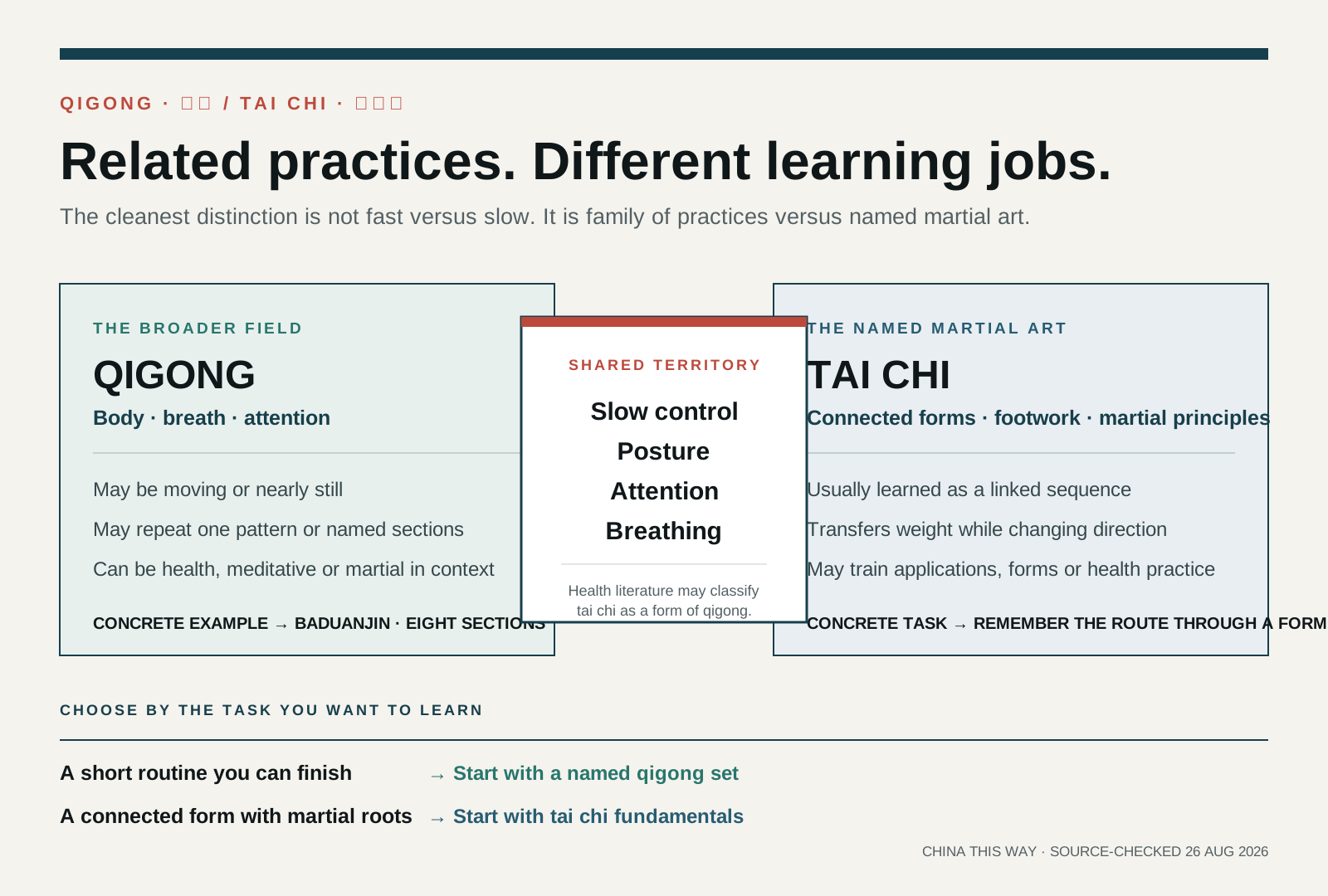
Qigong is the broader family of practices. Tai chi is a named Chinese martial art whose forms can also be practiced for health. Both may combine controlled movement, posture, breathing and attention, so they can look similar in a short video. They are related, but they are not two spellings for the same exercise.
The most useful difference for a beginner is the learning task. A qigong session may repeat one movement, hold a posture or work through a compact set such as Baduanjin. A tai chi student usually learns a connected form: weight shifts, steps, turns and hand movements have to continue into the next posture.
That is why “Which is better?” is too blunt. If you want a short routine you can recognize and finish, start with one named qigong set. If you want to learn a longer movement language with martial roots, start with tai chi fundamentals and a teacher who explains the form rather than asking you to imitate a silhouette.
Qigong vs tai chi at a glance
| Question | Qigong | Tai chi |
|---|---|---|
| What is the name describing? | A broad family of Chinese body, breath and attention practices | A Chinese martial art, also widely practiced for health and recreation |
| What might a session look like? | Repeated movements, a short named routine, standing practice or little visible movement | A connected sequence of postures with stepping, turning and weight transfer |
| What does a beginner have to remember? | The pattern, breathing approach and order of a specific practice | The route through a form as well as posture, direction and transitions |
| Is it always slow? | No. Many health-qigong routines are slow, but qigong is too broad for one speed rule | Often slow in common health classes, but speed alone does not define the art |
| Is it martial? | Not necessarily; the label covers practices with different purposes and histories | Yes in origin and technical structure, even when a class emphasizes health |
| Do you need equipment? | Often no; it depends on the named practice | Empty-hand forms need no equipment; some curricula also use sword, fan or other implements |
| A concrete starting point | Baduanjin, an eight-section standing routine | A beginner form or fundamentals class that teaches stance, stepping and transitions |
The table describes common learning patterns, not a border patrol. Qigong contains many systems. Tai chi has several styles and teaching goals. One class can sit close to the overlap while another makes the differences obvious.
The apparent contradiction: is tai chi a kind of qigong?
You will find credible sources saying both “tai chi and qigong” and “tai chi is a form of qigong.” The wording changes with the question being asked.
The U.S. National Center for Complementary and Integrative Health treats qigong as the broad health-practice category and says tai chi performed for health can be considered a form of qigong. In that frame, both coordinate posture, attention and breathing.
In martial arts, history and instruction, taijiquan has its own identity. The word quan (拳) means fist or boxing. Tai chi forms preserve martial postures, directional changes, stepping patterns and applications even when a particular class does not train fighting. Calling it only “qigong” can erase the thing its students are actually learning.
So the clean answer is:
- For a health-practice taxonomy: tai chi can sit inside the wider qigong field.
- For learning and cultural accuracy: tai chi and a named qigong routine such as Baduanjin are not interchangeable.
That is not a loophole. It is the difference between categorizing an activity and describing its full practice.
What a beginner is actually learning
In a named qigong routine
Take Baduanjin rather than the vague instruction “try qigong.” Its standardized standing routine has eight sections. Each section has a recognizable movement idea—raising the hands, drawing a bow shape, turning, folding, punching or rising through the heels—and the whole set has an opening and closing.
This bounded structure matters. You can watch one complete demonstration, identify where you are in the sequence and reduce the range while keeping the order. Other qigong practices may be structured differently, including repeated single movements or nearly still work, which is why a teacher or video should name the method rather than promise “qigong benefits” as if it were one exercise.
China’s official Health Qigong teaching material on breathing describes three linked elements: regulating the body, breath and attention. It also warns beginners not to force a sophisticated breathing pattern before the movement is familiar. Natural, unstrained breathing is a more defensible starting instruction than deliberately making every breath deep and slow.
In a tai chi form
A tai chi posture is not only a photographable shape. The student also has to arrive, transfer weight, change direction and leave for the next posture without losing control. A form is a connected route through those decisions.
That makes the early difficulty different. A beginner may be able to copy one hand position yet still step across an unstable base, leave weight on the wrong foot or forget which direction comes next. Good instruction exposes those transitions. A beautiful follow-along video that crops out the feet does not.
Tai chi curricula differ by style, school and purpose. Chen, Yang, Wu, Sun and other styles are not filters applied to one universal routine. They have related principles but different forms, emphases and teaching histories. Ask what form a class teaches before comparing its length or pace with another class.
Where “tai chi walking” fits
“Tai chi walking” is a useful search phrase but an imprecise product label. It usually refers to stepping drills that isolate controlled weight transfer, foot placement, posture and continuity from a larger tai chi practice. It is not simply ordinary walking performed very slowly, and it is not one globally standardized form.
A sensible drill should tell you:
- where the weight begins;
- how the empty foot moves and lands;
- when weight transfers;
- what the knee and hip are doing;
- how the next step connects.
If a clip only says “walk slowly to burn fat” or gives a medical promise without identifying the stepping method, it is using tai chi as a marketing adjective. If balance is already a concern, practice near stable support and get individual guidance rather than using a short social clip as a balance test.
Which should you start with?
Choose the next repeatable task, not the grandest philosophy.
Start with a named qigong set if you want…
- a compact routine with a visible beginning and end;
- a practice that often works in limited home space;
- fewer connected footwork decisions at first;
- a clear reference video you can compare with the same sequence next time.
Baduanjin is the best documented starting route on this site. The guide maps all eight sections, links the Chinese Health Qigong Association’s current full demonstration and separates traditional movement names from medical claims.
Start with tai chi if you want…
- to learn a connected form rather than a short repeated set;
- stepping, direction and weight transfer to be central;
- access to the martial logic behind the movement;
- a practice you are willing to build through regular instruction rather than collect from unrelated clips.
Ask a class what style and form it teaches, whether beginners learn footwork separately, and how the instructor adjusts range for pain or balance limitations. In the United States, NCCIH notes that there is no national certification standard for either tai chi or qigong instructors, so a certificate title alone does not answer those questions.
Start with neither from a random clip if…
- the instructor guarantees a cure or asks you to stop medical care;
- the camera hides the feet during standing movement;
- pain is treated as proof that the exercise is working;
- the routine, style or lineage is never named;
- the movement demands a range you cannot control.
The contemporary China behind both practices
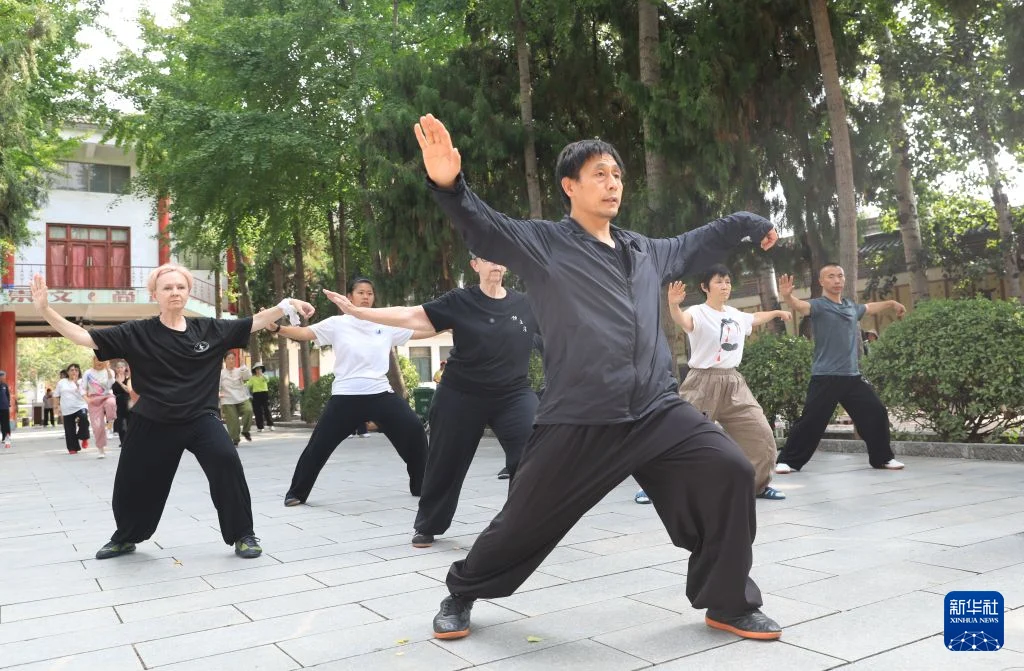
The default English-language image—anonymous older people moving in a misty park—hides most of the present-day system.
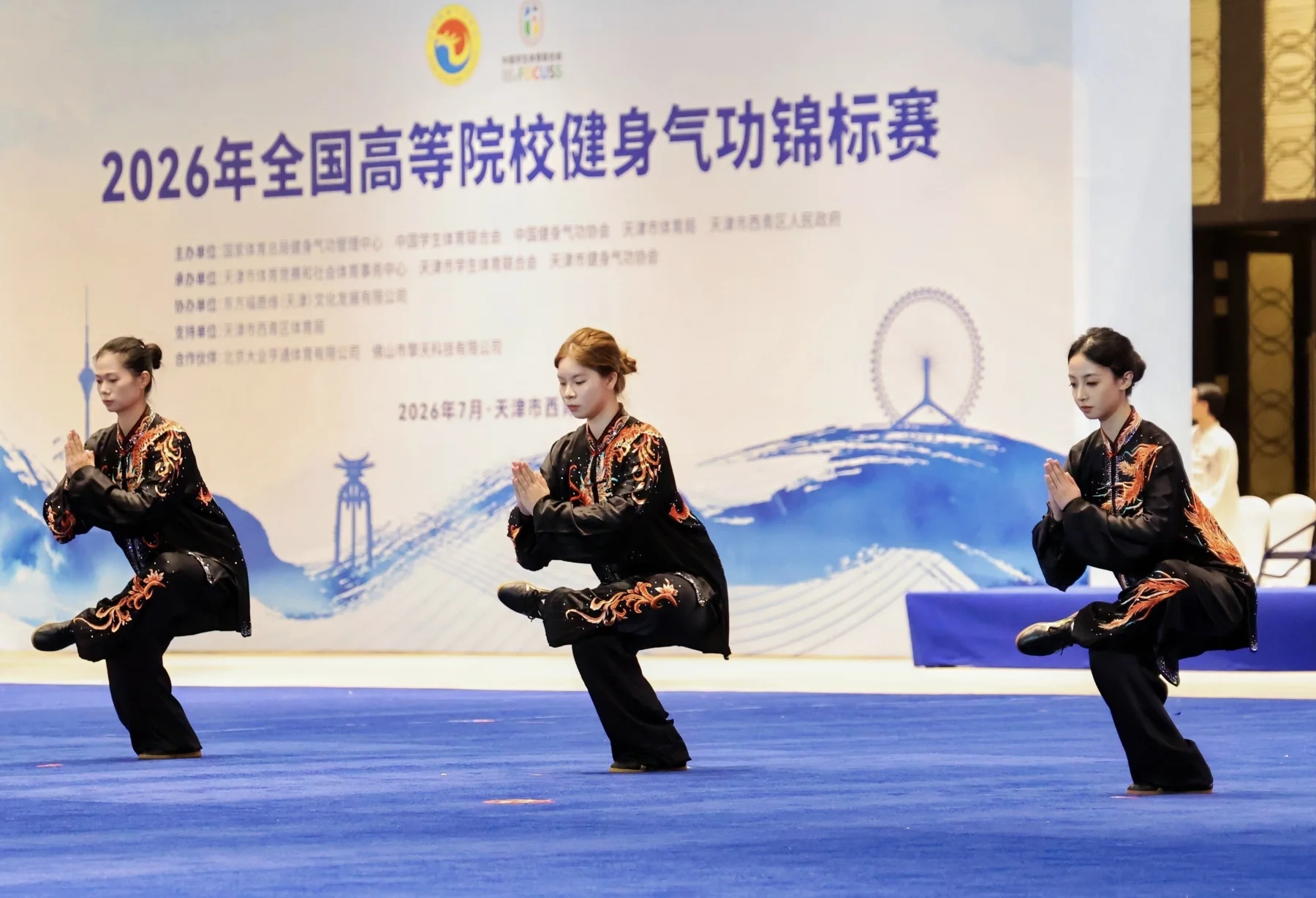
In July 2026, China’s national university Health Qigong championship brought 368 teams from 214 universities to Tianjin. The official report counted 1,509 teachers and students, including 1,145 young athletes, across 11 routines and multiple competition divisions. Participants reviewed video, corrected technique and competed under formal judging. That is a current campus-sport environment, not a museum tableau.
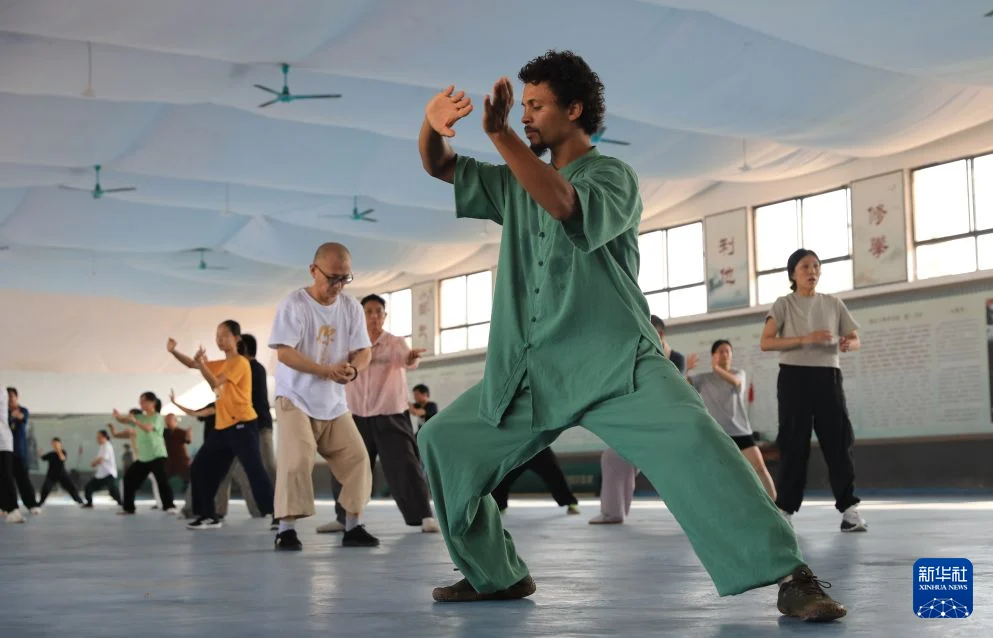
Tai chi is also moving through public events, international learners and high-performance sport at the same time. Beijing’s National Olympic Sports Center hosted 12 teams for the first International Tai Chi Day in March 2026, with several styles and weapons represented. In July, Xinhua photographed international students training Chen-style tai chi in Chenjiagou with Chinese teachers. The International Wushu Federation lists taijiquan and taijishan (tai chi fan) in the 2026 Dakar Youth Olympic wushu programme.
These examples do not prove that every young person in China practices either activity. They prove something narrower and more useful: qigong and tai chi currently live in universities, standardized teaching, international schools, community programmes, competitions and online video. “Traditional” describes their inheritance; it does not mean their present life is frozen in the past.
What evidence can—and cannot—tell you
Tai chi and qigong are often sold through long benefit lists. The evidence is more specific than the marketing.
NCCIH summarizes research by population, condition, programme and comparison. Its tai chi review says the practice appears generally safe and reports that related adverse events in reviewed studies were usually minor musculoskeletal aches or pain. Its qigong overview also describes the activity as generally safe while noting that evidence for particular conditions varies and can be limited or conflicting.
That supports a modest conclusion: controlled beginner practice is not inherently extreme. It does not mean every form, depth, instructor, online routine or medical situation is equivalent. Do not use either practice to delay diagnosis or replace a clinician’s treatment plan. Pregnancy, recent surgery, cardiovascular symptoms, significant balance problems and new or worsening pain deserve individual guidance.
Stop if you develop chest pain, faintness, unusual shortness of breath or sharp/worsening joint pain. Severe symptoms need prompt medical help, not a modified follow-along video.
Qigong vs tai chi vs yoga
All three labels can describe mind-body practice, but “slow movement plus breathing” is not enough to make them the same.
- Qigong names a broad Chinese field with moving and still practices.
- Tai chi names a Chinese martial art whose forms can also be practiced for health.
- Yoga names a large family of South Asian traditions and modern practice systems with their own histories, postures, breath work and philosophies.
Compare the actual class: what sequence it teaches, how much stepping or floor work it uses, what the instructor can correct and whether the pace fits your body. National labels are not exercise prescriptions.
Questions readers ask next
Is qigong easier than tai chi?
A short, named qigong routine may be easier to finish and remember than a long tai chi form. That does not make every qigong practice physically or cognitively easier, and it does not make Baduanjin “beginner tai chi.”
Which is better for beginners?
The better start is the one with a named method, visible instruction and a range you can repeat. Choose a compact qigong set if finishing a routine matters most; choose tai chi if learning connected stepping and a martial form is the point.
Can I learn both?
Yes. Keep the methods identifiable. Learning one Baduanjin sequence and one tai chi class is clearer than switching among videos that label every slow Chinese movement “qigong tai chi.”
Is Baduanjin qigong or tai chi?
Baduanjin is a named qigong routine. It is not a tai chi form, although both may use slow, controlled movement, breathing and attention.
Do tai chi and qigong build muscle?
They ask muscles to support posture, controlled transitions and repeated movement, but the training load varies widely. Neither label tells you a universal strength dose. If strength is the goal, inspect the actual class and keep progressive resistance training in the conversation.
Sources and scope
This comparison was checked on 26 August 2026 against the U.S. National Center for Complementary and Integrative Health’s qigong and tai chi overviews; General Administration of Sport materials on Health Qigong instruction, the 2026 university championship and International Tai Chi Day; Xinhua’s July 2026 Chenjiagou photo report; and the International Wushu Federation’s Dakar Youth Olympic programme.
Current U.S. search demand was checked separately through Google and Bing autocomplete with U.S. English settings. “Qigong vs tai chi,” “qigong for beginners,” “tai chi walking” and related comparison questions appeared across both engines. Autocomplete shows recurring query language, not exact search volume or a guarantee of ranking.
This page compares common learning structures. It does not define every qigong system, tai chi style or individual class, certify an instructor, prescribe treatment or promise a health outcome.