
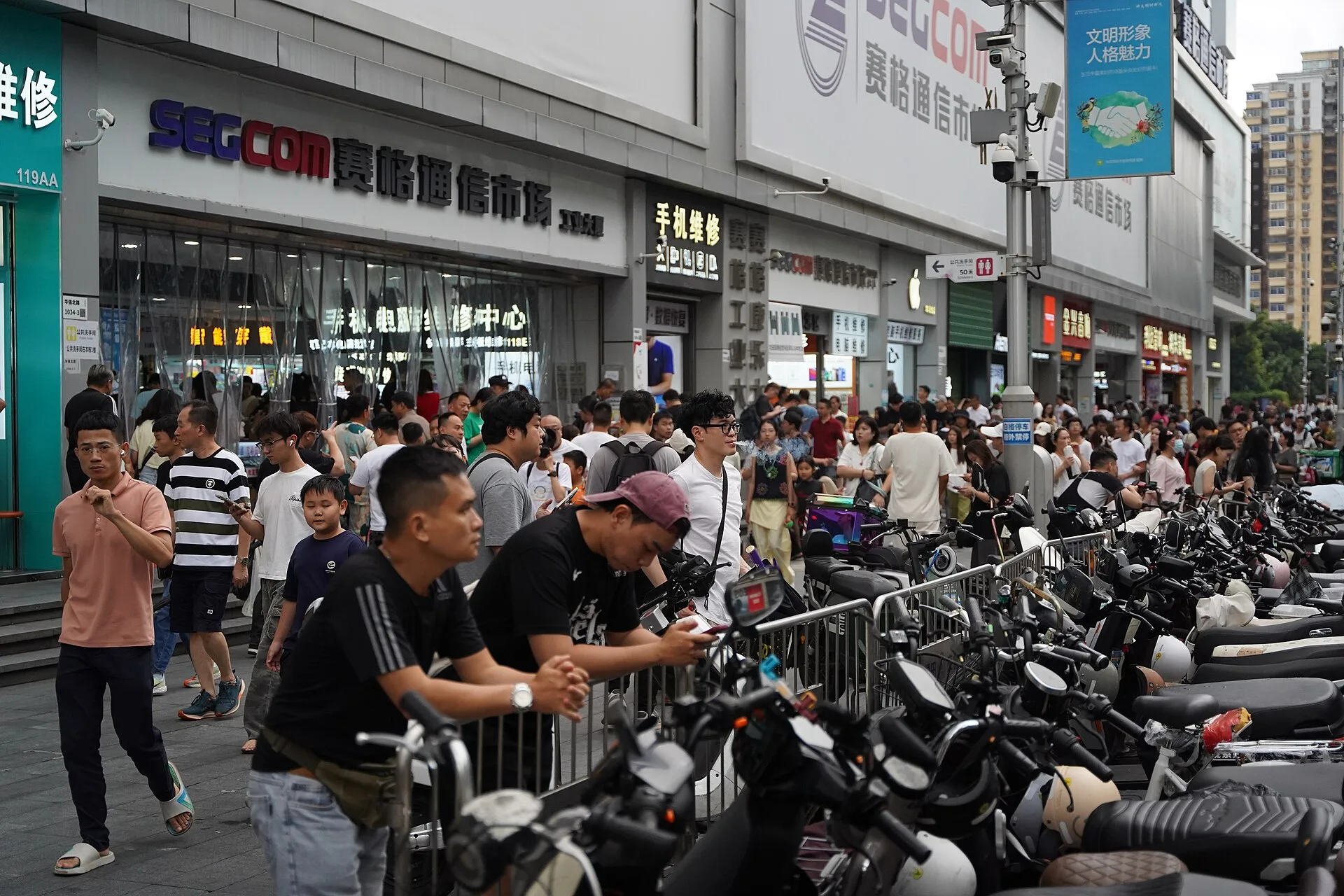

Huaqiangbei is not one market with a convenient front door. It is a pedestrian district in Shenzhen’s Futian area, surrounded by specialised market buildings whose floors can serve different buyers. Reading it correctly starts with the building name and the type of counter in front of you—not with the assumption that every stall sells the same category of finished gadget.
This distinction is practical. A visitor looking for a phone case, an engineer looking for a connector and a buyer comparing quantities may all say they are “going to Huaqiangbei,” yet need different buildings, floors and conversations.
The street is the index
Shenzhen’s municipal cultural-block page identifies the Huaqiangbei Technology Fashion Pedestrian Street and frames the wider area around technology, entrepreneurship and retail. The pedestrian street is therefore best understood as the public spine of a district. It helps you move between buildings; it does not contain the district’s full inventory by itself.
Above and beside it are named markets. A city-hosted 2024 account identifies specialised electronics markets and describes a history that runs from the SEG Electronics Market, opened in 1988, to later market buildings and maker spaces. Those dates explain why the district contains multiple generations of retail and wholesale space rather than a single master-planned store.
A glass counter can represent several businesses
What looks like a small retail stall can perform one or more jobs: showing samples, taking a wholesale order, arranging customisation, connecting a buyer with stock held elsewhere or directing repair work. The object in the case is not proof that it was made behind the counter—or even inside Shenzhen.
That is why the correct first question is not “How much is this?” but “What kind of order does this counter handle?” Minimum quantities, lead times, specifications and after-sales responsibility matter more to a sourcing buyer than the retail price of one sample. A casual visitor may only need to know whether single-unit sales are welcome.
Finished devices and components belong to different maps
Component markets organise value by technical category: connectors, displays, chips, boards, power supplies, tools. Consumer-facing floors organise it by use: phones, audio, cameras, computers, accessories. Repair services organise it by failure: screen, battery, port, data, casing.
These maps can overlap physically. The overlap is part of Huaqiangbei’s usefulness, but it can also make the district confusing. A floor full of finished earbuds says little about where a particular internal component is sold. A counter with reels of parts says little about whether the seller supports a complete product build.
Why the district keeps changing
The official planning language now includes technology, fashion, culture and tourism. The 2024 market account also describes product launches and maker teams. Those descriptions show an effort to give Huaqiangbei roles beyond traditional component trade.
They do not prove that the older trade has vanished. Districts change unevenly: a pedestrian street can be renovated while business continues in dense interiors; consumer attractions can open beside wholesalers. Any current visit should therefore treat building directories and posted floor signs as live evidence, not decoration.
A simple way to read a visit
Use four notes for every stop:
- Building and floor. Record the exact market name before recording the product.
- Business type. Retail, wholesale, repair, sample display or service intermediary are different encounters.
- Object state. Is it a finished device, a replaceable module, a loose component or a tool?
- Claim boundary. “Sold here,” “stocked here,” “assembled here” and “made in Shenzhen” require different proof.
This method turns the district from spectacle into a legible commercial space. It also prevents a common error: photographing a surprising gadget and treating it as evidence for how Shenzhen’s entire hardware economy works.
What this page cannot promise
No source can guarantee that a particular stall, part or price will still be present when you arrive. Market counts in city media are time-stamped descriptions, not a live directory. Product authenticity, intellectual-property status, electrical certification and export compliance must be checked for the exact item and destination market.
Huaqiangbei is valuable because many stages of product exchange sit close together. Proximity makes comparison faster; it does not remove the need to verify the seller, specification or origin.
Sources and scope
- Shenzhen Government: Huaqiangbei Technology Fashion Pedestrian Street — official location and district-planning frame.
- Shenzhen Daily: Huaqiangbei, mecca of techies — dated account of market buildings, history and maker activity.
- Shenzhen Government: Urban Civilization Profile — Huaqiangbei’s place among the city’s designated cultural blocks.
This is a spatial explainer, not a live shopping directory or sourcing endorsement. It was not field-tested. Readers should verify the building directory, opening state, product documentation and seller terms on the day of a visit.