
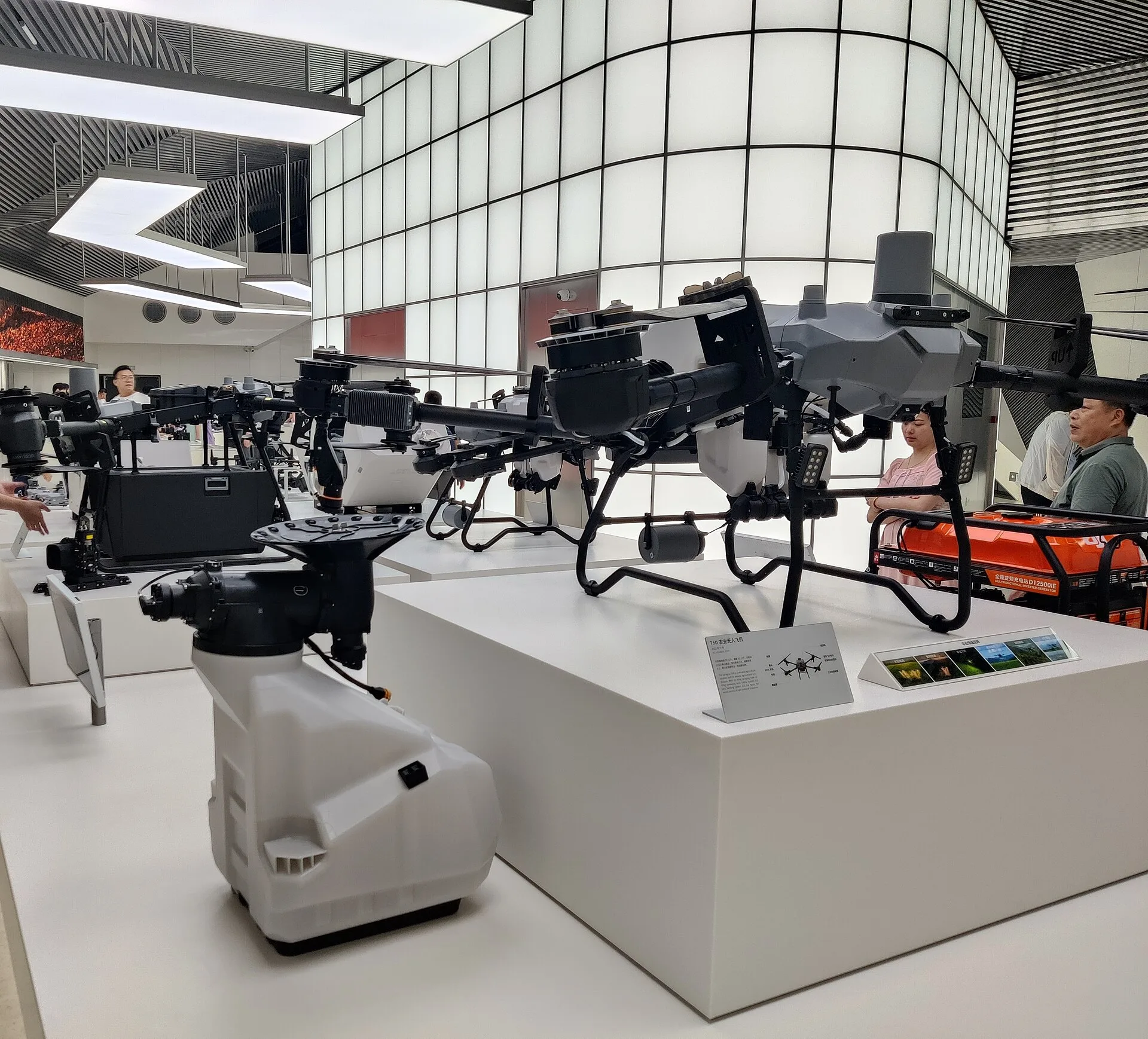

DJI is a useful Shenzhen product story because the object must coordinate several systems at once. A consumer drone needs flight control, motors, batteries, radio links, cameras, stabilisation, software and a body light enough to leave the ground. The finished product makes integration visible.
DJI links that integration to Shenzhen, where it is headquartered. The company says proximity to suppliers, materials and technical talent supports its work. That is a credible statement of company strategy, but it is still a company statement. Shenzhen does not automatically explain DJI’s product quality, and DJI does not represent every Shenzhen manufacturer.
The city claim: location shortens some conversations
DJI’s corporate profile says the company is headquartered in Shenzhen and benefits from direct access to suppliers and talent. A separate company history says it moved from its early Hong Kong start to Shenzhen.
The practical advantage described here is not simply “cheap manufacturing.” When hardware is being revised, distance affects how quickly a team can inspect a part, compare suppliers, change tooling or investigate a failure. A dense regional network can reduce the cost of iteration even when the final production line is not beside the design office.
That mechanism is plausible and consistent with Shenzhen’s broader product geography. It cannot be measured from DJI’s public page alone. The exact suppliers, lead times and engineering decisions for a particular model remain undisclosed unless documented elsewhere.
The product claim: the hard part is coordination
A drone can be divided into impressive specifications: flight time, camera resolution, obstacle sensing, transmission range. Those numbers are useful for comparing models, but they hide trade-offs.
A larger battery may extend nominal flight time while adding mass. Stronger motors may change noise, power demand and thermal behaviour. A better camera becomes less useful if stabilisation or transmission cannot support it. Software can limit or improve the behaviour of the same physical sensors.
The product therefore reveals a form of manufacturing that is closer to systems engineering than to assembling a list of parts. Shenzhen’s relevance lies in the number of conversations that must happen between those parts.
The design claim: usability is also risk control
DJI describes its products as making complex technology easier to use. For a flying object, ease is not only convenience. Interface choices can influence whether a user understands battery state, positioning, return-to-home behaviour and environmental limits.
The existence of a friendly interface does not make flight safe in every setting. Airspace rules, weather, radio conditions, local registration and operator skill remain external to the product. A consumer technology profile should therefore separate three layers:
- What the hardware can do. Model-specific specifications and tested limits.
- What the software permits or warns about. Version- and region-dependent behaviour.
- What the law allows. Rules set by the jurisdiction, not by the manufacturer.
This article does not advise on any of those rules. It identifies why a drone company has to design across them.
Shenzhen is more than a component market
English accounts often jump directly from Huaqiangbei’s counters to a global hardware brand. The missing layer is organisational capability. Buying parts does not create flight-control software, industrial design, testing, customer support or a reliable production process.
Shenzhen’s municipal profile emphasises design institutions as well as technology markets. The older Special Economic Zone history adds the policy and commercial environment in which firms developed. Those layers help explain why the city supports companies rather than only workshops.
The distinction protects against two opposite myths. Shenzhen is not merely a factory floor executing foreign designs. It is also not a magical place where access to parts guarantees a successful product. Integration remains difficult work.
How to read a DJI product without turning it into a national symbol
Use the object at its proper scale:
- identify the exact model and market version;
- separate manufacturer specifications from independent tests;
- distinguish a Shenzhen headquarters from the location of every component or assembly step;
- treat software, account and airspace behaviour as changeable;
- avoid using one company’s success to describe all Chinese manufacturing.
DJI reveals something specific: Shenzhen can support products whose advantage depends on fast coordination across electronics, mechanics and software. That is a stronger and narrower claim than “Shenzhen makes drones.”
Sources and scope
- DJI: About Us — headquarters, product categories and the company’s supplier-access explanation.
- DJI: Shenzhen, From Manufacturing to Design — the company’s account of moving to Shenzhen and its design narrative.
- Shenzhen Government: Urban Civilization Profile — current design institutions and the city’s official design framing.
- World Bank: Shenzhen SEZ as a policy reform incubator — longer policy and urban-development context.
This is a source-checked company profile, not a product review or field test. It makes no market-share, security, safety or regulatory recommendation. Company statements are identified as such.