
The pointed nose of a Fuxing train makes an easy symbol of Chinese high-speed rail. It is also the part of the system a passenger needs to understand least. A useful service appears only when rolling stock, track, power, signalling, stations, maintenance, ticketing and timetables work together.
“Fuxing” names a family rather than one identical train. Different models and configurations serve different speeds and routes. Treating the name as a single specification creates confusion, especially when comparing a train seen at a platform with a new prototype or a service on another line.
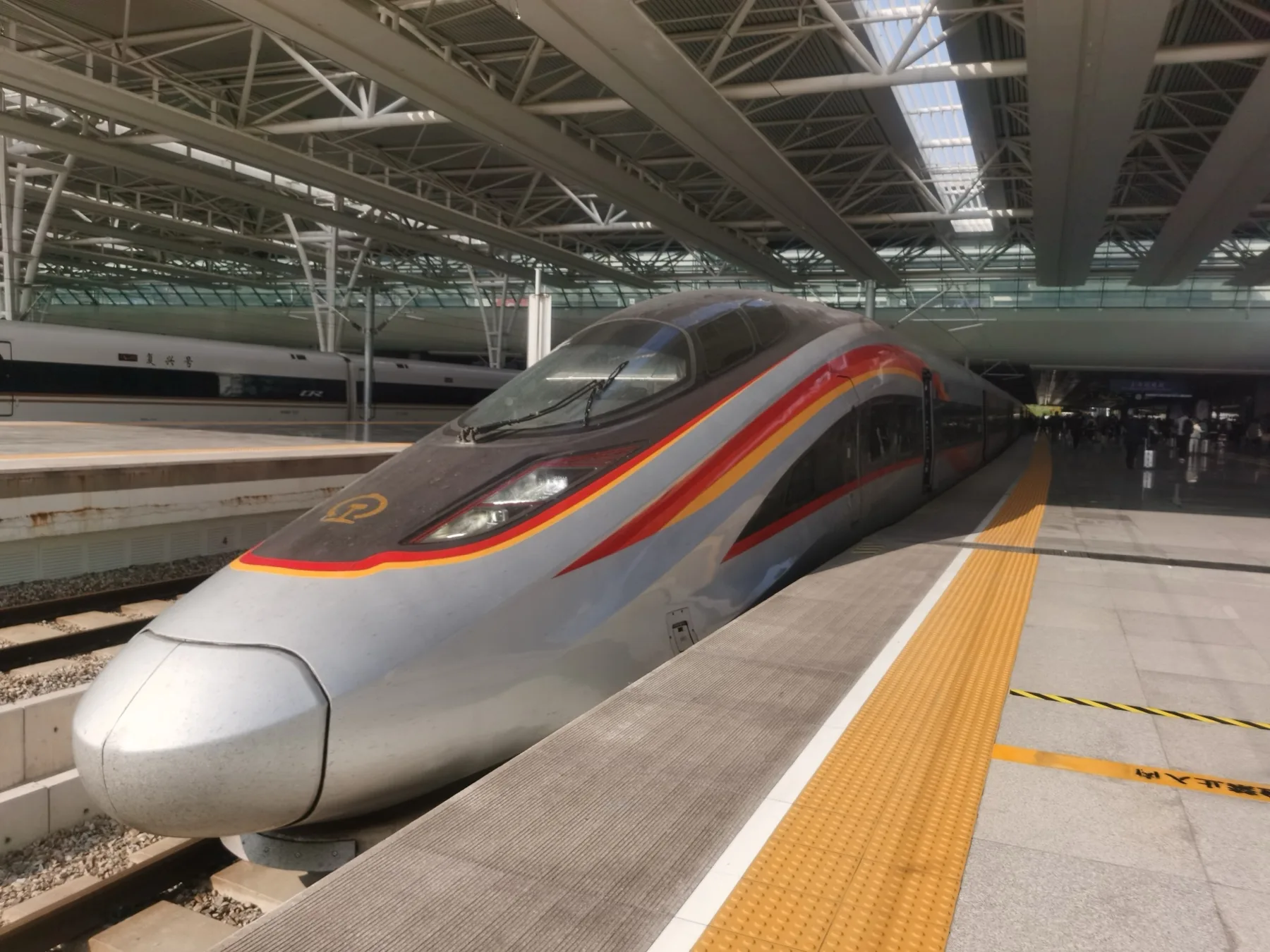
Start with an EMU, not a locomotive pulling coaches
Fuxing passenger trains are electric multiple units: traction equipment is distributed through the trainset rather than concentrated only in a separate locomotive at the front. That arrangement affects acceleration, braking, weight distribution, interior space and maintenance.
The aerodynamic nose matters at high speed, but it is not an engine compartment in the traditional sense. Power collection, converters, motors, braking systems, train control and passenger equipment are spread across a designed formation. Cars are meant to operate as a coordinated unit.
That coordination is one reason a high-speed train is not just ordinary coaches with a faster locomotive. Pressure changes in tunnels, vibration, crosswinds, braking distance, noise and repeated high-speed operation have to be handled across the whole vehicle.
Standardisation is a product decision
The Fuxing programme is associated with Chinese-standard EMUs. “Standard” should not be read as “every train is the same.” It means interfaces, technical requirements and core systems can be organised around a common platform while models and interiors vary.
For manufacturers and operators, standardisation can support procurement, component compatibility, training and maintenance. It also creates a basis for iteration: a new train can change aerodynamics or passenger features without rebuilding every part of the surrounding system from zero.
CRRC’s manufacturing material describes digital production and life-cycle data for delivered trains. Those are company claims, but they identify where the product continues after factory delivery. Reliability depends on inspecting components, monitoring wear, scheduling maintenance and feeding operating information back into engineering.
Useful speed belongs to the network
A vehicle’s maximum speed is not the same as a passenger’s average trip speed. Track geometry, station spacing, signalling, traffic, dwell time and timetable margins determine the service. A train capable of 350 km/h may spend only part of a journey near that speed. A slower service with fewer stops may beat a faster-labelled one over a particular city pair.
The World Bank’s study of China’s high-speed rail stresses the scale of planning, construction and service design around the network. Dedicated lines separate much high-speed passenger traffic from conventional operations. Large stations aggregate demand and connect services, but their location and transfer time can also add friction.
This is why comparing trains by top speed alone is misleading. The more revealing passenger measures are door-to-door time, frequency, reliability, station access and how many city pairs the timetable makes practical.
The station is part of the manufactured experience
On the day of travel, a passenger encounters identity checks, ticket data, security screening, wayfinding, waiting areas, platform gates and boarding. None is physically part of the train, yet each shapes whether the vehicle can carry large flows on schedule.
China Railway’s real-name ticket system connects a traveller’s document to the booking. The station then uses that record in its access process. For a foreign-passport holder, the practical quality of the rail product therefore depends partly on whether document data were entered correctly and whether automated or staffed channels can read it.
The train’s wide body and seating layout matter for comfort. The station’s scale and boarding sequence matter for usable capacity. Product and institution meet at the platform.
A family keeps changing
New Fuxing variants and experimental trains generate headlines about speed, energy use and intelligent systems. A prototype result should not be described as a network-wide passenger service. Testing, certification, route readiness and commercial deployment are separate stages.
Likewise, one manufacturer’s performance figure needs its stated conditions. Aerodynamic savings, energy reductions or automated functions may apply to a particular model and comparison. The safe editorial move is to identify the claimant and avoid turning a design target into a universal fact about every Fuxing train.
Read the product at three scales
At the platform, identify the model and formation rather than stopping at the brand name. During the journey, notice acceleration, tunnel pressure, ride quality, information displays and the effect of station spacing. After arrival, include the station transfer in the time calculation.
Together those observations show what the train really is: a manufactured vehicle nested inside a manufactured network and an operating institution. The nose may carry the image of speed. The less visible interfaces make that speed useful.
Sources and scope
- CRRC: smart production and life-cycle systems for Fuxing trains — manufacturer’s account of production and operating-data systems.
- World Bank: China’s High-Speed Rail Development — independent network, service and development context.
This profile does not claim that every Fuxing model has the same equipment or operating speed. Manufacturer performance statements are not treated as independent certification, and prototype announcements are kept separate from commercial service.