
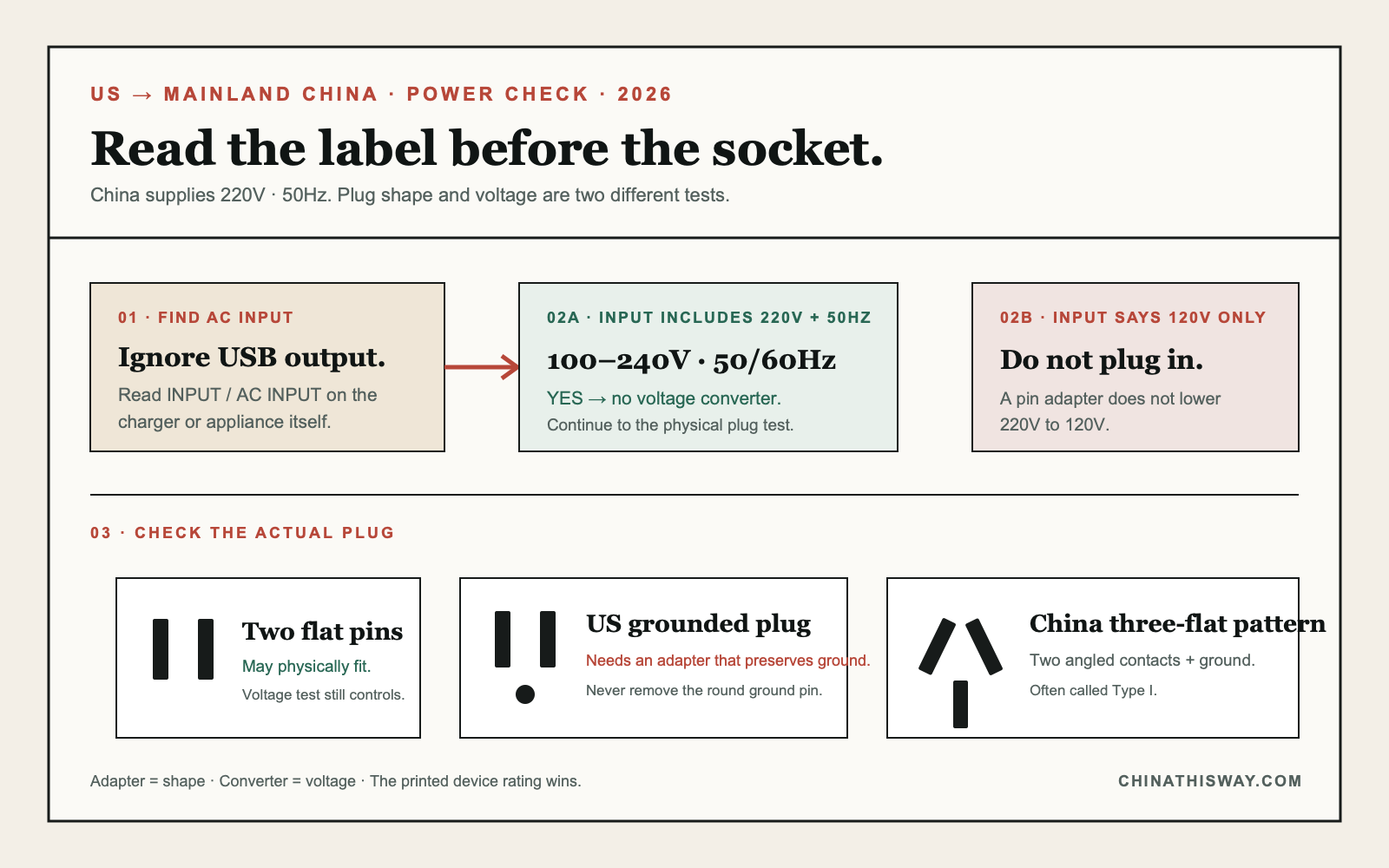
Most U.S. travelers do not need a voltage converter for a phone or laptop charger—but you must read the input label. Mainland China supplies 220V at 50Hz. If the charger says INPUT: 100–240V, 50/60Hz, it already accepts China’s supply; the remaining question is whether its pins fit the socket. If a device says only 120V or 110–120V, do not plug it directly into a 220V outlet just because the pins appear to fit.
An adapter changes the plug shape. A converter changes the voltage. They solve different problems, and a small travel adapter does not make a 120V-only hair dryer safe on 220V.
The answer for common U.S. travel devices
| What you are carrying | What to read on it | Likely requirement in mainland China |
|---|---|---|
| iPhone or iPad USB power adapter | 100–240V, 50–60Hz on the adapter |
no voltage converter; check the plug shape and socket access |
| laptop USB-C charger | the charger’s own AC input range | if it includes 220V and 50Hz, no voltage converter; plug adapter only if the pins do not fit |
| camera-battery charger | the input line on that charger, not the camera battery | follow the printed range; many are wide-voltage, but do not assume |
| two-flat-pin U.S. charger | voltage label plus physical fit | it may fit a two-flat-pin socket, but bring a suitable adapter rather than depending on every room having that opening |
| grounded U.S. three-pin plug | voltage label and the round grounding pin | usually needs a plug adapter that preserves grounding; do not remove or defeat the ground pin |
| U.S. hair dryer, curling iron or shaver | look for 120V only, a dual-voltage switch or a wide input range |
a 120V-only appliance needs a correctly rated voltage-conversion solution or should stay home; hotel-provided alternatives are often simpler |
| CPAP, medical charger or specialized equipment | manufacturer label and manual | confirm voltage, frequency, grounding and power requirements with the manufacturer; do not rely on a generic travel chart |
“Likely” is deliberate. The label on the actual power supply controls. Two products with the same purpose can have different input ranges.
China’s electricity: 220V, 50Hz
China’s official power-supply rules state that nominal low-voltage single-phase supply is 220V and nominal frequency is 50Hz. The Civil Aviation Administration of China gives the same 220V/50Hz figures in its visitor guidance.
That differs from the ordinary U.S. household supply a traveler expects for many portable products. The voltage difference matters even when the metal pins look familiar. Beijing’s official visitor FAQ warns that a device can be damaged if it is not designed for 220V—even when its plug fits the outlet.
Do not turn “made in China” into an electrical specification. A device manufactured in China for the U.S. market can still be labeled for 120V only. Read the input plate.
The 15-second input-label test
Find INPUT, AC INPUT or a line next to the power symbol on the charger or appliance. Use the full range, not the USB output line.
Label says 100–240V, 50/60Hz
China’s 220V/50Hz supply falls inside both ranges. You do not need a voltage converter for that power supply. You may still need a plug-shape adapter.
Apple, for example, states that its USB power adapters are designed for 100V to 240V AC at 50Hz to 60Hz. That supports Apple-branded adapters covered by its documentation; it is not evidence for every third-party charger that looks similar.
Label says 110–240V or another range that includes 220V and 50Hz
The voltage and frequency are within the printed range. Check plug fit, grounding, wattage and the manufacturer’s instructions.
Label says only 110V, 120V or 110–120V
Do not connect it directly to 220V. A passive plug adapter does not lower the voltage. Either leave the appliance at home, use a suitable local/hotel alternative, or obtain a converter specifically rated for that appliance’s voltage and continuous wattage.
You cannot find or read the label
Do not guess from the brand, USB connector or purchase country. Find the model’s manufacturer documentation or replace it with a clearly labeled, reputable wide-voltage charger before departure.
Which plug shapes appear in mainland China?
Official CAAC visitor material describes two common socket patterns:
- two flat parallel contacts, visually familiar to a U.S. two-prong plug;
- three flat contacts, with two angled contacts forming a V and a grounding contact.
Travel references commonly call these Type A and Type I. The name is less useful than the shape. A U.S. ungrounded two-flat-pin plug may physically fit an available two-pin opening. A U.S. grounded Type B plug adds a round grounding pin and does not match the three-flat-contact Chinese pattern.
Real hotels can have a mixture of current Chinese sockets, older fittings, desk modules and multi-standard receptacles. A photo on a booking page cannot guarantee the socket beside your bed. Pack for the official supply and the actual plug on your equipment, not for one hotel-room image.
Adapter versus converter
| Item | Changes | Does not change |
|---|---|---|
| plug adapter | physical pin geometry | voltage, frequency or power demand |
| voltage converter | voltage within its design and rating | plug shape unless built in; frequency; device compatibility |
| USB charger | AC mains to the stated USB output | worldwide-voltage support—read its AC input range |
| power strip | number and placement of outlets | voltage, grounding or hotel circuit capacity |
The words are often mixed in product listings. Ignore the marketing title and read the electrical ratings printed on the device.
The grounded-plug problem U.S. travelers miss
A two-prong U.S. charger is not the same as a three-prong U.S. laptop brick or appliance. If the original product has a grounding pin, choose a solution that keeps the protective earth path intact. Do not cut off the round pin or use an ungrounded “cheater” arrangement simply to make it fit.
Also check the adapter’s voltage and current rating. “Fits China” describes geometry, not whether a tiny accessory is appropriate for a high-wattage heating device. The appliance’s wattage, the converter’s continuous rating and the adapter’s rating all have to agree.
Why hair dryers and curling irons need extra care
Heating appliances consume far more power than a phone charger. Some travel models have a manual dual-voltage switch; others are 120V only. A converter that is adequate for a small electronic charger may be inadequate for a dryer. Frequency can also affect products with motors or timing circuits even when voltage is converted.
The lowest-dependency choice is often to use a hotel-provided dryer or buy/use equipment designed for local supply. If the appliance is essential, use the manufacturer’s stated international-use instructions and a properly rated solution; this page cannot certify a specific converter-appliance pair.
What to pack from the United States
For a normal phone-laptop-camera trip:
- photograph every charger’s input label before packing;
- confirm that each required charger includes 220V and 50Hz in its input range;
- count the actual plug shapes, including grounded plugs;
- carry one reputable adapter compatible with the Chinese socket shapes you may encounter and rated for the intended load;
- avoid stacking loose adapters, overloaded multi-taps and unsupported high-wattage appliances;
- keep one USB cable and compact charger in your carry-on, separate from checked luggage;
- ask the hotel about bedside sockets or a loan adapter if specialized equipment depends on it.
This is a compatibility checklist, not a recommendation to buy the largest “universal” device. A smaller, clearly rated adapter matched to your equipment can be easier to inspect and use.
Mainland China is not every Chinese-speaking destination
This guide is for mainland China. Hong Kong and Macao have different plug systems and should be checked separately. Taiwan also has a different supply context. A multi-stop trip needs a destination-by-destination test; “China adapter” on a retail package can hide those differences.
Questions readers ask next
Do I need a power adapter for China from the USA?
Bring one if you have a grounded U.S. three-pin plug or want a reliable fallback across different rooms. A two-flat-pin U.S. plug may fit a corresponding two-pin opening, but physical fit is only half the test; the device must also accept 220V/50Hz.
Do I need a voltage converter for my iPhone in China?
Apple says its USB power adapters accept 100–240V AC at 50–60Hz, so an Apple adapter covered by that specification does not need a voltage converter on China’s 220V/50Hz supply. Check your actual adapter label, especially for third-party products. Plug fit remains separate.
Will a U.S. laptop charger work in China?
If its input label includes 220V and 50Hz—commonly shown as 100–240V, 50/60Hz—the power supply accepts China’s mains. Check whether its two- or three-pin plug needs a physical adapter and preserve grounding.
Can I use a U.S. hair dryer in China?
Not if it is 120V only and connected through a passive plug adapter. Use a properly rated converter only when the appliance manufacturer permits it, or use a 220V-compatible or hotel-provided dryer.
Does a travel adapter convert 220V to 110V?
Usually no. A basic travel adapter only changes the pin shape. A product that changes voltage must explicitly state its input, output, continuous power rating and limitations.
What plug type does China use?
Mainland visitor guidance describes two flat parallel contacts and a three-flat-contact V-shaped pattern, commonly called Type A and Type I. Do not assume a U.S. Type B round grounding pin fits.
Sources and scope
- NDRC power-supply business rules — official nominal 50Hz frequency and 220V single-phase low-voltage supply.
- CAAC visitor electricity guide — official 220V/50Hz visitor guidance and common socket shapes.
- Beijing pre-departure travel tips — official visitor warning to prepare according to China’s 220V supply and socket image.
- Beijing electricity FAQ — official warning that physical plug fit does not prove 220V compatibility.
- Apple USB power adapter specifications — manufacturer-stated 100–240V, 50–60Hz range for Apple USB power adapters.
Electrical supply and linked guidance were checked on 26 August 2026. Always follow the rating plate and manufacturer instructions on the specific device. This page does not certify a particular adapter, converter, medical device or hotel outlet.