
Calling Weixin a super-app can produce the wrong mental image: one company kept adding buttons until a messaging app became very large. Feature count is not the decisive change. The platform becomes qualitatively different when outside organisations can provide services inside a shared environment of identity, discovery, payment and distribution.
That is why an operating layer is a better description. Weixin does not replace a phone’s operating system, and Tencent does not own every service a user encounters. But Mini Programs and platform interfaces let merchants, public agencies and developers build functions that run within Weixin’s rules.
Messaging supplies repeated attention
Weixin began with communication and still uses social connection as its centre. People return because messages, groups and contacts are persistent needs. Services placed near that habit do not have to persuade the user to open an unrelated app from a home screen.
A link or Mini Program can arrive in a chat, appear in search, open from a QR code or be found through an Official Account. Discovery is therefore distributed across social, physical and platform surfaces.
This does not mean every user “lives inside Weixin” or never uses standalone apps. That phrase hides differences in age, work, region and service category. The more defensible point is that a communication layer can route attention into many other tasks.
Mini Programs change who can build the next screen
A native feature is designed and operated by Tencent. A Mini Program can be supplied by a third party but run within the Weixin environment. Tencent describes Mini Programs covering shopping, dining, travel and public services. Academic work on China’s app economy treats their introduction as a shift that turned WeChat/Weixin into a platform in its own right.
For users, the appeal is lower setup friction. A lightweight service can open without a separate app-store installation. For organisations, the platform provides distribution and technical interfaces. The trade-off is dependence: the service must follow platform rules and may rely on platform identity, payment or traffic.
This is closer to an ecosystem than a folder of shortcuts. The host defines capabilities and governance; third parties supply many of the destinations.
Identity, payment and context reduce repeated setup
Moving among independent apps often means creating accounts, entering payment details and learning a new interface. A platform can let a service request authorised identity information, invoke payment or return the user to the previous context.
That continuity makes small, occasional services viable. A hospital registration tool, museum booking page or restaurant order flow may not deserve permanent space on someone’s phone. Inside a super-app, it can be retrieved when needed and disappear afterward.
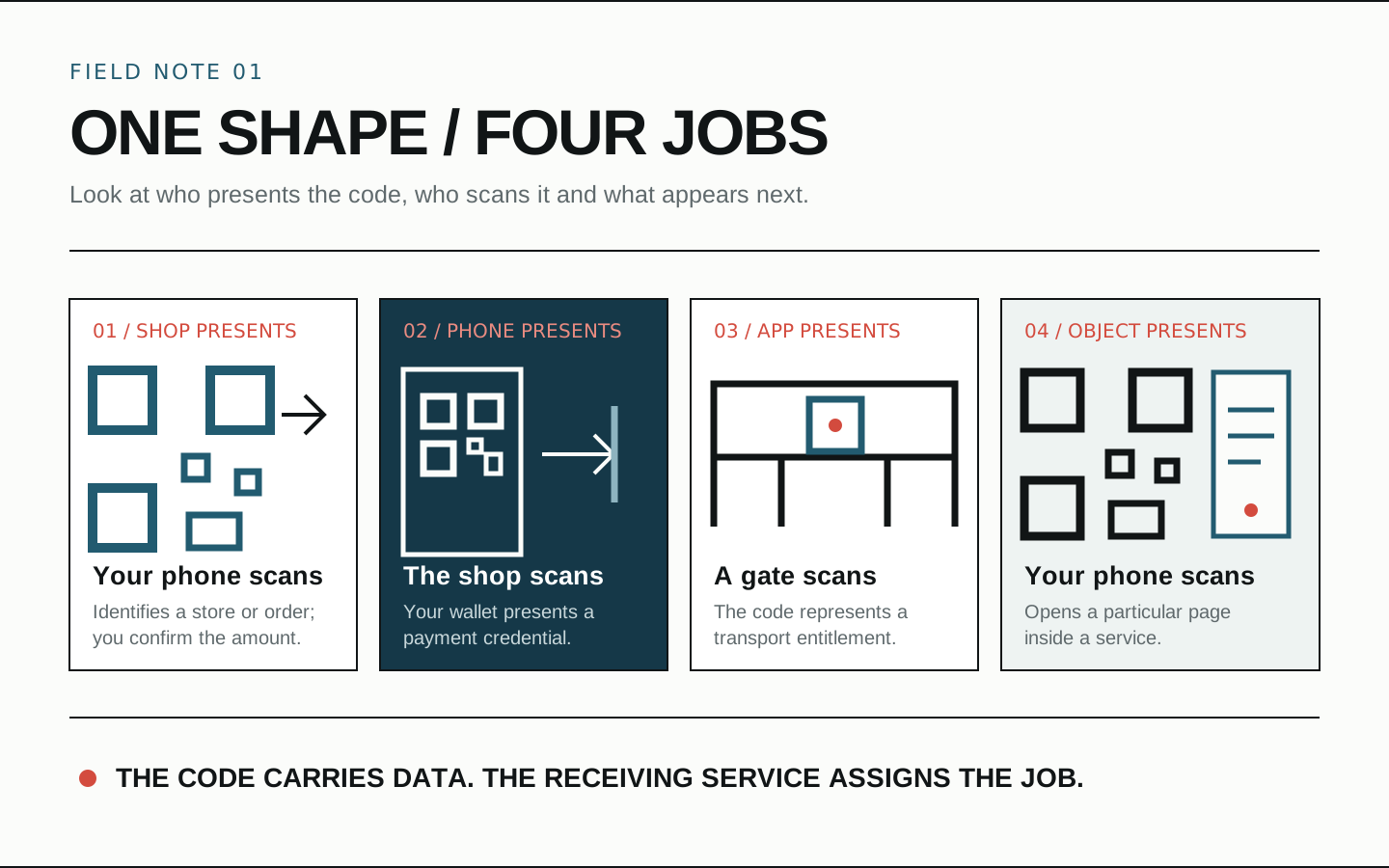
QR codes strengthen the connection to place. A code at a table, counter or machine can open the relevant digital service instead of asking the user to search a global app store. The code is only an address; Weixin supplies the runtime, account context and possible payment route.
Convenience concentrates power
The same integration that removes friction also concentrates governance. The platform decides technical access, review, data rules, ranking and enforcement. A policy change can affect many businesses at once. Developers gain reach but operate on land they do not control.
Users also face privacy and security questions. A Mini Program may be third-party software even when it appears inside a trusted host. Permissions, merchant identity and payment confirmation still matter. Familiar visual surroundings should not be mistaken for one organisation taking responsibility for every transaction.
Academic analysis of super-app and app-store logics focuses on this platform power. The key comparison is not “more features versus fewer.” It is who controls distribution, developer access and the economic relationship between services and users.
Why the model feels different to visitors
A visitor may arrive with a set of specialised apps: messaging, maps, restaurant booking, transit, wallets and tickets. In China, some paths may begin inside Alipay or Weixin, then pass through a Mini Program rather than a recognisable standalone app.
That can make instructions sound vague. “Use Weixin” may mean search for an account, scan a code, open a Mini Program or pay a merchant. Naming the layer matters. Ask which service to open and how it is discovered inside the host.
Foreign accounts, phone numbers and cards can also have different capabilities. A local user’s smooth path is not proof that every visitor has identical access.
The clearest test
An app is not a super-app merely because it offers news, video and shopping tabs. Ask whether third parties can build services within it, whether common identity or payment tools connect those services, and whether users discover them through the host’s social and physical network.
When those pieces reinforce each other, the host begins to act like an operating layer for parts of daily life. Weixin is the strongest Chinese example, but the concept is structural—not a synonym for “Chinese app” and not a guarantee that every integrated service is good.
Sources and scope
- Tencent: Weixin and WeChat product overview — the company’s current feature and ecosystem map.
- New Media & Society: On super apps and app stores — independent analysis of Mini Programs, platformisation and developer relationships.
This article explains platform mechanics, not current access for a specific account. Feature availability, identity checks, payments and Mini Program rules can vary by region and change over time.