
A QR code in a Chinese city is best understood as a hand-off, not as a payment method. One code may identify a shop. Another, displayed on a customer’s phone, may carry a payment credential for a cashier to scan. A transport app can generate a code for a station gate. A Weixin Mini Program code can lead to a particular page inside a service.
The black-and-white pattern is only the carrier. The app that reads it, the service behind that app and the setting around the code determine what happens next.
Scope: Checked on 23 August 2026 against Chinese government visitor guidance and technical documentation from Alipay+, Weixin and DENSO WAVE. This is source-checked, not field-tested. Availability still varies by city, merchant, wallet, card issuer and account status.

The square is not the system
DENSO WAVE, the company that developed the QR Code, describes it as a standardized way to encode data. That technical fact matters because two codes that look almost identical can carry different information and trigger different software.
The most useful question is therefore not “Does China use QR codes for this?” It is: who presents the code, who scans it, and what does the receiving service do with the data?
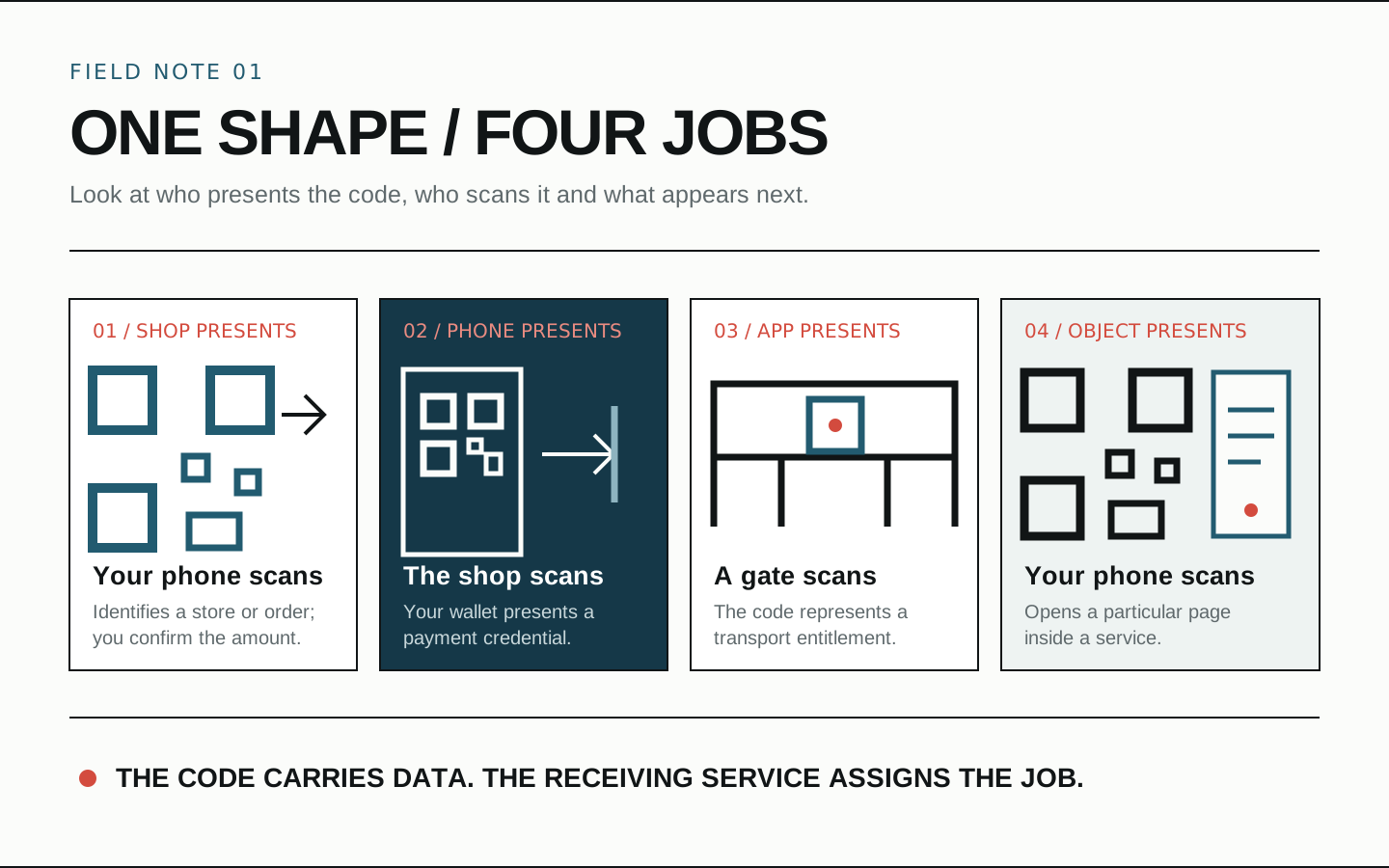
1. The shop presents a code; you scan it
This is the payment scene many visitors first notice: a printed code beside a till, on a counter or on a small stand. Alipay+ calls this merchant-presented mode.
Its technical standard separates two common versions. A store code identifies the merchant; after scanning, the customer enters the amount and confirms it. An order code already carries the order information, including a fixed amount, so the customer checks and confirms rather than typing the price.
This distinction explains why a paper sign can be enough for one seller while another checkout displays a fresh code for each order. The first can act as a durable pointer to a merchant account. The second is tied to a particular transaction.
It also explains part of the format’s physical reach. Alipay+ notes that a printed store code does not require the merchant to install extra scanning hardware. That lowers the equipment threshold for a small counter or self-employed seller. It does not mean every printed code works with every wallet.
2. You present a code; the shop scans it
The direction can reverse. In consumer-presented mode, the customer opens a payment code in a wallet and shows it to the merchant. The merchant’s reader scans the code after the transaction amount has been set.
That is the action in the Beijing photograph above. The picture establishes the direction of the interaction: phone toward merchant reader. It does not establish which wallet was used, whether the transaction succeeded or which funding source sat behind it. Those details are deliberately not inferred from the image.
The two payment directions solve different checkout conditions. A printed merchant code minimizes equipment on the seller’s side. A merchant scanner can make more sense at a staffed checkout where the till already knows the amount. Both use a similar square, but the responsible device and confirmation flow differ.
3. An app presents a travel credential; a gate scans it
A metro or bus code is not simply a shop payment code placed on public transport. China’s 2025 government guide for foreign residents and visitors says that some mobile-payment apps and transport-operator apps generate QR codes for station gates. In its Alipay example, a user selects a city, completes identity verification, obtains a transport code and has it scanned at entry and exit.
The code in this setting represents a travel entitlement inside a fare system. The gate needs to associate an entry and exit with the correct account and fare rules. That is a different job from identifying a merchant or carrying a checkout amount.
The word some is important. The government guide does not promise identical support in every city or app. It also tells travelers to check which payment methods are accepted. A working transport code in one city is not proof that the same setup will work elsewhere.
4. A printed code opens a particular service page
Payment is only one possible destination. Weixin’s official developer documentation says a Mini Program code can be generated for a specified page, and scanning it can take the user directly to that page.
That creates a useful bridge between a physical object and software context. A code can point to the page associated with that place or object instead of asking the user to search through an app from its home screen. The document proves the page-linking mechanism; it does not prove what any particular restaurant, museum, rental service or sign has implemented.
This is why two codes on the same counter may do unrelated work. One can open a service page. Another can initiate payment. Their surroundings and labels are part of the interface.
Why the pattern feels built into the street
QR codes fit many physical settings because the printed symbol is cheap to reproduce, while the software behind it can assign a specific merchant, order, trip or service page. The scan moves a small piece of context from the physical setting into an app. The user does not need to type an account number, search for a venue or manually copy a long link.
The repeated gesture creates visual continuity: point a camera or in-app scanner at a square. Underneath, however, the systems remain separate. Different wallets use different code formats and routing rules. Transport operators set their own eligibility and fare conditions. A Mini Program page belongs to its own service. The surface feels consistent even when the back ends are not.
That gap between a familiar gesture and separate systems is also where visitors can get stuck.
What changes for an overseas visitor
Current Chinese government guidance says foreign users can register supported payment apps, bind eligible overseas cards, scan a merchant’s collection code or show a payment code. The same guidance warns that card verification is handled by the issuer and that supported brands, limits and fees vary between products.
In other words, seeing a familiar code does not guarantee that an unfamiliar account can complete the task. The user may still need the right app, phone number, identity check, wallet region, card network or transport registration.
This is not a problem that official policy treats as finished. In February 2026, eleven Chinese authorities issued guidance calling for remaining digital-service bottlenecks for overseas users to be addressed, with more foreign-language support and better integration of overseas e-wallets.
Nor does the prevalence of mobile payment make cash and cards disappear from the official picture. The same 2025 visitor guide presents bank cards and RMB cash alongside mobile payment. The practical fallback depends on the merchant or transport setting, but “there is a QR code” and “QR is the only permitted route” are not equivalent statements.
How to read the next code you encounter
Before scanning or presenting a code, look for four clues:
- Direction: Are you scanning something fixed, or is a merchant or gate scanning your phone?
- Operator: Which app, wallet, transport company or venue name appears beside the code?
- Result screen: Does the next screen show a merchant and amount, a travel credential, or a service page?
- Confirmation: Before approving a payment, do the merchant name and amount match the physical transaction?
A QR code’s appearance does not reveal the data inside it. That limitation is noted in DENSO WAVE’s own technical FAQ. The safest interpretation comes from the label, the receiving app and the confirmation screen—not from the square alone.
Sources and scope
- Guide to Working and Living in China (2025) — official guidance on mobile payment, overseas cards, payment-code directions, transport codes, cash and bank-card alternatives.
- Alipay+ merchant-presented mode standard — store codes, order codes and customer-scans-merchant flow.
- Alipay+ consumer-presented mode standard — customer-presents-code and merchant-scans-customer flow.
- Weixin Open Docs: Get Mini Program Code — generating a code that opens a specified Mini Program page.
- DENSO WAVE: What is a QR Code? and QR Code FAQ — the symbol’s technical role, limits and trademark statement.
- China promotes digital tourism and payment services for overseas personnel — February 2026 policy direction on remaining access, language and interoperability problems.
This page explains documented mechanisms. It does not measure adoption, rank payment platforms or promise that a particular foreign card, wallet or transport code will work. No transaction was performed for this review.
QR Code is a registered trademark of DENSO WAVE INCORPORATED.