
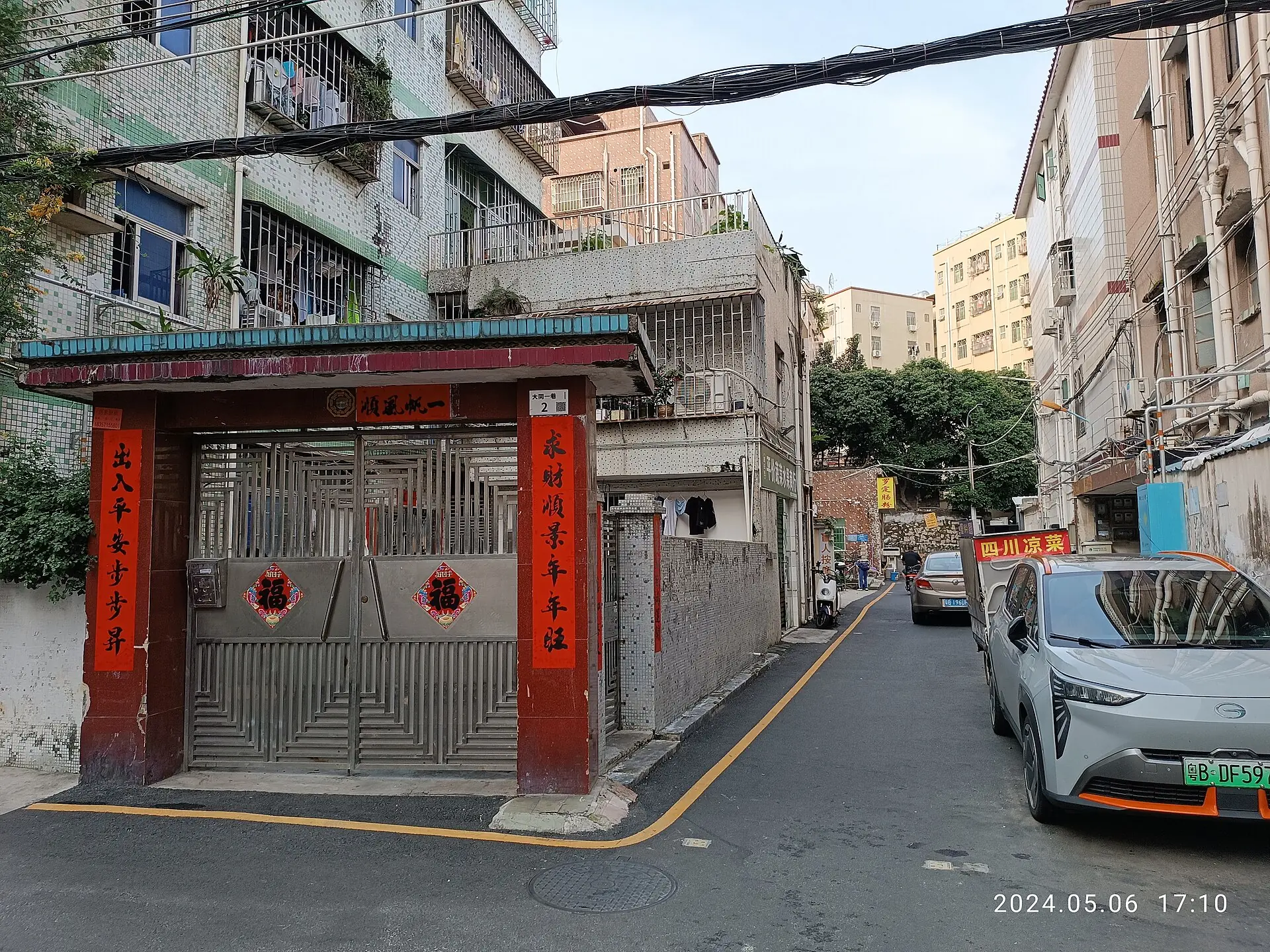

“Urban village” sounds like an aesthetic category: tight lanes, dense mid-rise buildings, signs at street level and towers immediately beyond. In Shenzhen, the term chengzhongcun points first to a historical and institutional condition. Rural settlements and their collective organisations remained as the city expanded around them.
The resulting neighbourhoods became crucial rental and commercial spaces for migrants, while original villagers and village companies retained distinctive interests in land and buildings. Physical density is the visible outcome. The explanation begins with land and urbanisation.
Two land systems met a fast-growing city
China’s land system distinguishes state-owned urban land from collectively owned rural land. As Shenzhen urbanised, development did not proceed across an empty surface. Existing villages had residents, houses, collective assets and forms of local organisation.
Academic research shows how collective land and property rights complicated redevelopment. Legal changes and local policy altered formal ownership, but village collectives and successor shareholding companies continued to matter in the control and income of many properties.
This is why “an old village left inside the city” is only partly right. The agricultural setting may disappear while collective institutions and property relationships continue. The village becomes urban in use and population without becoming institutionally identical to a conventional planned neighbourhood.
Density answered a housing market
Shenzhen’s rapid growth drew workers and entrepreneurs from across China. Formal housing did not meet every income level or employment situation. Village buildings supplied rooms, small shops, workshops and flexible leases close to jobs.
Original village households had strong incentives to add rental floor area. Buildings rose close together on limited plots, producing narrow gaps often called “handshake buildings” because neighbours across an alley can nearly reach one another.
That form can deliver affordability and central access. It can also create weak daylight, ventilation, fire access and public-space conditions. Both are true. Calling every urban village a slum erases its economic role and internal variation; romanticising density erases real safety and infrastructure problems.
The residents are not one community
“Villager” can refer to members of the original collective with inherited rights and shares. Many people living in the neighbourhood may instead be tenants who migrated to Shenzhen and do not hold those collective rights. Landlords, tenants, shopkeepers, village companies and local government therefore experience redevelopment differently.
A compensation agreement that benefits property holders does not automatically protect a low-income tenant. A new development may improve infrastructure while removing inexpensive rooms and informal business space. The question “is redevelopment good?” is incomplete unless it asks good for whom, on what timeline and with what replacement housing.
The neighbourhood also should not be imagined as socially isolated. Residents work across the city; businesses serve both local and outside customers; metro construction and surrounding development change land values. An urban village is embedded in Shenzhen’s labour and transport networks even when its lanes feel distinct from the adjacent planned blocks.
Informal does not mean without rules
Some construction exceeded formal permissions or developed through ambiguous rights. Yet daily life is organised through leases, village companies, local committees, utility arrangements, shop regulations and interpersonal networks. “Informal settlement” describes a relationship to planning and law; it does not mean an absence of institutions.
Research on Shenzhen’s redevelopment shows repeated efforts to redefine property rights and create urban-renewal units involving government, collectives and developers. Negotiation can be slow because land parcels, buildings and claims are fragmented.
This also explains why a village cannot simply be replaced as one object. Redevelopment reorganises ownership, income and social access along with buildings.
Read the edge as well as the lane
When visiting, the most informative point is often where an urban village meets a planned road or new commercial complex. Notice the change in block size, storefront rhythm, building setbacks and public space. Look for multiple entrances and services rather than photographing only the narrowest alley.
Do not use residents as scenery. Dense residential space is not an invitation to point cameras into rooms or doorways. A respectful reading pays attention to infrastructure and public-facing business while recognising that people live and work there.
Why the category still matters
Urban villages helped Shenzhen absorb extraordinary population and economic growth. They supplied housing and entrepreneurial space that formal development did not supply in the same way. Their weaknesses also reflect the costs of rapid urbanisation and unequal access to land, services and secure housing.
The term is useful when it keeps those relationships visible. It becomes misleading when used as a visual label for any dense Chinese neighbourhood. Not every old lane is an urban village, and not every urban village has the same history.
The correct definition is therefore more institutional than picturesque: a previously rural collective settlement transformed by urban expansion, carrying distinctive land, governance and rental relationships into the city around it.
Sources and scope
- Land Use Policy: property rights and urban-village redevelopment in Shenzhen — land institutions, renewal policy and stakeholder relationships.
- Cultural Anthropology: Urban Villages and the Making of Shenzhen — collective organisation, migration, rental economies and city formation.
This article explains a Shenzhen pattern and does not generalise every finding to all Chinese cities. Individual villages differ, and redevelopment status can change rapidly.