
“Douyin makeup” is a loose English label for camera-aware looks shared on and around China’s Douyin platform. To try it without copying somebody else’s face, pick one direction first—lifted eyes, softer skin, a high blush placement, or a blurred lip—then test it in the light where you will actually wear it.
The effect comes from coordination, not a magic product list: controlled skin texture, placed light and shadow, separated lashes, blush, lip edges, and the camera all pull in the same direction. A look that sings under a front-facing ring light can look overdrawn in daylight. Keep the choices that still make sense at conversation distance.
Begin with the screen you are actually seeing
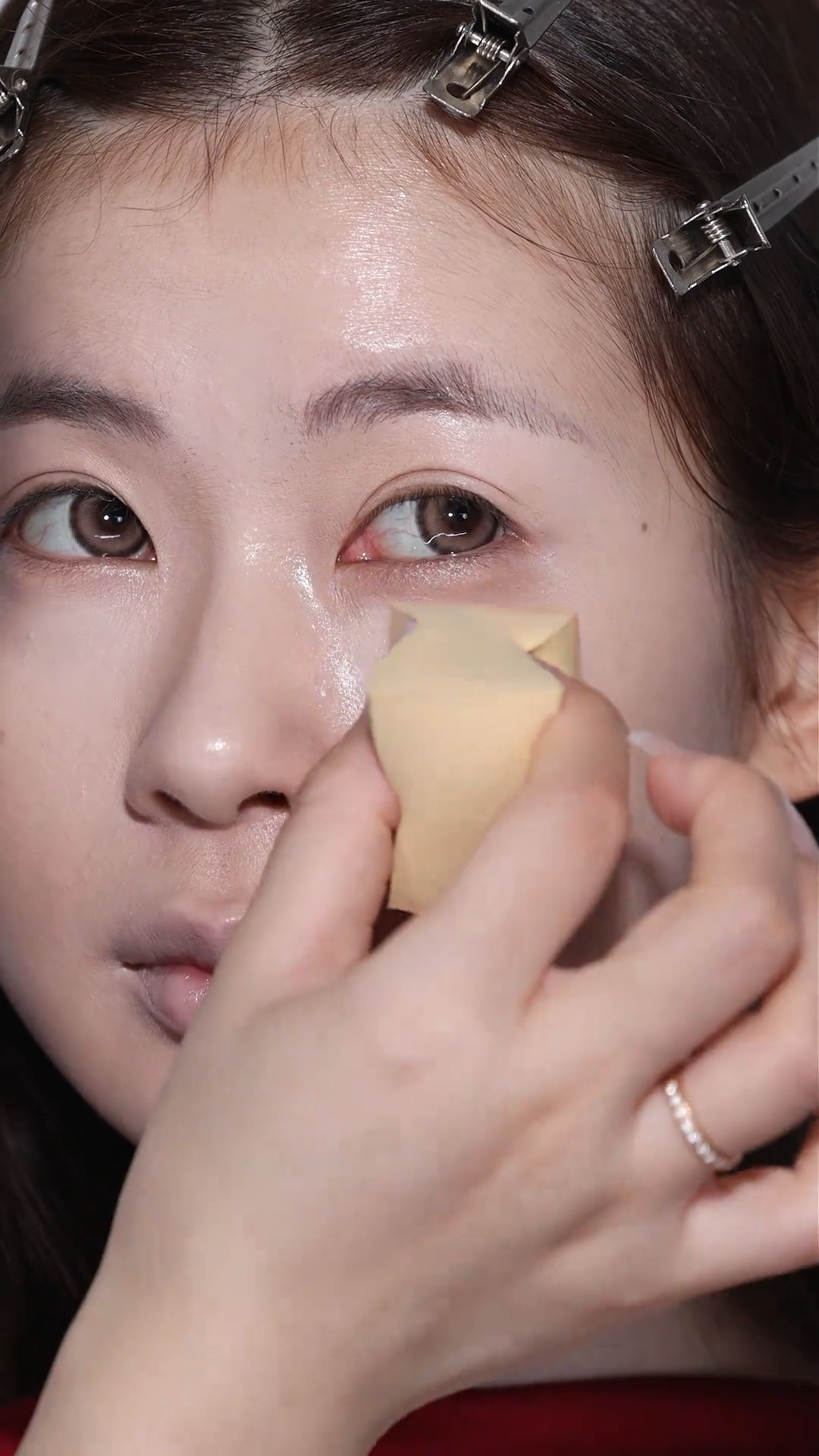
Skin needs control, not erasure
Many widely shared looks reduce random shine and color variation so the eye, blush and lip placements read clearly on a small screen. That does not require an opaque mask. Current creator vocabulary also includes 清透—clear, light or translucent—and 氛围感, the overall atmosphere created by texture, color and light.
For real life, prepare the areas that crease or become oily, then use coverage only where it changes the visual read. A phone’s exposure, smoothing and compression can erase texture that another person will still see at conversation distance.
Light and shadow are designed for one viewpoint
The bright center under the eyes, nose or chin and the darker outer contour are often doing graphic work: creating a readable center, changing apparent proportions and surviving a front-facing lens.
Placement must follow the individual face and light. A copied stripe can look elegant in one three-quarter video and obvious in daylight. Start with a small change, photograph it under the light where it will be worn, and blend the boundary rather than trying to redraw bone structure.
Choose one direction for the eyes
The eye effect may use a fine extended liner, emphasized lower-lash detail, grouped upper lashes, a bright inner area or a shadow that lengthens the outer corner. These are separate controls.
Choose a direction before adding intensity:
- lifted — outer line and lash weight move upward;
- lengthened — line extends laterally with limited vertical weight;
- rounded — central lash and highlight increase vertical openness;
- soft-focus — edges stay diffused and contrast remains low.
Trying to maximize all four can make the eye look crowded rather than atmospheric.
Blush changes the mood before it changes the face
High, lateral blush can connect with the eye area; central blush can feel youthful or flushed; low muted color can make the whole face read calmer. Temperature matters as much as location: peach, rose, mauve and beige-red interact differently with skin, lip and lighting.
The word “youthful” describes a styling effect, not an instruction that adults should look younger. Do not use blush placement to label facial features as defects.
A lip edge can be soft, centered or crisp
Popular examples range from a softly expanded gradient to a small defined cupid’s bow or a darker center. The shared principle is intentional edge control. Concealing the entire natural lip line and painting a tiny shape is one technique, not the category definition.
For wear outside filming, check the lip while speaking and smiling. A gradient that works in a still frame may break at the inner rim, and an overdrawn highlight can look disconnected in side light.
The camera is another cosmetic layer
Ring lights flatten some shadows and create bright eye reflections. Window light reveals texture. A wide front camera can distort features at close distance. White balance shifts blush and lip color; beauty filters can change skin, jaw, eyes and nose after the makeup is finished.
That means an honest tutorial should disclose its conditions. If a creator changes lens, exposure, smoothing or facial geometry, the final frame cannot be attributed to cosmetics alone.
Take one choice off-screen at a time
Treat each screen-first choice as a draft, then test the part that changes when you leave the camera setup:
- Very bright under-eyes survive compression and pull attention toward the center of the face. In ordinary light, lower the contrast and check the blend from the side.
- Separated lash clusters remain legible on a small screen. For a full day, shorten the outer groups or use fewer clusters so the eye still feels comfortable.
- A pale matte base creates a clean graphic field in video. Match your undertone and place coverage only where it helps; changing the apparent color of your skin is not required.
- A narrow nose highlight creates a strong vertical line in a front view. Soften the edge and turn your head before deciding whether it works.
- A blurred, enlarged lip reads as volume in a still image. Speak, smile and check the profile so the painted edge does not separate from the moving lip.
- Heavy smoothing removes texture and can change facial proportions. Count it as post-production, not as a cosmetic step you failed to reproduce.
“Chinese makeup” is not one face or one historical line
Some current Douyin creators use 新中式 (new Chinese style), 玉感 (jade-like), landscape, opera, classical-literature or dynasty references. Others make clean everyday looks, idol-inspired looks, subcultural looks or transformations with no traditional claim.
An ink-dark liner, red lip or jade color does not by itself prove historical reconstruction. Contemporary styling can quote a material, silhouette or mood without reproducing a specific period. The responsible description names the reference and the modern transformation instead of saying “ancient Chinese women did this.”
That distinction also protects the modernity of the scene. Douyin beauty culture is produced through current cameras, editing, cosmetics, creator commerce and young people’s rapid visual experimentation. Tradition is one available language, not a cage around the category.
Adapt the direction, not somebody else’s features
Use features as coordinates, not problems:
- Take an unfiltered front and three-quarter photograph in the light you will use.
- Choose one desired direction—lift, length, roundness, softness, graphic contrast or translucence.
- Change only one layer: eye direction, blush position, lip edge or center light.
- Compare at conversation distance and on camera.
- Keep what works in both contexts; reduce what depends entirely on one angle or filter.
For hooded or monolid eyes, place liner and highlight while the eye is open so the design remains visible in the resting position. For textured or dry skin, prioritize preparation and selective powder. For deeper skin tones, translate contrast and temperature, not the creator’s exact pale color. A “jade” atmosphere could come from controlled luminosity, muted green accessories and a balanced red lip without lightening the complexion.
These are styling options, not corrections.
Four creator examples refuse one universal formula
We reviewed nine signed-out public Douyin or Douyin Jingxuan pages dated from December 2025 through July 2026. Their captions named different moods and problems: new Chinese style, a clear atmosphere, face-specific placement, jade feeling and landscape-inspired color.
The evidence contradicted the one-filter stereotype. Creators were naming different problems and moods: original-camera finish, face-specific placement, muted sculpting and cultural reference. We excluded engagement counts, comments, product claims and platform-wide ranking. This is a small vocabulary window, not a measure of what all Douyin users prefer.
What to keep for an everyday version
Douyin makeup is not the same thing as all Chinese makeup, and it is not “just a filter.” It is a loose outside label for many camera-aware looks. To wear one beyond the screen, keep a single directional eye choice, one intentional blush placement and a lip edge you can maintain while speaking. Match the finish and contrast to your own skin instead of copying a paler foundation shade. If the result looks harsh, reduce under-eye brightness, nose highlight, contour edge or lash density one at a time and check in side light.
“New Chinese style” is a contemporary field that may reinterpret materials, literature, dress or decorative language associated with Chinese tradition. It is not a verified historical face. Name the particular reference when it is known; otherwise describe the modern visual choice you can actually see.
For the content culture around the platform, read what to watch on Douyin. When a clip names a product, keep the creator and original post in view instead of reducing the look to a shopping list.
Sources and scope
- Douyin Jingxuan: new Chinese style demonstration, January 2026 — sampled creator vocabulary, not popularity evidence.
- Douyin: clean atmosphere makeup, March 2026 — sampled current visual language.
- Douyin Jingxuan: adapting placement to face shape, March 2026 — supports the face-specific rather than one-template framing.
- Douyin Jingxuan: jade-inspired makeup, June 2026 — one contemporary named concept, not a historical authority.
What changed, 9 September 2026: the page now begins with an away-from-camera decision and uses one tightly cropped, attributed public tutorial frame instead of an abstract face diagram.
Checked 9 September 2026. This page analyzes visual design and platform vocabulary. It does not measure national popularity, endorse products, diagnose skin, define one Chinese beauty standard or treat a modern styling reference as historical reconstruction.