

The useful question is not whether a garment contains enough “Chinese elements.” It is what the garment asks you to see first—and whether that answer changes when a runway photograph enters a feed.
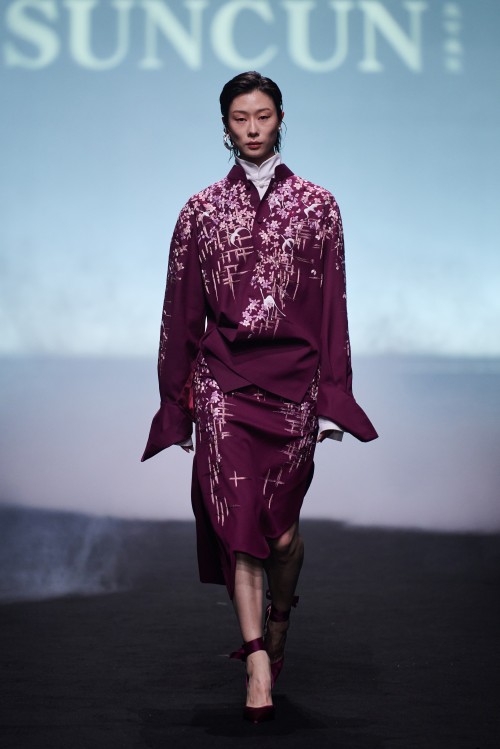
One SUNCUN 三寸盛京 look from Shanghai Fashion Week AW 2026 makes the tension visible. On the body, it is a layered burgundy outfit with a high neckline, wrapped waist, uneven hem and dense surface pattern. In the official image, those decisions are compressed into a frontal, full-length silhouette. The picture makes the garment instantly legible, but it cannot show how the cloth moves, how heavy the embroidery feels or whether the fastening works outside the runway.
Read the outline before the decoration
Cover the patterned surface mentally and the look still has a strong identity. The shoulder is controlled rather than oversized. The torso is pulled inward by a wrapped waist. Below it, layered panels break the hem into several lengths. That outline does more contemporary work than any single motif.
The high neckline may prompt a quick “traditional” reading, but the garment does not behave like a historical reconstruction. Its authority comes from the combination: a long vertical body, an asymmetric wrap and enough open space around the lower legs for the silhouette to remain mobile. Calling it simply a qipao, hanfu or “Tang suit” would erase the actual construction visible in front of us.
This is the first lesson of new Chinese style on screen: the cultural reference may attract the eye, while proportion determines whether the look feels current.
The surface works at two distances
At thumbnail size, burgundy color and pale pattern create one rich field. The eye reads atmosphere before technique. At closer range, the surface separates into floral and calligraphic-looking marks, denser around the torso and carried into the layered lower section.
That two-distance behavior matters in a feed. A garment needs a readable large shape to stop the scroll, then enough material detail to reward a closer image. But the photograph cannot certify what produced the texture. The brand page describes traditional fabrics, embroidery and craft brought into modern life; it does not give this specific photographed look a fiber, stitch or provenance record. We can discuss the visible surface and the brand’s own claim, but not upgrade either into independent proof of craftsmanship.
The camera turns one outfit into a category signal
The official photograph is nearly frontal, with the model isolated against the runway. That angle clarifies symmetry and makes the asymmetric hem easier to compare. It also flattens depth. We cannot see the back, the interior closure, the garment’s weight in motion or how the layered panels behave when seated.
This is where a feed can mislead without containing a false image. A sharply selected runway frame converts a complex object into a category signal: high collar, decorated textile, wrapped line, dark red palette. Once those features become a repeatable visual shorthand, very different garments can be grouped under the same label even when their construction, history and daily use diverge.
The label xin zhongshi—新中式, usually translated as “new Chinese style”—is therefore most useful as an invitation to inspect decisions, not as a checklist.
Daily styling changes the claim
Chinese reporting in 2025 described combinations such as brocade with a hoodie, embroidered outerwear with jeans and a horse-face skirt with a white T-shirt. Those examples do not define the category. They show what changes when a garment leaves the controlled runway image: the cultural reference has to negotiate with commuting, layering, shoes, bags and ordinary fabric.
The SUNCUN look solves that problem as a complete runway composition. A daily wearer would have to decide which part carries the idea. Keeping the wrapped upper layer while simplifying the lower half would preserve the silhouette. Keeping the patterned textile while removing other decorative signals would make the surface the focus. Copying every visible feature at once would reproduce the styling, not necessarily understand it.
That distinction gives an American reader something a definition cannot: a way to separate the garment’s visual logic from a retailer’s category label.
A second runway object shows the category can move
People’s Daily’s report on Shanghai Fashion Week SS 2026 identifies Yijia’s “Huayan Xinyun” presentation as embroidering firework-and-flower imagery onto pale clothing and adding small crystal beads. This is a different design operation from SUNCUN’s dark, layered density. One uses contrast, wrap and a richly patterned field; the other, as described in the report, places a concentrated image and reflective detail onto a quieter ground.
The comparison is deliberately narrow. It shows that “new Chinese style” does not require one color, silhouette or amount of ornament. What persists is the act of translating a cultural or material reference into a current garment and a current image system.
Four checks for the next image you see
First, name the physical decision: silhouette, fastening, textile, surface work or styling. “Chinese-looking” is not precise enough. Second, name the camera decision: front view, close crop, motion, lighting or background contrast. Third, mark what the image cannot verify, such as fabric content, handwork, comfort, back construction or historical lineage. Finally, ask whether another outfit using a different color and shape could still make a comparable design move.
That sequence prevents two common errors. It avoids treating every standing collar as the same historical garment, and it avoids treating a beautiful feed image as proof of quality. It also keeps contemporary Chinese fashion in the present tense: designers are making choices for bodies, runways, retail and screens at the same time.
Sources and scope
The garment reading is based on one identified SUNCUN AW 2026 runway image and the brand description published by Shanghai Fashion Week. The wider context comes from Shanghai’s official fashion-week material, dated Chinese reporting on daily combinations and a People’s Daily report identifying a separate SS 2026 presentation. The page does not authenticate historical reconstruction, certify materials or recommend a purchase.