
Luo Tianyi is a virtual singer, but the music around her is made by identifiable people. A composer writes the song. A tuning artist shapes a voicebank into phrasing. Illustrators and animators give the performance a body. Musicians, stage designers and fans carry the work into its next version.
That chain is more interesting than asking whether she is “real.” Start with a song that returned to the stage years after it first circulated.
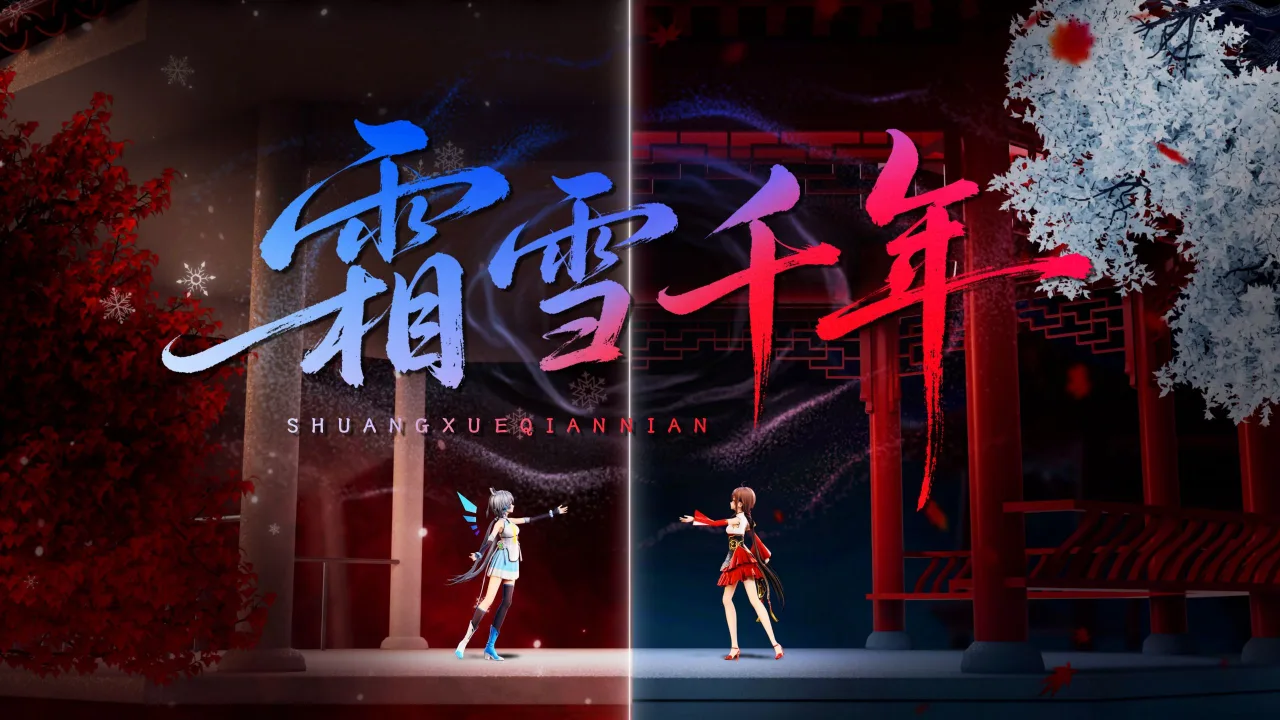
The character is stable; the performance is not
Vsinger gives Luo Tianyi a recognizable design, colour, age, voice source and fictional personality. Those details make one song visually continuous with another. They do not write the songs.
The voicebank works more like an instrument with a face. Different producers can give it different melodies, diction, breath, emotion and genre. The same character can therefore hold work by many creators without pretending that one fictional biography caused all of it.
For a newcomer, credits are the best map. Look beyond the singer line for composition, lyrics, tuning, arrangement, illustration and video. They show which parts of the performance changed hands.
One song can keep accumulating versions
《霜雪千年》 is useful because the 2026 concert does not present it as a disposable new release. It returns as shared memory. The official post frames the duet as meeting an old friend again, while the new arrangement places that memory inside a current live production.
The virtual characters remain visually young. The audience and production history do not. That contrast lets a song gather years without requiring its performer to age in the usual celebrity narrative.
A new performance can change scale, instrumentation, animation, costume and staging while keeping the synthetic voice and character relationship recognizable. Fans are not only following “what happens next” to a fictional person. They are following what new makers can do with a known voice.
Tuning is performance
Typing lyrics into singing software does not produce a finished vocal interpretation. A tuning artist decides timing, pitch movement, consonant placement, dynamics and transitions between notes. Those decisions can make the same voicebank sound restrained, bright, theatrical or intimate.
This is the layer most likely to disappear in a simple “AI singer” description. Luo Tianyi predates the current wave of generative performers, and an official credit such as “作词/作曲/调校” separates writing, composition and vocal tuning rather than hiding them inside the character.
The result may be synthetic, but it is not authorless.
The audience helps a work continue without owning every part
Fans translate, illustrate, cover, dance to and discuss songs. Some create entirely new works with an available voice product or under a character-use framework. Others simply preserve a song by asking for it at a concert and recognizing its first notes years later.
Those forms of participation are not interchangeable. An official stage performance, a fan cover and an unauthorized repost have different sources and rights. “Community-made” should not erase the people credited on a particular work.
The useful cultural point is narrower: a virtual singer makes continuity portable. The recognizable character can connect works produced by different human teams, and the audience learns to read the credits as part of that world.
How to enter the music without learning all the lore
Watch the 2026 performance once for the song. Then reopen its description and follow one credit:
- search the composer or tuning artist for another song;
- compare an earlier performance with the current arrangement;
- follow Yuezheng Ling’s part to hear how the duet changes the vocal colour;
- look for an official upload before a repost, because descriptions often preserve the complete team.
This route moves outward through works rather than inward through a character encyclopedia. You do not need every birthday, colour code or fictional relationship before the music can matter.
What to watch next
Start with 《霜雪千年》 at the 2026 Hangzhou concert. Then use the official Vsinger character and work page to choose a second song with a different production team. Compare the tuning and arrangement before comparing the character art.
Sources and scope
- Luo Tianyi and Yuezheng Ling perform 《霜雪千年》 — official performance, date and named song-production credits.
- Vsinger virtual singers — official character identity, voice-source and work routes.
This is a reading of one official performance and the production model visible in its credits. It is not a complete history of Chinese vocal synthesis, a ranking of producers or a claim that every fan work is licensed by Vsinger.