


Black Myth: Wukong does not place an old story inside a modern graphics engine and leave it unchanged. It selects, recombines and invents.
That distinction matters. A viewer can recognise Sun Wukong, a staff, Buddhist sculpture or a timber hall and still misunderstand what the game is doing. The useful question is not “Which part is authentically Chinese?” It is: what moved from literature, built heritage and decorative craft into the game, and what changed during that movement?
Start with adaptation, not summary
The game’s official description says it is rooted in Chinese mythology and based on Journey to the West. “Based on” is doing important work.
The sixteenth-century novel is already a layered work: pilgrimage, comedy, danger, religious imagination and social satire occupy the same journey. The game does not reproduce that journey chapter by chapter. It creates a darker action role-playing structure, gives the player the Destined One rather than simply handing over the novel’s Monkey King, and reorganises familiar figures around combat, exploration and player discovery.
So the game is an entry into a long afterlife of the novel—not a replacement for reading it and not a definitive visual edition.
Architecture works as a grammar
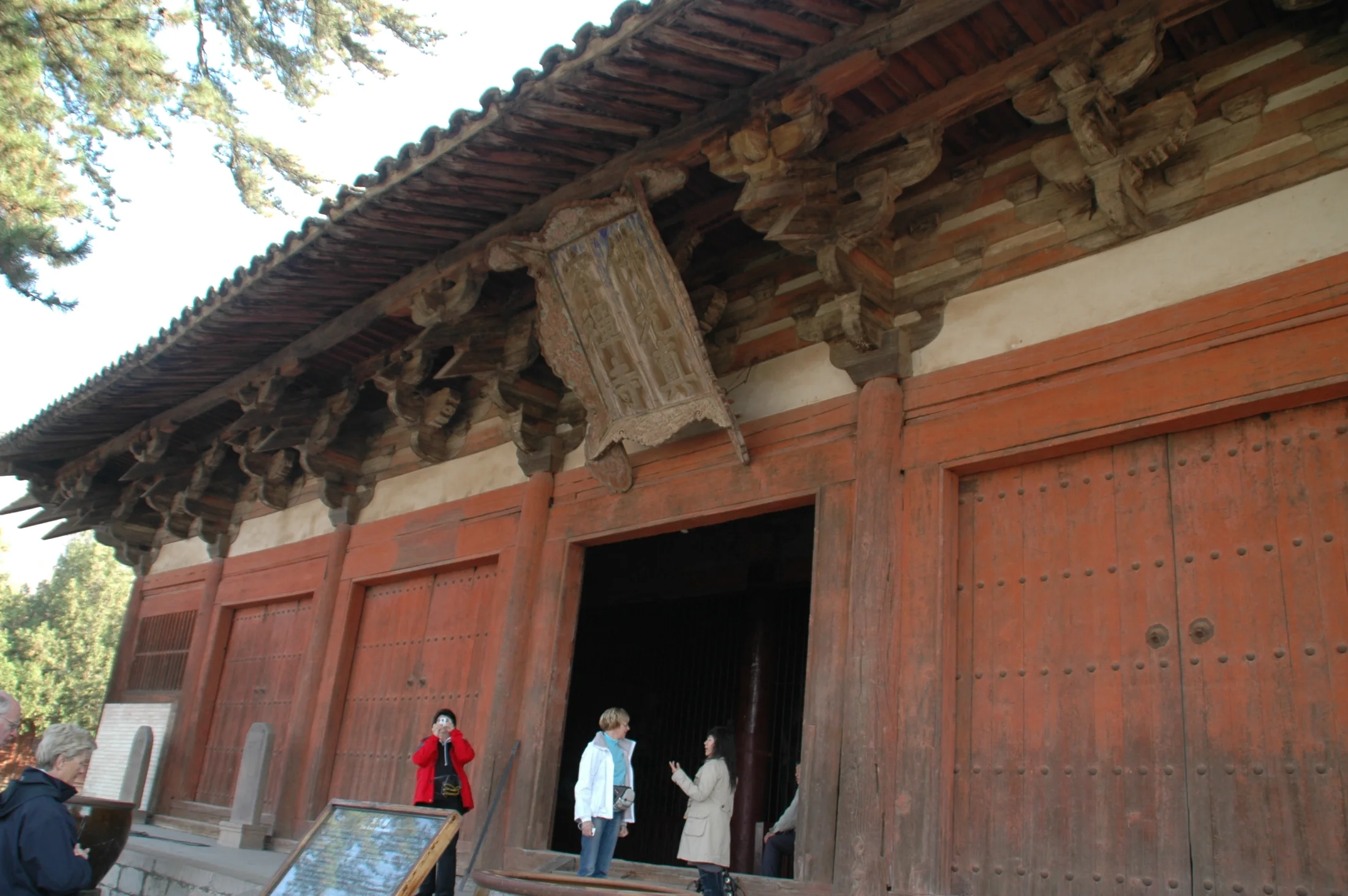
The release trailer moves through courtyards, caves, statue-filled interiors, roof structures and weathered surfaces. Those spaces feel specific because they use relationships familiar from real sites: a hall raised on a platform; deep eaves supported by bracket sets; painted or modelled figures filling an interior; a route compressed between rock and architecture.
Real buildings help a viewer read that grammar, but the location hunt can become misleading. Foguang Temple at Mount Wutai, for example, is a living heritage site with an exceptional timber hall and a much longer religious and architectural history. UNESCO’s Mount Wutai record describes the wider sacred landscape and its monasteries. The photograph here supplies architectural context; it is not presented as proof that this exact facade appears in a particular level.
That boundary protects both sides. The game can combine and exaggerate references to make a playable world. The heritage site should not be flattened into “the place from a game.”
A costume is evidence of another translation
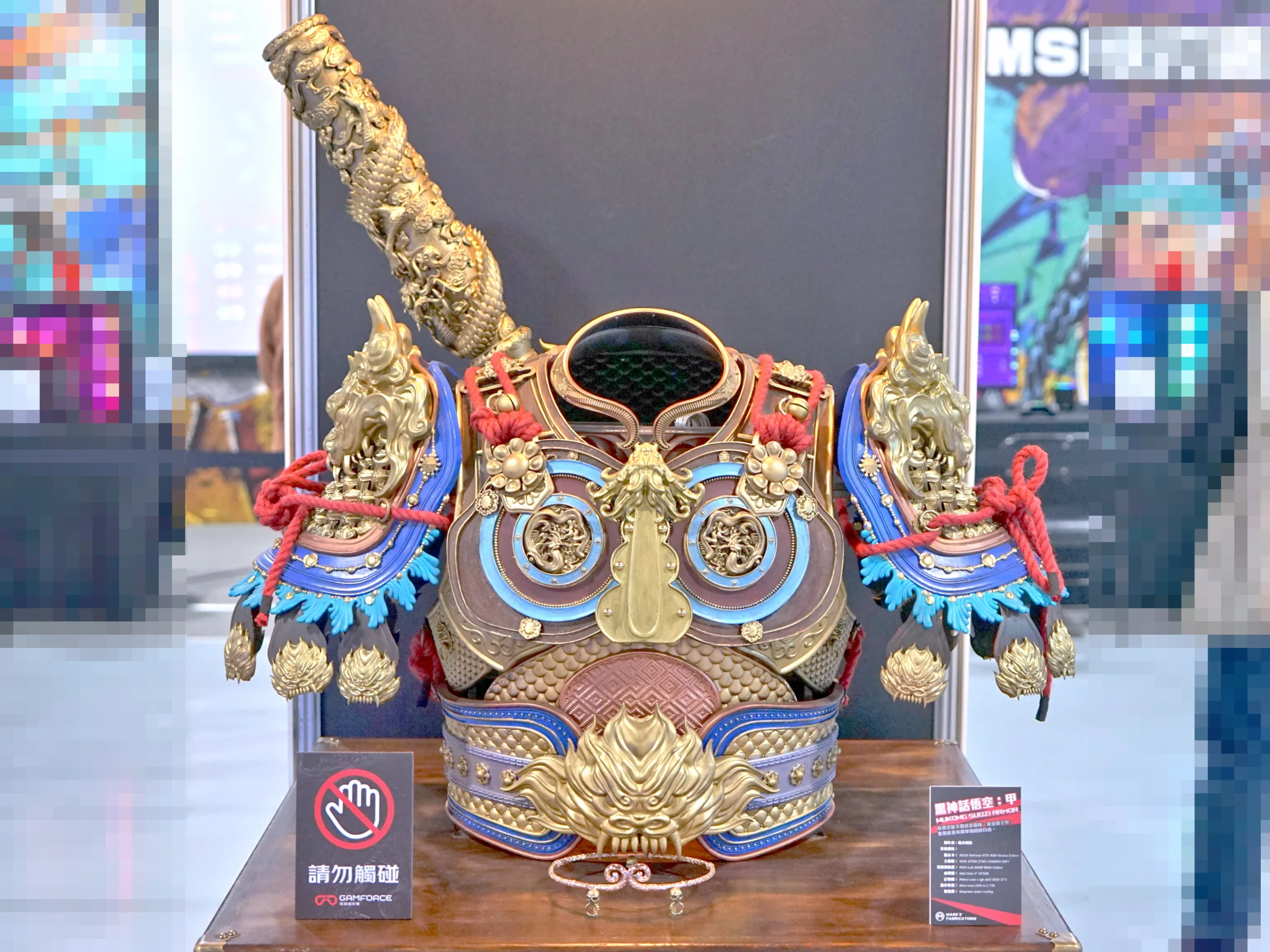
The displayed Suozi armour is not ancient armour pulled unchanged from a tomb. It is a contemporary object made after a digital costume.
Look at the work it performs: layered plates have to hold their shape outside the screen; sculpted animal and floral motifs have to survive close inspection; colour, cord and metal-like surfaces must remain readable under convention lighting. A game asset designed for animation becomes weight, joins, paint and assembly.
This is where “traditional culture” becomes too blunt a label. The object combines references associated with Wukong, the game’s own art direction, current fabrication techniques and the expectations of a gaming audience. Treating it as a historical replica would erase most of that design work.
The global route is visible in use
The game’s route outward is not only a sales chart. Its Steam, PlayStation and Xbox presence places a Hangzhou-developed title inside global platform systems. Players then move it again through guides, fan art, costume construction, streaming, criticism and convention performance.
That circulation can be seen without pretending every response is the same. Some players arrive through Journey to the West. Others first encounter the story through a boss fight or trailer. A cosplayer may study the digital armour more closely than the plot. A visitor may later recognise a bracket set or temple hall without knowing its date or religious use.
Each route produces a different kind of knowledge. None is complete by itself.
What the success story can hide
Reuters’ launch reporting documented the game’s unusually large early audience and its cultural-tourism effect. Those facts matter, but they can encourage two shortcuts:
- one hit does not describe the whole Chinese game industry;
- interest in a game location does not automatically become careful understanding of a heritage site.
The stronger story is narrower. A Chinese studio built a globally distributed, technically ambitious work from materials that overseas audiences were not expected to already understand. It did not translate everything into a lecture. It allowed architecture, costume, sound and encounter design to carry meaning—then left players to notice, miss, research and reinterpret.
That is contemporary cultural production: not the preservation of an untouched symbol, but the creation of a new work that remains answerable to where its materials came from.
A three-step way to read the game
- Name the medium. A novel, temple, game environment, replica armour and convention costume do different jobs.
- Find the relationship. Ask what changed in scale, material, sequence or function when a reference moved.
- Return to the source. If a building or story catches your attention, use a heritage or literary source before repeating a location-list claim.
This keeps curiosity open without turning the game into either a museum label or a national symbol.
Game Science’s next Black Myth project shifts to another figure with a very different visual history. Our companion explainer, Who Is Zhong Kui in Black Myth?, separates the new footage from older demon-queller imagery and unconfirmed fan theories.
Questions readers ask next
Do I need to have read Journey to the West before playing?
No. The game supplies its own immediate story and visual cues, but knowing the earlier characters, places and transformations reveals more of what is being adapted rather than merely displayed.
Is every location in the game a direct copy of one real building?
No. The visual language draws from documented architecture, sculpture and landscape, while the game recombines them for play. A resemblance is not proof of a one-to-one source.
Sources and scope
- Game Science: Black Myth: Wukong official site — developer framing and official audiovisual material.
- Steam: Black Myth: Wukong — current product description, developer, publisher and PC release context.
- Reuters: launch, audience and cultural-tourism response — dated independent reporting, not a permanent audience count.
- Xbox: Black Myth: Wukong — current Xbox availability and product scope.
- UNESCO: Mount Wutai — heritage context for the sacred landscape and monasteries, not a game-location confirmation.
Platform availability, editions and official descriptions can change. The architectural reading is limited to visible relationships and named heritage context; it does not claim that every photographed site is a one-to-one game asset.
Choose the next layer
Watch the official trailer once for action, then a second time with the sound low. Pause on transitions between exterior, threshold and interior. The world becomes easier to read when architecture stops being background.