Black Myth: Zhong Kui is interesting because Game Science has chosen a hero whose world is stranger than “a man who kills demons.” In Chinese art, Zhong Kui can be hunter, judge, protector and commander of unruly supernatural attendants. That gives the studio room to build combat around authority and ambiguity—not merely replace Sun Wukong with another famous face.
The official 15-minute gameplay above shows a project in motion, but Game Science says its early footage is still experimental. Watch it for movement, spaces, creature design and the relationships staged inside a fight. Do not treat every recognizable symbol as a solved plot clue.
A hero defined by his job, not one fixed journey
Sun Wukong arrives with a famous journey, companions and a recognizable narrative spine. Zhong Kui travels differently. Images and stories emphasize what he does—subduing, judging, commanding or warding off harmful forces—more consistently than one universally fixed adventure.
For a game designer, that looseness is useful. A demon beside Zhong Kui need not be a disposable enemy. It can be captive, servant, comic companion, subject or threat. A doorway can be more than scenery because Zhong Kui’s image has served a protective function at thresholds. None of this predicts the game’s systems; it explains why the source material offers more relationships than a simple boss ladder.
Watch who commands the scene
The gameplay’s value is not that it proves a release date. It lets us see Game Science testing weight, scale, architectural movement and encounters in which identity is not immediately obvious. The most useful second viewing asks three questions: who appears to command the scene, which creatures behave as participants rather than targets, and how spaces frame protection, intrusion or judgment.
That method keeps interpretation alive without turning it into fake news. The visual parallels below are ways of seeing, not a leaked design document.
The demon-queller is also a protector
Zhong Kui is best understood as a demon-queller and protective figure whose image has travelled through Chinese stories, paintings, household customs and popular entertainment. Game Science has made him the title figure of its new game, but that firm identification is not yet a plot synopsis.
The official site and the new 15-minute gameplay trailer establish the project and its current visual direction. They do not settle the release date, the final story, or whether every prominent human figure in the footage is Zhong Kui. Older art can help us recognise the cultural material around the title, but it cannot be used as a leaked script.
Keep the game and the older stories in view together
The developer’s own page calls Black Myth: Zhong Kui the second Black Myth title and a standard single-player action role-playing game based in Chinese mythology. It says the project keeps the previous title’s business model, while pursuing a different character and new ideas in gameplay, world and narrative design. The official gameplay upload shows a work in production rather than a finished product specification.
For now, three layers should stay separate:
- Confirmed project facts: the title, developer, broad genre and official footage.
- Visible details: figures, spaces, creatures, movement and combat shown on screen.
- Interpretation: guesses about identity, plot, symbolism, release timing and how a scene may adapt an older story.
Search results and social feeds collapse those layers quickly. A character resembles a familiar image, a theory becomes a headline, and the headline is repeated as fact. This page keeps the labels attached.
No single biography explains every Zhong Kui
There is no single short “canon biography” that explains every Zhong Kui image. The Met traces the tale back to the Tang dynasty but presents the familiar account as a tradition, not a modern identity card with one authorised version.
What is safer to follow is function. The Met names him a demon-queller and shows him commanding a crowded supernatural group. The Palace Museum documents his image being hung in a seasonal household setting. Even those two objects of evidence already make “Chinese demon hunter” too narrow: Zhong Kui can confront harmful forces, command demons and protect a threshold. The role is larger than one weapon or adventure plot.
The demons around him are not a queue of bosses
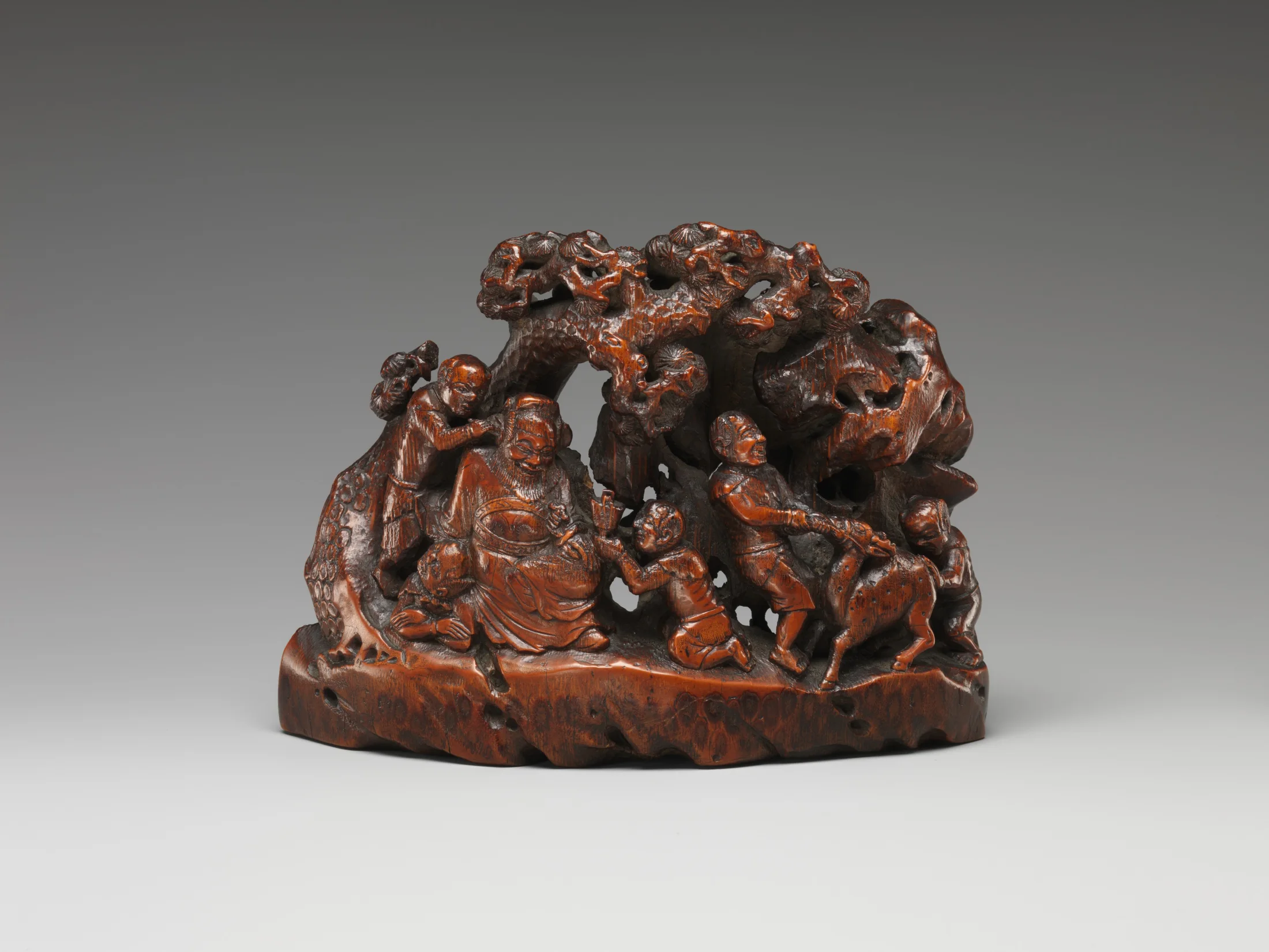
The Metropolitan Museum of Art’s bamboo carving Demon queller Zhong Kui with demons, made in China in the late seventeenth or early eighteenth century, complicates the easiest reading.
Zhong Kui sits at the centre. Smaller demon figures crowd around him, but they are not arranged as a row of interchangeable enemies waiting to be defeated. Some attend him and present objects. The scene communicates hierarchy, command and an unruly supernatural court.
This matters when watching a game trailer. A demon beside Zhong Kui is not automatically a boss, ally or victim. Historical images allow all kinds of relationships: capture, discipline, service, procession and comic disorder. The museum object opens those possibilities; it confirms none of them for the game.
A fierce face can guard a household
A protector is most useful at a threshold. Images of Zhong Kui have therefore circulated not only as gallery art but as objects used around homes and seasonal observances.
The Palace Museum’s account of the Duanwu Festival includes hanging Zhong Kui images among the associated customs. Read that precisely: it documents a cultural practice, not a survey proving that every Chinese family follows it now. China is too large, and present-day family life too varied, for that shortcut.
The custom does explain something more durable. Zhong Kui’s image can perform a job. It marks a wish to keep disorder, illness or malign forces outside a protected space. A game can draw on that protective force without retelling a festival custom scene by scene.
What remains open in the 2026 footage
The current footage generates several obvious questions. The available official material reviewed for this page does not yet provide firm answers to them:
- Who exactly is playable? A title character does not prove that every shown player-controlled figure is that character.
- What is the final story? A sequence built for a gameplay reveal is not a complete narrative outline.
- When will it release? Game Science says it does not have even a rough date. Treat dates without a direct studio announcement as speculation.
- Which storefronts and consoles are final? PC and mainstream consoles are the current plan. Steam, Epic, PlayStation and Xbox should not be marked confirmed until Game Science names them for this title.
- Does an old legend identify a boss or ending? Cultural resemblance is a clue for interpretation, not production documentation.
Those unknowns are not empty space to fill with release-date guesses. They are what make the footage worth revisiting: Game Science has shown enough of a relationship between human, demon and protected space to invite interpretation, but not enough to reduce the game to a solved wiki entry.
A second viewing changes the question
On a first viewing, watch the action. On a second, sort your notes into three columns.
What is visibly there? Record only what the frame supports: clothing, posture, architecture, objects, creature design and the direction of an encounter.
What has an older visual parallel? Compare the image with a museum object or a named text, and keep the date and medium attached. A Qing-dynasty bamboo group is not an all-purpose diagram of ancient China.
What are you inferring? Name the theory as a theory. This is where the interesting discussion belongs, as long as the label survives.
That method is slower than decoding every frame into lore. It is also more rewarding: the game remains a new creative work, while the older material keeps its own history.
The Wukong connection is creative, not genealogical
They now share a game series, not a source story.
Sun Wukong is a central figure in Journey to the West. Zhong Kui comes from a different body of folklore and protective imagery. Game Science can place both inside the Black Myth identity without pretending that Zhong Kui is a missing Journey to the West character.
The connection worth following is creative rather than genealogical. Black Myth: Wukong translated literature, architecture and craft into a contemporary game. Zhong Kui gives the studio a different cultural archive: household images, demon processions, official robes, fierce faces and the unstable line between monster and attendant.
What is known without flattening the mystery
Game Science calls this the second Black Myth title and a single-player action RPG. The August 2026 upload is presented as gameplay, distinct from the earlier CG reveal. The studio names PC and mainstream consoles in broad terms, but it has not announced a date or individual storefronts. Zhong Kui is the title figure, yet the footage does not identify every human-looking figure or provide a complete playable-character explanation.
Calling the game a plot sequel to Wukong would go beyond that record. Zhong Kui does not come from Journey to the West; the connection is Game Science’s contemporary series and its decision to build another game from a very different Chinese cultural archive.
Sources and scope
- Game Science: Black Myth: Zhong Kui official site — title, developer and broad project framing.
- Black Myth / Game Science: official 15-minute gameplay trailer — current visual evidence; not a release-date or final-plot source.
- The Metropolitan Museum of Art: Demon queller Zhong Kui with demons — dated object, public-domain image and museum description.
- The Palace Museum: Duanwu Festival — one museum account documenting the custom of hanging Zhong Kui images.
This article deliberately excludes release-date predictions, frame-by-frame plot claims and unattributed folklore summaries. It will be checked again as Game Science publishes firmer project information.