
Yes. You can use renminbi cash in China. A national cash-payment regulation effective February 1, 2026 says that businesses and fee-collecting organizations generally may not refuse cash or discriminate against it, except where law or regulation requires a non-cash method. For an ordinary face-to-face purchase, “China is cashless” is not an accurate rule.
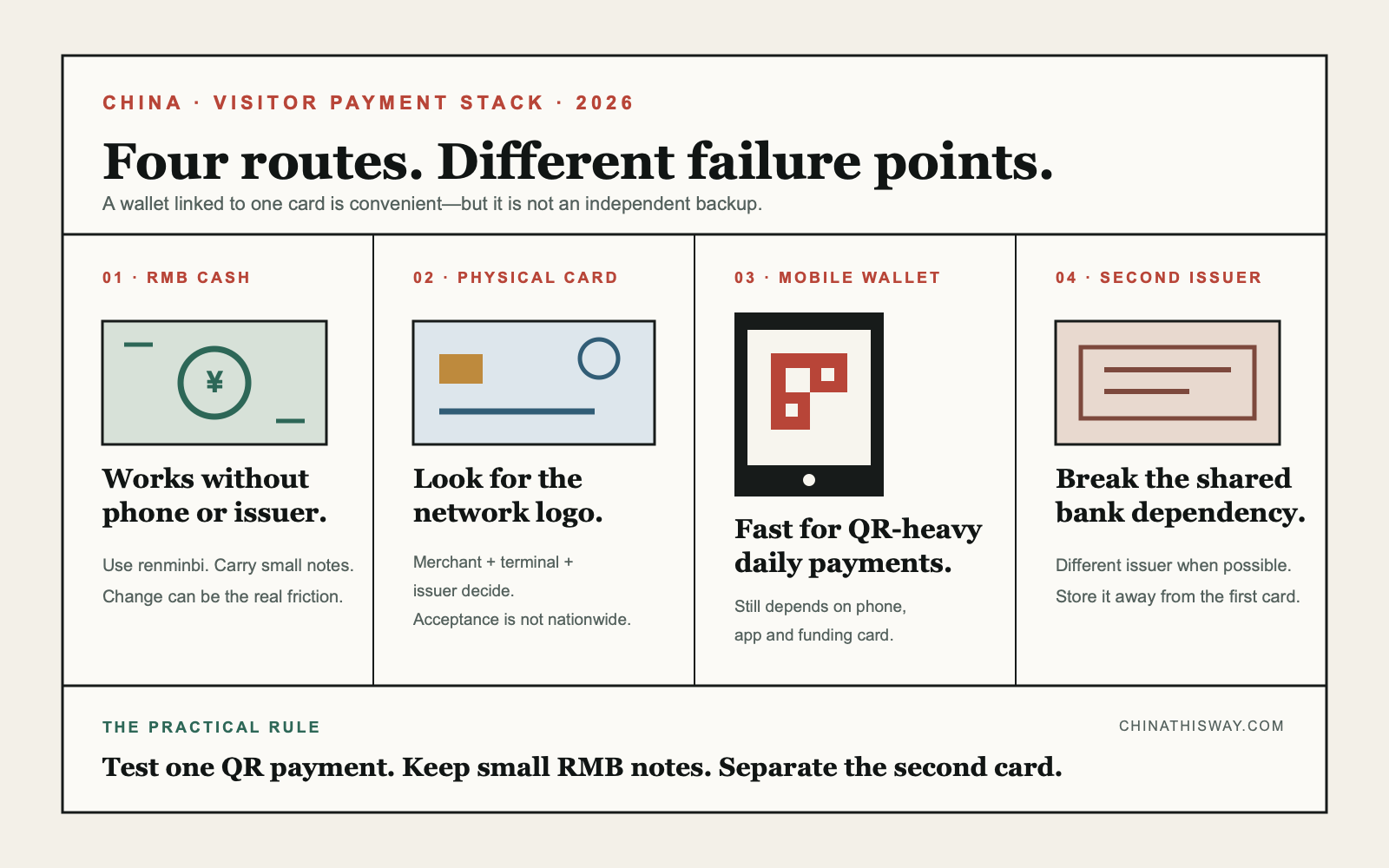
That does not mean U.S. dollars work at the counter, every cashier has change for a large note, every unattended machine accepts notes or every foreign Visa card works at every shop. The resilient setup is RMB cash + at least one mobile-payment route + two physical cards from different issuers when possible.
The answer depends on the payment you mean
| What you want to use | Can a visitor use it? | The boundary that matters |
|---|---|---|
| RMB notes and coins | yes | use renminbi, not U.S. dollars; a small merchant may not have useful change for a large note |
| U.S. dollars in a shop | do not plan on it | exchange or withdraw RMB through an authorized route first |
| Visa, Mastercard or another overseas card at a terminal | sometimes | look for the matching card-network logo and ask the cashier; acceptance is not universal |
| Overseas card linked to Alipay or Weixin Pay | supported visitor route | issuer approval, identity checks, merchant type, account limits and the live app result still control |
| Apple Pay or Google Pay as used at home | do not make it your only route | a familiar wallet does not prove the merchant terminal or card route is supported |
| e-CNY | an additional option in supported areas | it is not required for an ordinary visitor and should not replace simpler tested fallbacks |
Cash is legal; convenience is a separate question
The 2026 regulation is more specific than the slogan “merchants must take cash.” It separates how a transaction happens.
- Face-to-face service and staffed collection: the business should support cash and maintain reasonable change.
- Online reservation with in-person delivery or service: if in-person collection is available, the business cannot use “the order began online” as a blanket reason to refuse cash.
- Unattended machines and closed-loop card systems: the operator should clearly show the available methods, a cash-conversion route and a service contact. A conversion route should not add a fee or an unreasonable restriction.
- A transaction completed entirely online: the provider can state the supported electronic methods in advance. Cash acceptance is not physically possible in the same way.
This matters in practice. A staffed restaurant meal and an online-only app order are not the same payment situation. Neither is a station ticket counter the same as an unattended vending machine.
If a staffed merchant says it cannot take cash, first keep the interaction calm. Ask whether it can make change, whether another staffed counter can collect the payment or whether a manager can help. The regulation protects the cash option, but solving a dinner bill is usually more useful than trying to win an argument at the counter.
Bring RMB, not a stack of U.S. dollars
Cash acceptance means renminbi cash. Do not expect a restaurant, taxi driver or convenience store to price an ordinary purchase in U.S. dollars.
Official visitor guidance lists three practical ways to obtain RMB:
- exchange currency at a bank outlet or qualified exchange point displaying the relevant service sign;
- use a self-service currency-exchange machine where available;
- withdraw RMB at an ATM displaying your card network’s logo.
The ATM logo shows a supported network, not a promise that your particular bank will approve the withdrawal. Your issuer can impose a daily limit, foreign-transaction charge or ATM fee. The machine operator can also show a fee or conversion choice. Read the screen, decline a transaction you do not understand and check your bank’s own terms before departure.
Keep smaller notes for buses, small purchases and change-sensitive counters. Do not place all cash, cards and the phone in the same wallet or bag.
Two useful sentences
- 可以用现金吗? Kěyǐ yòng xiànjīn ma? — Can I use cash?
- 可以找零吗? Kěyǐ zhǎolíng ma? — Can you make change?
Showing the Chinese text is often clearer than trying to pronounce it in a noisy shop. Ask before the merchant prepares a service if cash is your only working route.
Where a U.S. credit card is likely to work
China’s official visitor guides tell cardholders to look for logos such as UnionPay, Visa, Mastercard, American Express, JCB, Diners Club or Discover at the checkout counter. If the logo is absent, ask the cashier.
That is a merchant-by-merchant test, not a nationwide acceptance promise. Airports, major hotels, department stores and large visitor-facing venues are more likely to operate card terminals than a neighborhood breakfast shop or street stall, but the logo and the actual authorization result matter more than the category name.
Before travel:
- confirm that the card can be used in mainland China;
- know how the issuer handles fraud verification while you are abroad;
- keep the issuer’s support route somewhere other than the card itself;
- carry a second issuer or network if available;
- do not rely on a card that requires an SMS number you cannot access.
At the counter, wait for a completed terminal result. A card being inserted, tapped or swiped is not proof that the authorization succeeded.
Why QR payment is useful but not the same as a Chinese bank account
Official guidance allows overseas visitors to register Alipay or Weixin/WeChat Pay and bind eligible international cards. The wallet can then fund supported merchant payments through a QR flow.
This does not automatically provide every domestic-wallet function. A foreign-card-funded account may not support person-to-person transfers, red packets, balance top-ups or every mini-program transaction. A successful card binding also does not guarantee that the issuer will authorize the next purchase.
Set up the official app before a critical transaction, then make one small staffed purchase. Confirm all four layers:
- the app account opens normally;
- the intended card appears as a funding source;
- the merchant name and amount are correct;
- both the app and merchant show a completed payment.
Use our separate Alipay foreign-card setup guide or WeChat Pay foreign-card guide for the account-specific steps. This page decides what to carry; those pages diagnose one wallet.
Build a payment stack that fails in different ways
A payment method is not a backup when it depends on the same broken component.
| Failure | What may fail with it | Independent next route |
|---|---|---|
| phone lost, flat or offline | both mobile wallets, app-only receipts and verification messages | RMB cash or a physical card |
| card issuer blocks a transaction | physical card and any wallet funded by that same card | cash or a card from another issuer |
| merchant has no overseas-card terminal | physical Visa/Mastercard at that merchant | RMB cash or a supported merchant QR payment |
| wallet account needs additional verification | that wallet and linked-card QR payments | cash, physical card or the other wallet if already tested |
| cashier has no change for a large note | that cash transaction at that moment | smaller notes, staffed alternative counter or another accepted method |
| unattended machine accepts only listed methods | cash may not enter the machine directly | follow the posted conversion/help route or use a staffed counter |
For a short trip, a strong minimum is:
- one tested Alipay or Weixin Pay account;
- two physical cards from different issuers if you have them;
- enough RMB in small denominations for a transport or meal fallback;
- issuer and wallet support details stored offline;
- the hotel name, address and phone number in Chinese.
Do not carry more cash than you can protect merely because one article called China cashless. The goal is a small independent fallback, not replacing every digital payment with notes.
A first-day test that takes ten minutes
Do not discover the payment stack at the airport rail gate with a line behind you.
- Obtain a modest amount of RMB through an authorized exchange point or compatible ATM.
- Buy one inexpensive item from a staffed merchant using the mobile wallet.
- Check the wallet record and card-issuer record.
- Ask a second staffed merchant whether the physical card network is accepted, but do not force a test purchase you do not need.
- Separate a few small RMB notes from the main wallet.
The test is successful only when you know which route worked, which card funded it and where the backup is stored. “The app opened” is not a payment test.
If a payment fails at the counter
Use the shortest branch first.
The wallet shows a clear decline
Switch to cash or another independently funded method. Diagnose the issuer or account later. Repeatedly scanning the same code can create duplicate or ambiguous attempts.
The app is spinning and the merchant has not received payment
Do not immediately pay again. Check the wallet transaction record and ask the merchant to check the order. Wait for a clear failed, cancelled or completed state.
Your foreign card is rejected
Confirm that the merchant supports the displayed network and that the amount is correct. Then use another route. The cashier cannot override an issuer decline.
Cash is refused at a staffed counter
Ask whether the problem is change, store procedure or a genuinely non-cash transaction required by a specific rule. Request another staffed counter or manager if practical. Keep the receipt, place, time and any posted payment notice if you later need to report a cash-access problem.
The ATM retains the card or produces no cash
Record the bank, ATM location, time and transaction message. Contact the ATM operator and card issuer through official numbers. Do not accept help from a stranger who asks for the PIN.
What this guide does not promise
It does not claim that:
- every merchant will follow the cash rule correctly on the first request;
- every ATM with a network logo will approve every overseas card;
- Visa or Mastercard acceptance is universal;
- one mobile-wallet setup works for transfers, transport and every mini program;
- fees, limits or exchange rates are identical across issuers and apps;
- Hong Kong or Macao follows the mainland payment rule described here.
Mainland China, Hong Kong and Macao have different currencies and payment environments. This guide covers ordinary visitor payments in mainland China.
Questions readers ask next
Is China completely cashless in 2026?
No. Mobile payment is deeply embedded in everyday life, but RMB cash remains a protected payment route. The rule effective February 1, 2026 generally prohibits refusing or discriminating against cash, with specific treatment for staffed, unattended and fully online transactions.
Can Americans use cash in China?
Yes. Nationality does not prevent a visitor from using RMB notes and coins. Convert or withdraw renminbi through an authorized route; do not assume a shop will accept U.S. dollars.
Do taxis and restaurants in China take cash?
RMB cash is a valid route for ordinary face-to-face service, but practical friction can include limited change. Ask before the service if cash is your only method and carry small notes.
Can I use my U.S. Visa or Mastercard in China?
At merchants or ATMs displaying the matching network logo, subject to the merchant, terminal and issuer approving the transaction. Do not treat the logo as proof that every card or every merchant will work.
Should I bring cash or use Alipay in China?
Bring both. A tested mobile wallet is convenient for QR-heavy daily payments; a modest RMB cash reserve remains independent of your phone, app and foreign-card authorization.
Is a second mobile wallet enough as backup?
Not if both wallets use the same card and phone. An issuer block, lost phone or dead battery can affect both. Cash and a second physical card from another issuer create more independent routes.
Can a shop legally refuse RMB cash?
The 2026 regulation generally prohibits cash refusal and discrimination, subject to limited situations where law or regulation requires non-cash payment. Unattended and fully online transactions have specific handling rules, so the exact transaction design matters.
Sources and scope
- RMB Cash Receipt and Payment Service Regulation — current Chinese regulation, effective February 1, 2026; cash acceptance, change, unattended service and online-only boundaries.
- Guide to Working and Living in China 2025 — official guidance on bank cards, overseas-card-funded mobile payment, RMB cash and transport payments.
- Payment service guide for overseas visitors — official overview of mobile payment, overseas cards, cash exchange and ATM withdrawal.
- PBOC policy on optimizing payment services — cash as a backstop, overseas-card acceptance and ATM access for visitors.
- Payment options in China, updated from December 2025 information — current government visitor instructions for cards, cash, mobile wallets and e-CNY.
Rules and public guidance were checked on 26 August 2026. Your issuer, wallet account, merchant, ATM and live confirmation screen control a particular transaction. This page does not quote a universal fee or exchange rate.